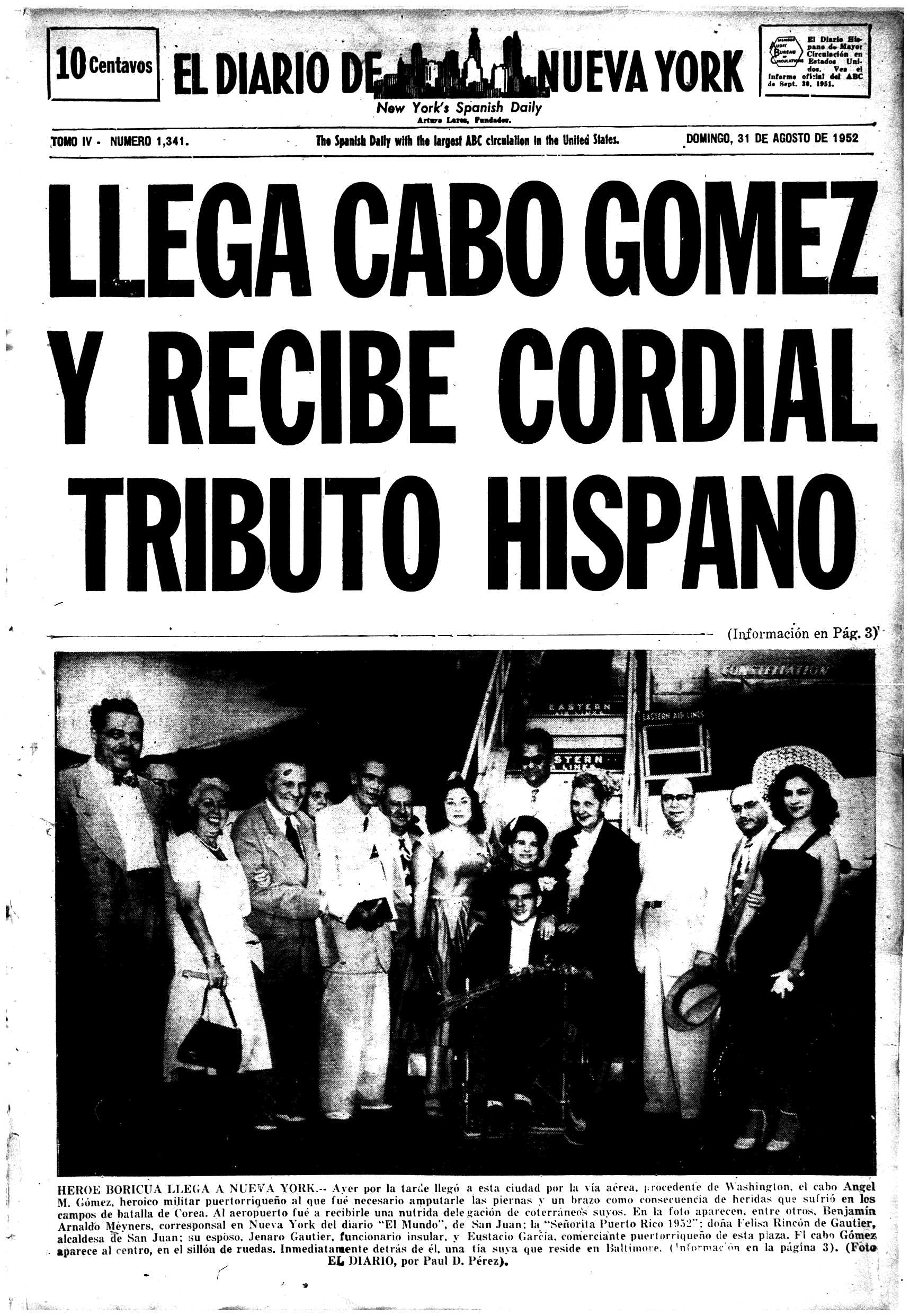
On August 30, 1952, at 2:18 PM, an Eastern Airlines plane landed at La Guardia Airport in New York. The Puerto Rican and Hispanic community had been preparing for the flight’s arrival. Corporal Ángel Gómez, a Puerto Rican soldier badly wounded in Korea, was aboard that flight. Unbeknownst to him, his ordeal had turned him into an icon for island-based Puerto Ricans and the growing Boricua colonias in New York City.
In September 1951, El Diario de Nueva York published a photograph of the wounded Puerto Rican soldier receiving medical treatment, rehabilitation therapy, and training in how to use his prosthetic limbs at Walter Reed Military Hospital in Maryland.
El cabo Gómez, as the press referred to him, hailed from Aibonito, Puerto Rico. He had lost both legs and one arm in Korea due to a direct mortar hit on his position the previous year. The Puerto Rican press highlighted that Corporal Gómez was the first soldier in the U.S. military to lose three limbs and survive. While this may sound macabre, those wounded in war have a long history of becoming living examples of the sacrifices made for the nation.
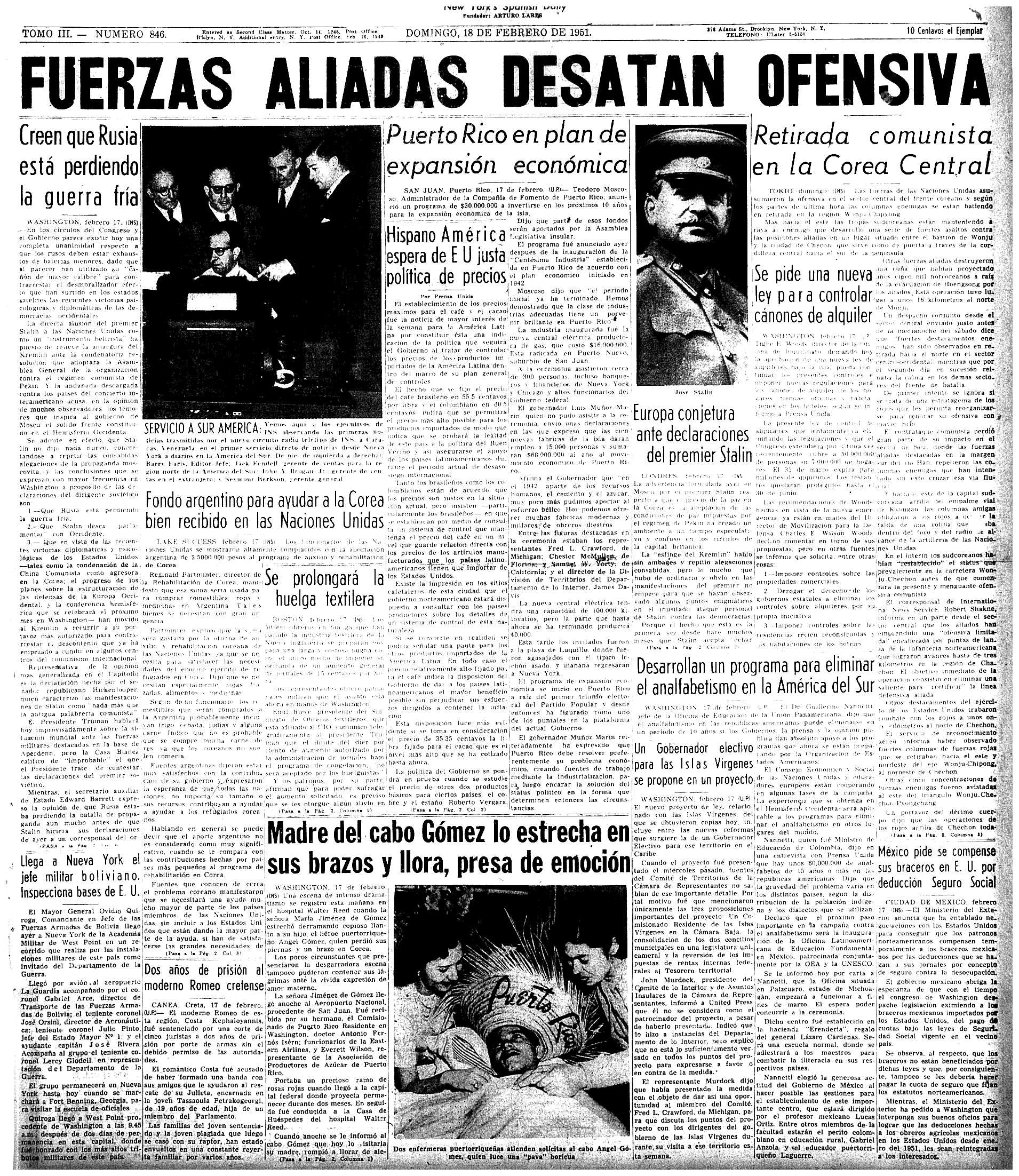
Gómez appeared in the photograph wearing a pava (Puerto Rico’s traditional peasant hat) with the inscription “Puerto Rico” in large, bold letters. He was flanked by two women identified as Puerto Rican nurses. The story centered on the arrival of his mother, María Jiménez de Gómez, in Maryland to be with her son. The newspaper also noted that Puerto Rico’s Resident Commissioner in Washington, Antonio Fernos Isern, would host both the soldier and his mother for dinner.
Both the state and island-based press closely followed the story of el cabo Gómez, routinely publishing updates on his recovery as well as lists of donations from private individuals and businesses to help facilitate Gómez’s reentry into civilian life.
In August 1952, El Diario de Nueva York informed its readers that not only had the corporal learned to walk again, but he had also completed driver training at Walter Reed. The newspaper further reported that New York City, where Gómez would briefly stop before returning to Puerto Rico, was preparing a grand reception for the “Puerto Rican hero.” The event would include Mayor Vincent Impelliteri, state representatives, and leaders of the Hispanic community. Gómez also had family on the mainland, and it was his plan to travel first to Baltimore, where he would meet his aunt, who would accompany him to Puerto Rico.
Throughout the Korean War, the private sector sought to associate itself with Puerto Rican soldiers, both as part of promotional campaigns and to demonstrate unwavering support for their efforts in Korea to “save democracy.”
Consequently, news that Gómez would return to Puerto Rico aboard an Eastern Airlines flight, with his travel expenses paid by the Asociación de Productores de Azucar de Puerto Rico, appeared alongside advertisements promoting nonstop airfare between San Juan and New York.
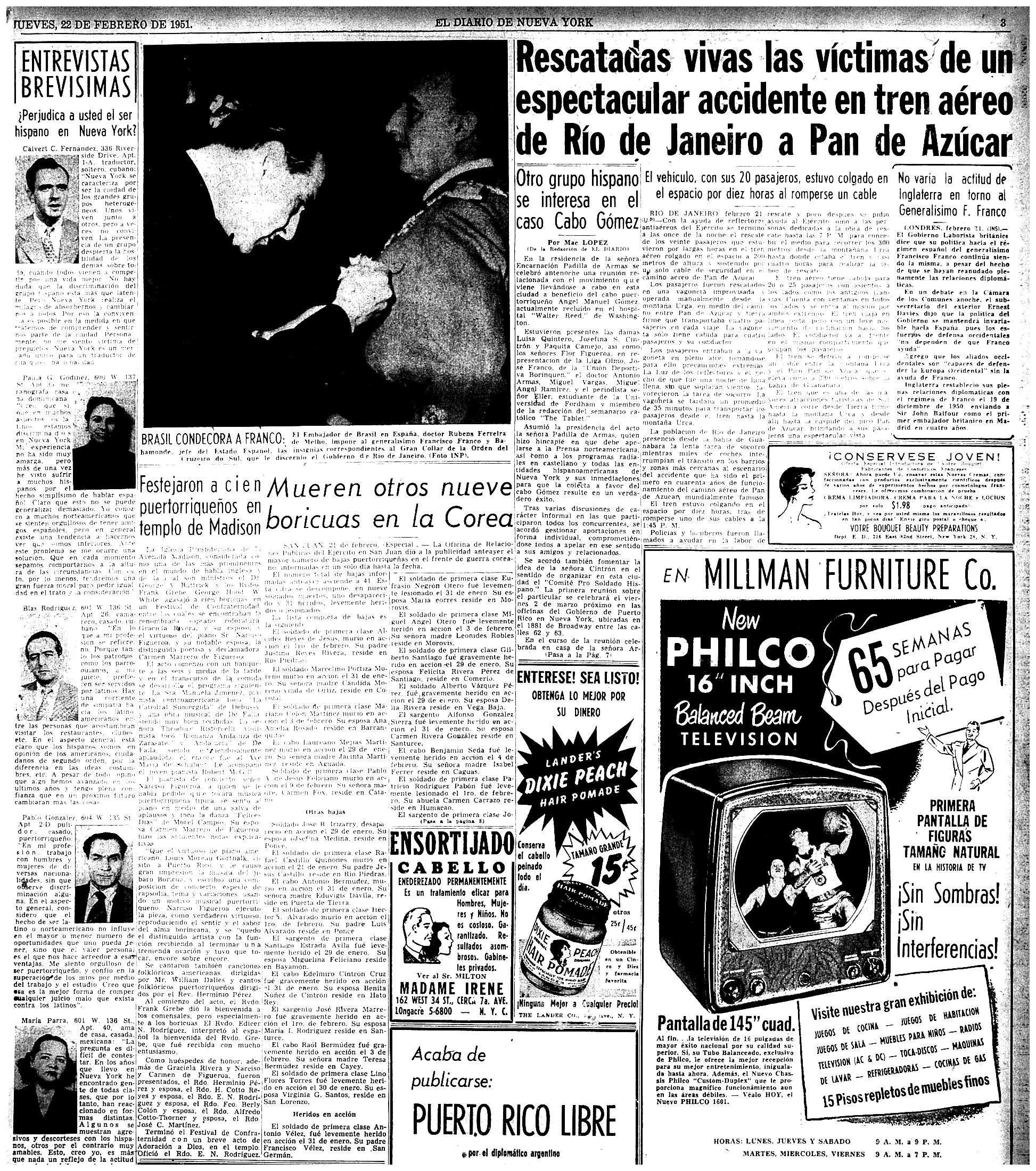
Gómez would be neither the first nor the last Puerto Rican veteran of the Korean War to return to the island through New York and receive a hero’s welcome from city officials and the rapidly growing Puerto Rican community. On several occasions, returning veterans were honored with parades through Harlem and the Bronx and were even presented with the keys to the city.
As I have argued elsewhere and in my book Soldiers of the Nation and my forthcoming book on the experience of the Puerto Rican soldiers, the island and the emerging Puerto Rican communities in the U.S. mainland during the Korean War- the participation of tens of thousands of Puerto Rican servicemen in the conflict was instrumental in the creation and consolidation of the Commonwealth, el Estado Libre Asociado de Puerto Rico.
Equally important was what the war effort—and the return of wounded Puerto Rican soldiers and former prisoners of war through New York—meant for the rapidly expanding Puerto Rican communities throughout the city and across the Eastern Seaboard at a time when newspapers and elected officials openly discussed “the Puerto Rican problem” using demeaning, racist and alienating language. These returning soldiers allowed the growing Puerto Rican communities in NY and Eastern Seaboard to stake a claim of belonging for they too had done their part to “defend the nation and democracy.”
The return of these wounded soldiers and POWs through New York helped forge an unbreakable nexus—an air bridge, both literal and symbolic—between New York and Puerto Rico.
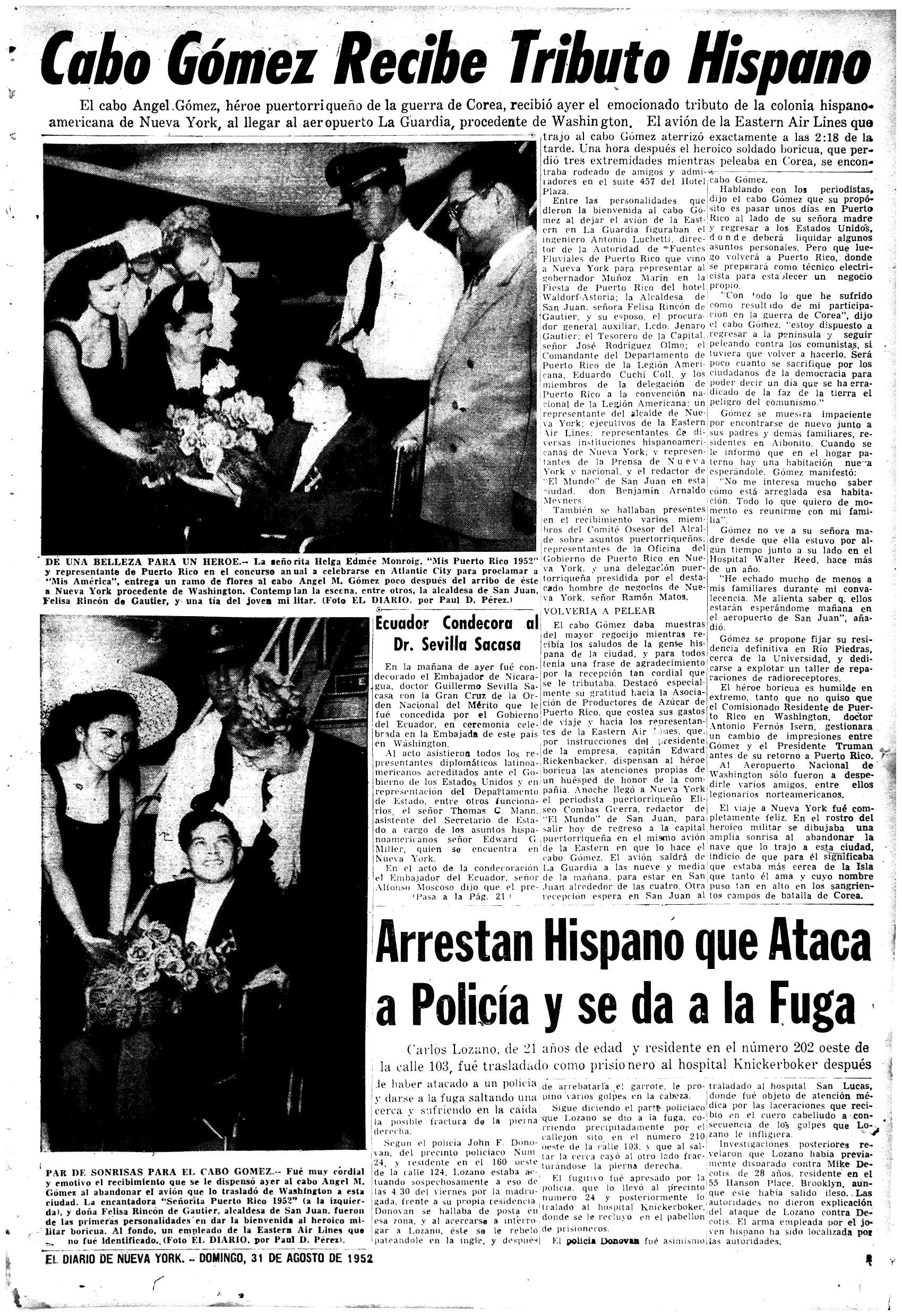
The press in New York fully appreciated the symbolic value of Gómez’s sacrifice. El Diario reported:
“The trip to New York was a happy one. After debarking the plane that brought him to this city this this heroic soldier’s face showed a big smile, evidence that for him it meant that he was a little closer to the Island he loves so much and to which he brought glory in the bloody battlefields of Korea.”
The corporal was treated as a celebrity during the few hours he remained in New York. Yet, despite the honors, he longed only to return home.
The next day, August 31, 1952, he arrived in San Juan aboard an Eastern Airlines flight. He was received by elected officials who escorted him to the Caribe Hilton. Contemporary news reports stated that thousands of Puerto Ricans lined the streets to greet their returning hero. El Diario de Nueva York reprinted the following editorial from El Mundo, an island-based newspaper:
“Corporal Angel Gómez, who left three of his limbs in the Korean battlefields, is getting ready to return to Puerto Rico.
His body suffered grave amputations. But his indomitable spirit carries an imponderable strength: that of character purified by adversity.
At twenty-three years of age, missing his legs and one arm, he has not surrender. Efficiently and gently rebuilt in Walter Reed Memorial Hospital of Washington, Gómez is not a human ruin.
He is a symbol of the new man whom, without letting his will falter when his limbs broke, reemerges in life full of hope and decides to be useful again.
During his long hours of pain and estrangement, his memories filled with nostalgia and dreams.
It felt as if the return home was always delayed. But that day has come when he can say: “It gladdens much, very much, to return home. There is no place like home.””
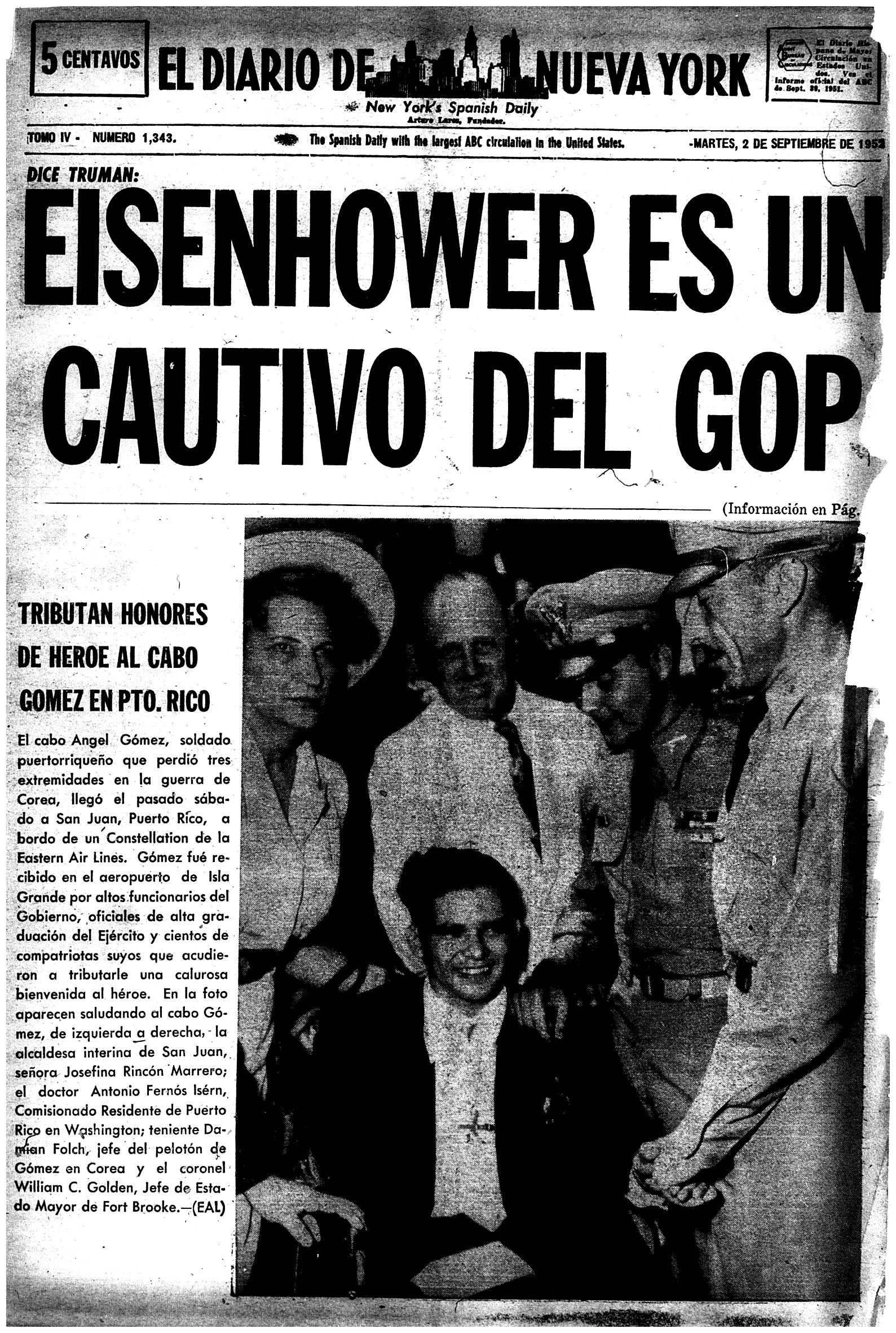
The odyssey of el cabo Gómez, as narrated by both state and island-based newspapers, was rich in symbolism:
-the jíbaro transformed into a war hero, surviving against impossible odds;
–the reunification of a family made possible through the efforts of the Puerto Rican diaspora and elected officials;
-and the embodiment of the Puerto Rican soldier who, upon returning home, would help build a modern Puerto Rico.
Gómez became the living incarnation of the jíbaro turned citizen-soldier, a figure whose sacrifice was presented as foundational to the emerging Commonwealth.
This was an enormous burden to place upon any man—or woman. It must have been particularly hard for a man who had endured and survived such extreme physical trauma and whose psychological scars seem to have gone unattended.
The day after his arrival in San Juan, el cabo Gómez returned to his hometown of Aibonito. Once again, he was welcomed by local officials, businessmen, and members of the clergy. There were parades, ceremonies, speeches, and celebrations in his honor. Eventually, however, he collapsed from a combination of exhaustion and the concussive effects of the fireworks set off to celebrate his homecoming.
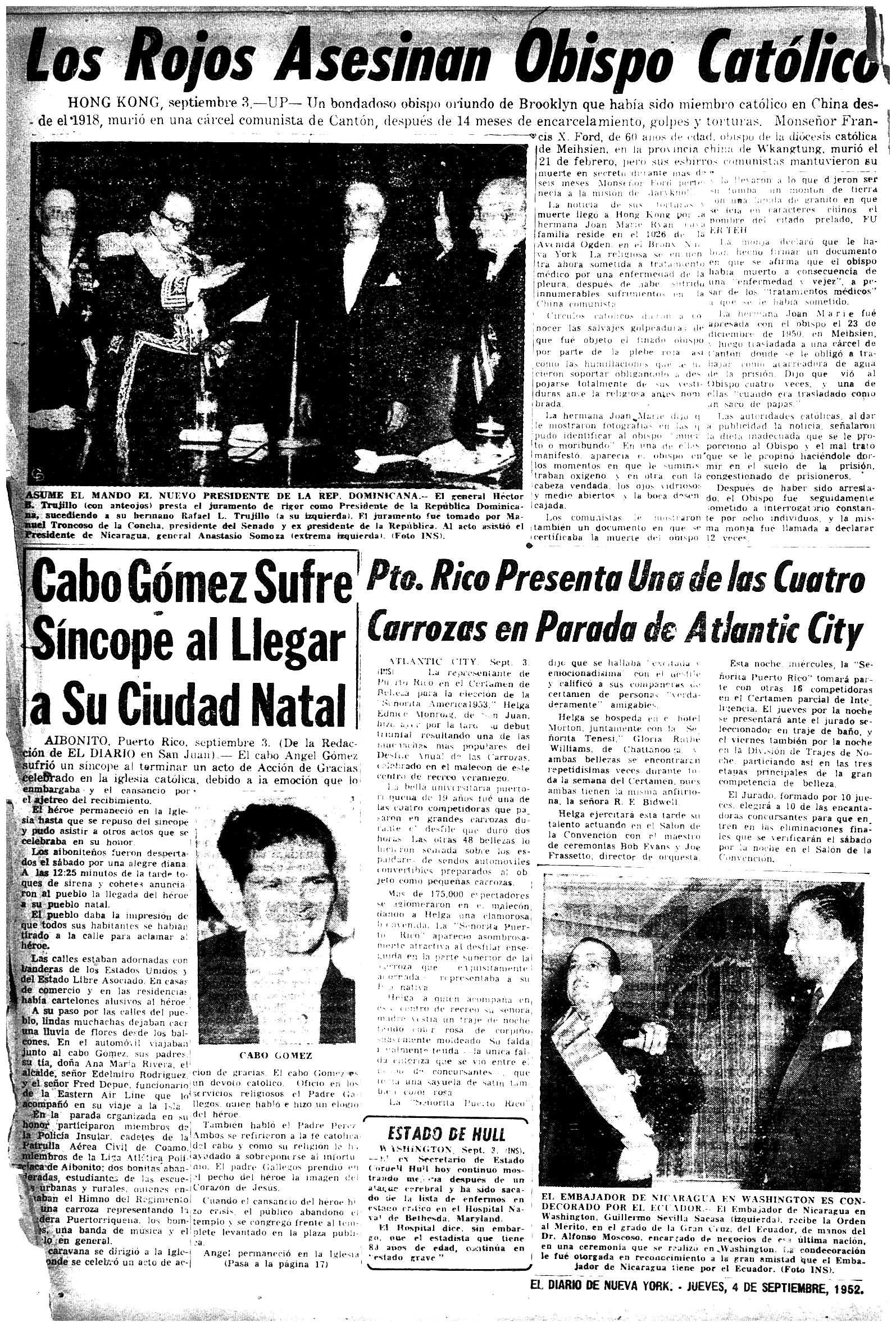
His physical recovery had been nothing short of miraculous, but his invisible wounds remained.
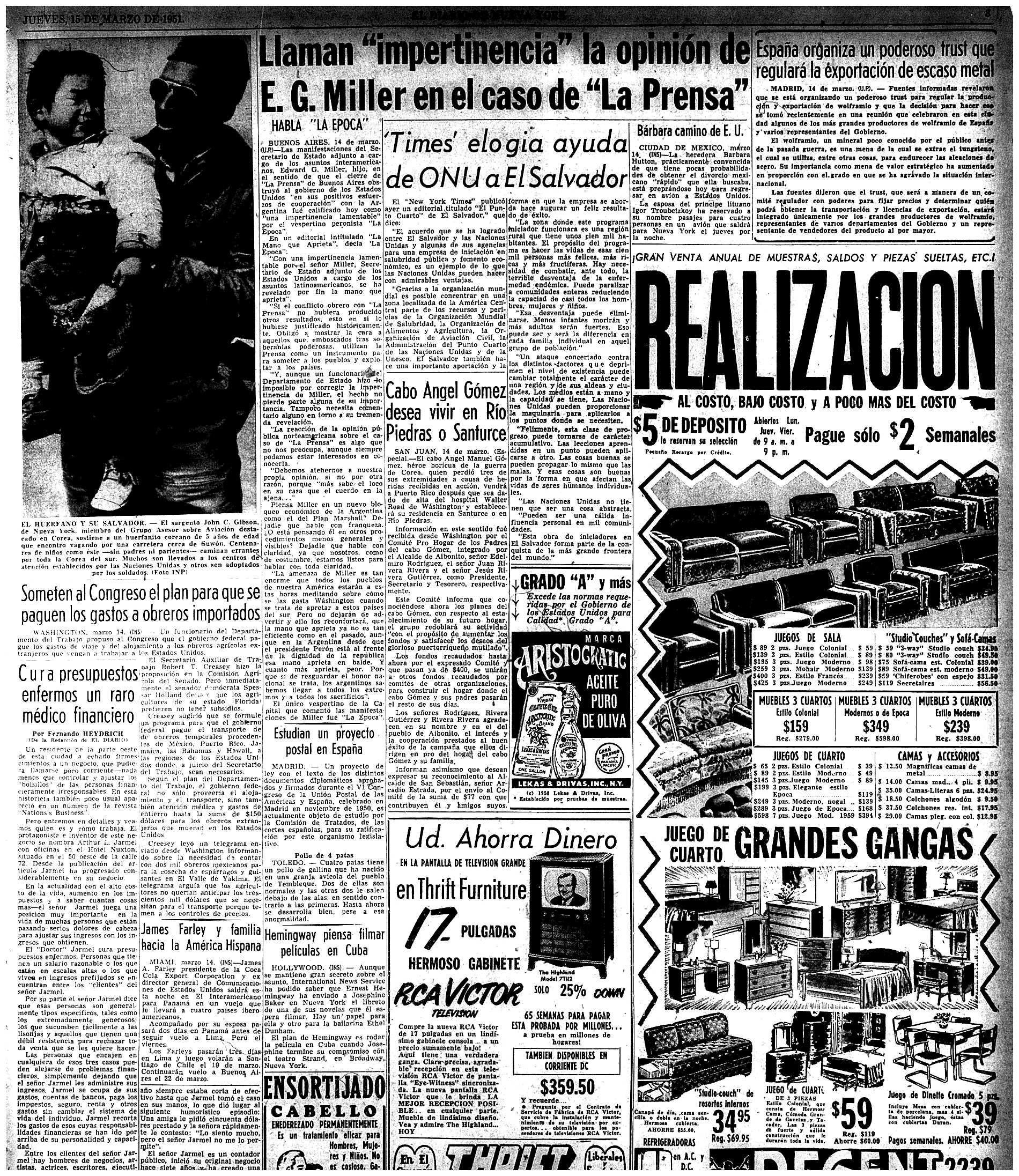
Ángel Gómez intended to live a quiet life as a radio repairman, strategically locating his shop near the University of Puerto Rico in Río Piedras. That alone would have been quite an accomplishment. After all, he had been transformed into a symbol of Puerto Rico’s indomitable spirit.
Even for those who never knew his story, his figure would have been unmistakable as he walked from his shop to the specially adapted car that restored a measure of his independence. The military had paid for half of the vehicle, while Gómez covered the remaining cost himself—yet another testament to the determination that reporters and public officials so often celebrated.
Unfortunately, I lost track of his story after he fainted during the celebrations in Aibonito. It has proven difficult to uncover what became of him after he returned to Puerto Rico. I hope he was able to live the long, peaceful, and fulfilling life that had nearly been taken from him on the battlefields of Korea.
More than seventy years later, his sacrifice deserves to be remembered—not simply because of the terrible wounds he endured, but because his story illuminates a pivotal moment in Puerto Rican history.
Through him, we glimpse how one wounded soldier came to embody the aspirations of the emerging Commonwealth (Estado Libre Asociado), the bonds between the Island and its diaspora, and the extraordinary resilience of ordinary Puerto Ricans.
If any of his surviving relatives or friends happen to read this essay, I hope they know that Ángel Gómez’s sacrifice and perseverance have not been forgotten.
Postscript
Since first writing this essay, I have been able to confirm that el cabo Gómez fulfilled his goal of establishing a radio repair shop near the University of Puerto Rico in Río Piedras, where he quietly rebuilt his life after the war. That small but meaningful detail brings a fitting measure of closure to the story of a man whose perseverance was as remarkable as his sacrifice.
Note
This essay was originally written in 2016 and published by the Center for Puerto Rican Studies at Hunter College, CUNY. It was removed from the Center’s website several years later as part of what I view as a clear and broader pattern of suppressing aspects of Puerto Rican history and stories that do not conform to prescribed ideological and dogmatic narratives.
I am republishing it today because of the public’s renewed interest in Puerto Rican history and because I remain committed to recovering, preserving, and disseminating our history and our stories—even when they challenge politicians, activists, or unethical scholars, or make them uncomfortable for that’s the true calling of the historian.


[…] Read whole article: The Odyssey of El cabo Gómez: A Puerto Rican Soldier Returns Home a Hero for an Emerging Nation […]
LikeLike