America’s Ireland: Nationalist Violence and Colonial State Terror in 1930s Puerto Rico
Puerto Rico’s “shooting war” of the 1930s—an escalating cycle of violence between Pedro Albizu Campos’s Nacionalistas and the coercive machinery of U.S. colonial rule—remains one of the most tragic and politically consequential episodes in the island’s modern history.
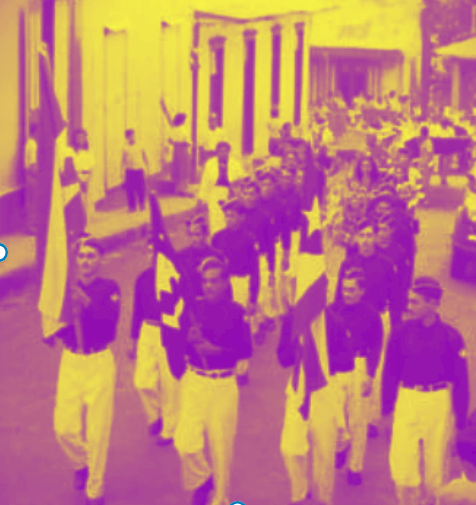
During these years, observers increasingly referred to Puerto Rico as “America’s Ireland” or the “Ireland of the Caribbean,” a comparison rooted in the Nacionalistas’ embrace of bombings, assassinations, and retaliatory violence reminiscent of the most militant factions of the Irish independence struggle.
Yet the analogy only partially holds. By the mid‑1930s, the Nationalist movement also displayed characteristics that echoed contemporary European fascist movements: monopolizing patriotic symbols, imposing compulsory military service within the party, organizing paramilitary formations, blacklisting opponents, and using violence and intimidation against fellow Puerto Ricans.
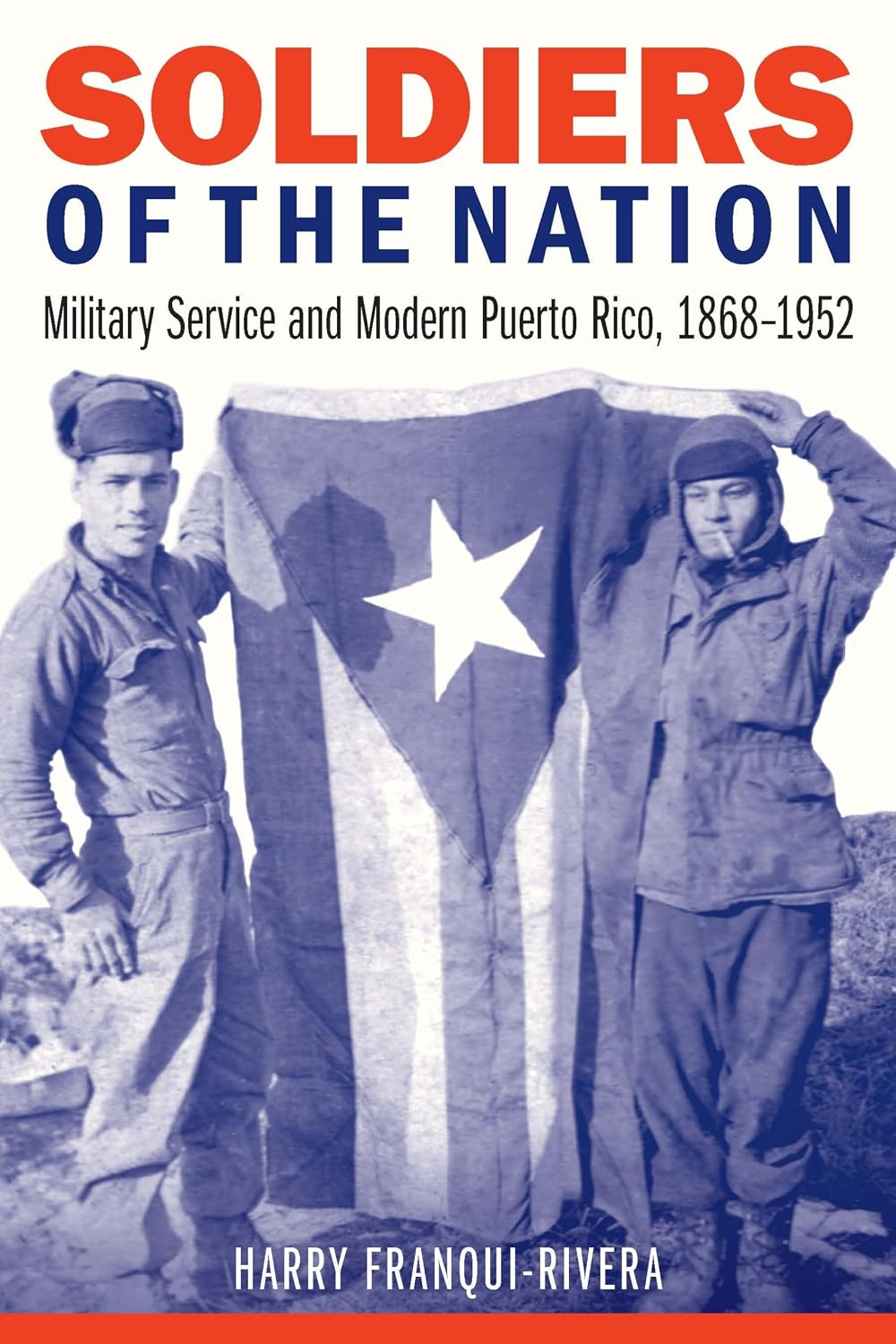
In Chapter 4 of Soldiers of the Nation I underscore this duality. The 1930s were marked by deep economic distress, political instability, and a “virulent Nacionalista anti-American campaign” met by “the colonial authorities’ belligerent and often criminal persecution of the Nacionalistas.” The island “came to be called ‘America’s Ireland’ or the ‘Ireland of the Caribbean’” as political discontent transformed into open conflict.
What emerged was not a simple binary of colonizer versus anti-colonial resistance. Instead, Puerto Ricans found themselves trapped between nationalist extremism and state terror and repression—two forces increasingly convinced that violence was the only viable path forward.
I. Nationalist Violence: From Symbolic Confrontation to Militarized Insurgency
1. Assault on the Capitol (April 6, 1932)
Later narratives often portray the Puerto Rican flag as synonymous with the Nationalist movement. Yet early 1930s events reveal a more complicated reality. When the Puerto Rican Legislature considered a bill to make the modern Puerto Rican flag the official emblem of the insular government, Nationalists stormed the Capitol, physically disrupting the session.
Their argument: the colonial legislature had no moral authority to adopt a revolutionary symbol. The irony is striking—the bill sought to honor the flag, but the Nacionalistas viewed the act as a colonial appropriation by Puerto Ricans elected by Puerto Ricans.
The melee left one Nationalist dead and marked a turning point in the movement’s increasingly coercive tactics. The Nacionalistas had already begun using violence, fear, and terror to enforce their exclusive claim over patriotic symbols.
2. Bombing Campaign (July–Summer 1935)
On July 4, 1935, the Nacionalistas initiated a bombing campaign targeting PRRA offices, the U.S. Court Building, and police stations. Though casualties were avoided, the symbolism was unmistakable: the Puerto Rican Reconstruction Authority—intended to alleviate economic misery—was attacked precisely because its success threatened the Nacionalistas’ ability to mobilize discontent.
3. Río Piedras Shootout (October 24, 1935)
The Río Piedras incident marked the moment when political violence escalated into open warfare. Nacionalistas circling students protesting Albizu Campos’s insults (“effeminate,” “prostitutes”) for not being at the vanguard of the fight for independence, (an intimidation tactic), were detained near campus. A gunfight during transport left four Nacionalistas and one policeman dead, with forty wounded.
Chief Riggs’s chilling warning: “We regret the events in which five citizens lost their lives. But the police has strict orders to enforce the Law prohibiting the carrying of arms. It would be anarchy if we allowed armed people to walk freely on our streets, a constant threat to peace and tranquility. I’m not disposed to tolerate this state of disorder. Every citizen has the right to express and defend his political principles, but within the order and serenity which should characterize the actions of every citizen.
No one has the right—unless properly authorized—to carry an illegal weapon and to establish a state of mayhem in the community. I will let it be known, that if anyone persists in committing these crimes, there will be war, war without end, not against politicians, but against criminals. Whoever resists arrest by an agent of the public order, is a criminal and a savage.”
Riggs’s statement marks a the turning point in the conflict. About a week later, Pedro Albizu Campos responded in a radio address:
“The Yankee Chief of police, Colonel Francis Riggs, has declared to the nation that there will be war. The Nationalists recognize his frankness and pick up the glove. There will be war. War against the Yankees!”
4. Creation of the Ejército Libertador (December 1935)
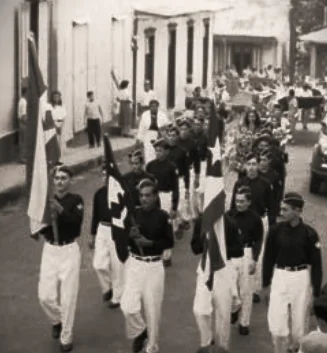
At the December funerals, the Nationalist Party declared the formation of the Ejército Libertador and vowed that for every dead Nationalist, an American would be killed. Albizu instituted compulsory military service for party members, transforming the movement into a self-declared “liberating army.”
Albizu ordered “the general drafting into the military of all nationalists over eighteen years old” and publicly organized the Cadetes de la República as a conspicuous paramilitary force.
5. Assassination Plans and Coup Proposals (1935–1936)
Army intelligence reported plans for coordinated attacks on police stations, National Guard armories, and targeted assassinations. These reports—whether exaggerated or not—reflected the increasingly militarized posture of the movement.
6. Assassination of Police Chief E. Francis Riggs (February 23, 1936)
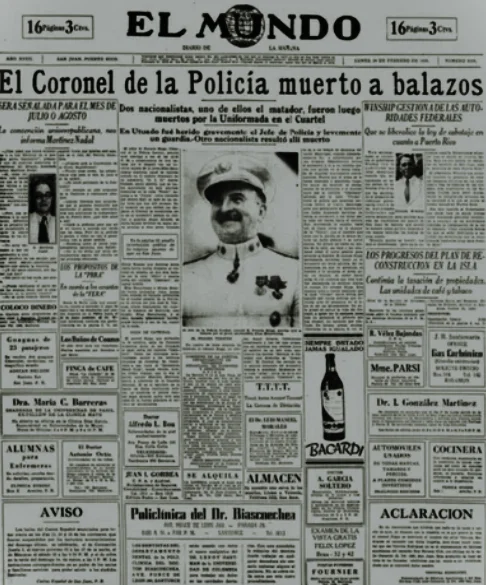
Nationalists Hiram Rosado and Elías Beauchamp assassinated Riggs in San Juan.
The assassination was presented by Albizu Campos as revenge for the Río Piedras killings.
He publicly celebrated the attack and praised the assassins. Luis Muñoz Marín was pressed to condemn the assassination. When he did- Washington saw it as too little, too late, and too ambiguous.
This event led to Massive public reaction; Increased support for Nacionalistas in some sectors; Federal crackdown on the movement; Arrest and prosecution of Albizu Campos and other Nationalist leaders.
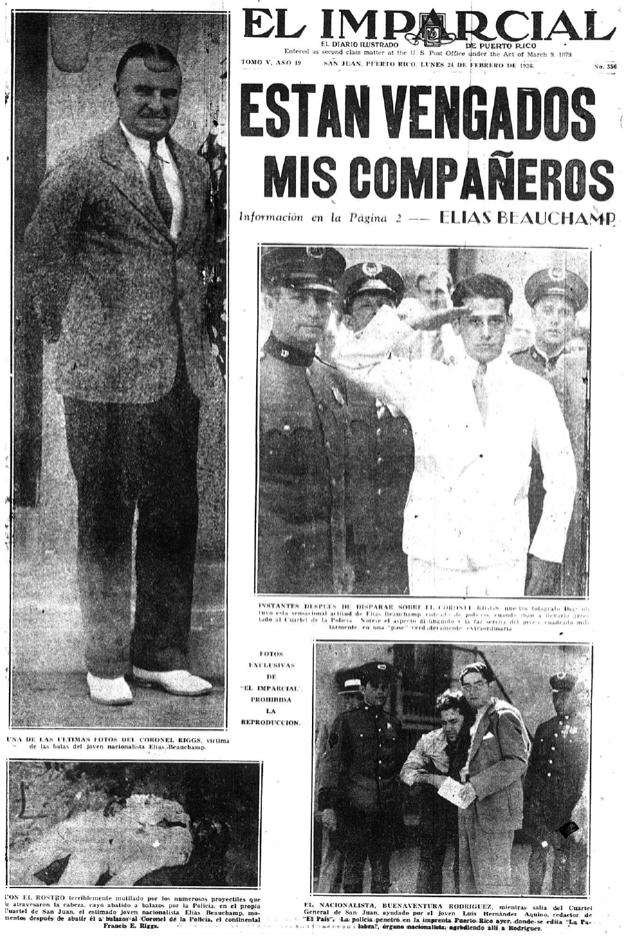
7. Police Execution of Rosado and Beauchamp (February 1936) -After assassinating Riggs, Rosado and Beauchamp were murdered while in police custody.
This became one of the most controversial episodes of the period and significantly increased public hostility toward the Insular Police. Military intelligence noted that public anger over the killings overshadowed outrage over Riggs’s assassination.
This pattern would continue with both sides overplaying their hand and alternating winning and losing the support of the public.
8. Violence Against Other Puerto Ricans (1935–1938)
One of the most important and needed corrections to popular memory is that Nationalist violence was not directed solely at colonial authorities. The Utuado “Tiroteo por la Bandera Puertorriqueña” (1936), where Nationalist Luis Baldoni threatened young women and shot a man over the “improper” use of the flag, exemplifies the movement’s coercive policing of national identity.
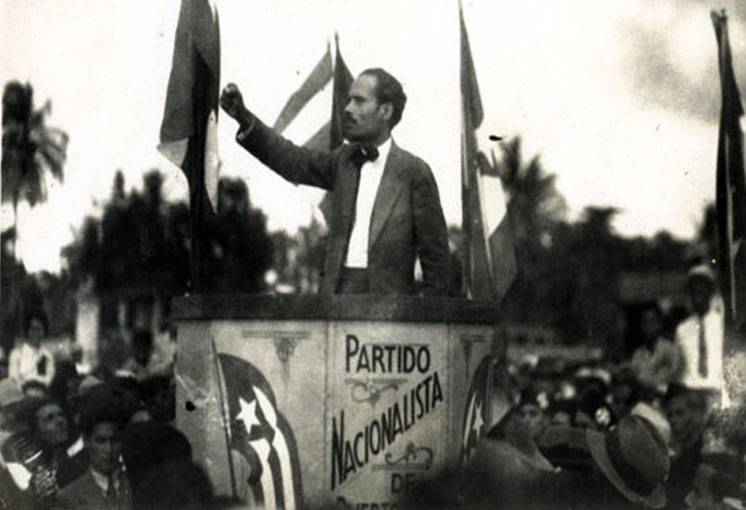
The broader context is important. Grosfoguel describes a struggle over who had the right to claim the Puerto Rican flag as a national symbol.
The Nationalists increasingly treated the flag as their exclusive property and reacted aggressively when rival political groups—particularly Liberals, who were also pro-independence—used it.
The specific episode involving five girls waving the Puerto Rican flag comes from contemporary accounts surrounding the Utuado confrontation. Baldoni reportedly confronted and threatened young women who were carrying or waving the flag because they were associated with rival political elements rather than the Nationalist Party. The confrontation culminated i
n gunfire. During the incident Baldoni shot a man—identified in some accounts as having intervened in the dispute—causing severe facial wounds. Contemporary newspaper coverage described the event as a “Shootout for the Puerto Rican Flag” (“Tiroteo por la Bandera Puertorriqueña”).
What makes the Utuado incident historically significant is that it undermines the narrative that all Nationalist violence was directed exclusively against colonial authorities. Rather, the dispute began as a conflict between Puerto Ricans over who had the legitimate right to display and represent the Puerto Rican flag.
And this was not an isolated incident but a pattern.
Other incidents included:
9. Attack on Socialist Leader Santiago Iglesias Pantín (October 25, 1936)
A group of Nacionalistas wounded Socialist leader Santiago Iglesias Pantín during a rally in Mayagüez. This occurred after Albizu Campos’s imprisonment and represented an expansion of Nationalist violence beyond police targets to political opponents.
10. Nationalist Mob Attack on Liberal Party Meeting (November 1936)
After Albizu’s imprisonment, Nationalist militants attacked a Liberal Party gathering because the Liberales were displaying the Puerto Rican flag. The Nationalists considered the flag their symbol and viewed its use by rival political organizations as illegitimate.
The incident reflected growing conflict not only with colonial authorities but also with rival independence factions.
These actions began eroding public sympathy for the Nacionalistas. But the American-appointed governor and the Insular Police would once again overplay their hand.
The significance here is that the target was not colonial authorities, police, or the military. The victims were fellow Puerto Rican nationalists and independence supporters who simply belonged to a rival political movement.
This illustrates how the Nationalists increasingly treated the flag as exclusive property of their movement rather than a symbol of the broader Puerto Rican nation. And how they resorted to violence to spread fear and terrorize even supporters of independence not affiliated with them.
This is a Clear Pattern of Intimidation Against Political Rivals.
The attack on the Liberal meeting was not isolated. During 1935–1938, Nationalists increasingly targeted: Socialists, Republicans, Labor leaders, and other Political opponents often with Violent Disruptions of rival political meetings, and the existence of “black lists.”
This period marks a transition from anti-colonial agitation toward coercion against other Puerto Ricans who disagreed with Nationalist strategy.
Further-these actions mirrored patterns visible across interwar Europe, where fascist movements claimed exclusive ownership of national identity and used violence to silence dissent.
II. Colonial State Terror: Militarization, Repression, and the Ponce Massacre
If Nationalist violence reflected revolutionary extremism, the colonial state’s response revealed the authoritarian impulses of U.S. rule in Puerto Rico.
1. Militarization of the Insular Police
Under Governor Blanton Winship and Police Chief Riggs, the Insular Police became a militarized force equipped with submachine guns, riot gear, and training from the 65th Infantry and FBI agents. Winship personally supervised intensified police training and that the 65th Infantry’s intelligence section produced weekly reports on “subversive activity.”
2. Surveillance, Mass Arrests, and Political Prosecutions
The colonial government increasingly abandoned constitutional norms, relying on political prosecutions, mass detentions, and extrajudicial killings. The execution of Rosado and Beauchamp became a symbol of state lawlessness.
3. The Ponce Massacre (March 21, 1937)
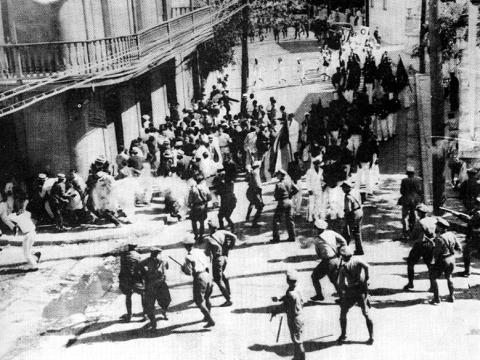
The Insular Police opened fire on an unarmed Nationalist parade in Ponce after revoking a previously approved permit. Approximately 150 heavily armed policemen confronted about 80 Nationalist cadets and affiliated groups. A shot was heard, followed by sustained police fire.
17 Nationalists and bystanders were killed. About 100 wounded. And 2 policemen killed- likely in their own cross fire.
This isthe most notorious act of state violence of the period and it led to:
- Widespread public outrage.
- Massive funerals.
- Increased support for Nacionalistas.
- The American Civil Liberties Union concluded that the event was a massacre.
The permit controversy –The Nationalists originally had been denied permission to parade in Ponce. Later:
- Mayor José Tormos Diego approved the event as a civic parade.
- The Nationalists promised the march would not have a military character.
- Acting under Governor Blanton Winship’s orders, Insular Police Chief Enrique Orbeta traveled to Ponce and persuaded the mayor to revoke the permit.
- The Nationalists were informed that the permit had been withdrawn and warned not to march.
The confrontation – Despite the revocation:
- Approximately eighty Nationalist cadets assembled.
- They were accompanied by the Daughters of the Republic and the Nationalist Nurses.
- Police Captain Guillermo Soldevilla deployed more than 150 policemen armed with rifles, carbines, and submachine guns.
A single shot was heard followed by a police barrage.
The Insular Police opened fire on a group of unarmed Nacionalistas.
The slaughter of the unarmed nationalists, which came to be known as the Ponce Massacre.
Why a massacre?
The ACLU investigation– The American Civil Liberties Union concluded that the event was a massacre. Arthur Garfield Hays’s investigation determined that police actions amounted to a “police riot.”
Criticism from the Puerto Rico National Guard officers– Lieutenant Colonel Miguel A. Muñoz criticized police tactics, specifically: encircling the crowd; failing to leave an avenue of escape; the possibility that the policemen killed were victims of friendly fire rather than Nationalist gunfire.
Public reaction-the massacre generated widespread outrage: More than 15,000 attended the funeral in Ponce; about 5,000 attended services in Mayagüez; newspapers published large photographs of the killings daily.
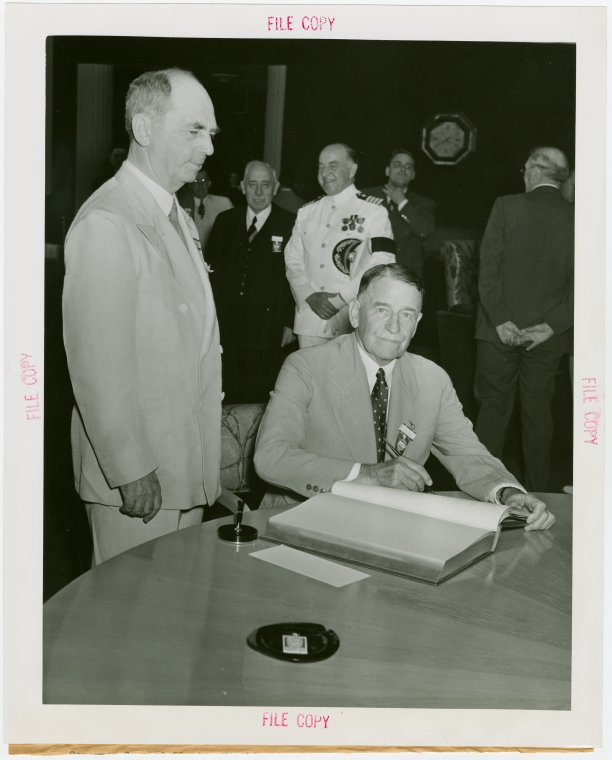
Governor Winship was indeed engaged in a campaign of state-terror seeking to destroy the Nationalist movement and was unwilling to tolerate dissent.
As such, the Ponce Massacre was the culmination of:
- The militarization of the Insular Police.
- The prosecution and imprisonment of Nationalist leaders.
- Increasing repression by the colonial administration.
- A growing “shooting war” between the Nacionalistas and the state.
The Nacionalistas, however, were not passive passive. The event followed a campaign of bombings, shootings, assassination plots, attacks on political rivals, and the assassination of Riggs. Nonetheless, while the Nationalists were violent, the response at Ponce represented a far greater abuse of state power against an unarmed demonstration.
The Ponce Massacre occurred within a cycle of escalating violence, but it was fundamentally a state-inflicted massacre of unarmed Nationalists and civilians, carried out under the authority of Governor Winship and executed by a militarized armed police force after the parade permit had been revoked.
4. Suppression of Commemorative Activities (April 1937)
Police barred groups larger than two from entering cemeteries on José de Diego’s birthday, placing troops and National Guard units on alert—another example of Winship’s broader campaign of repression following Ponce.
5. Attempted Assassination of Winship (July 25, 1938)
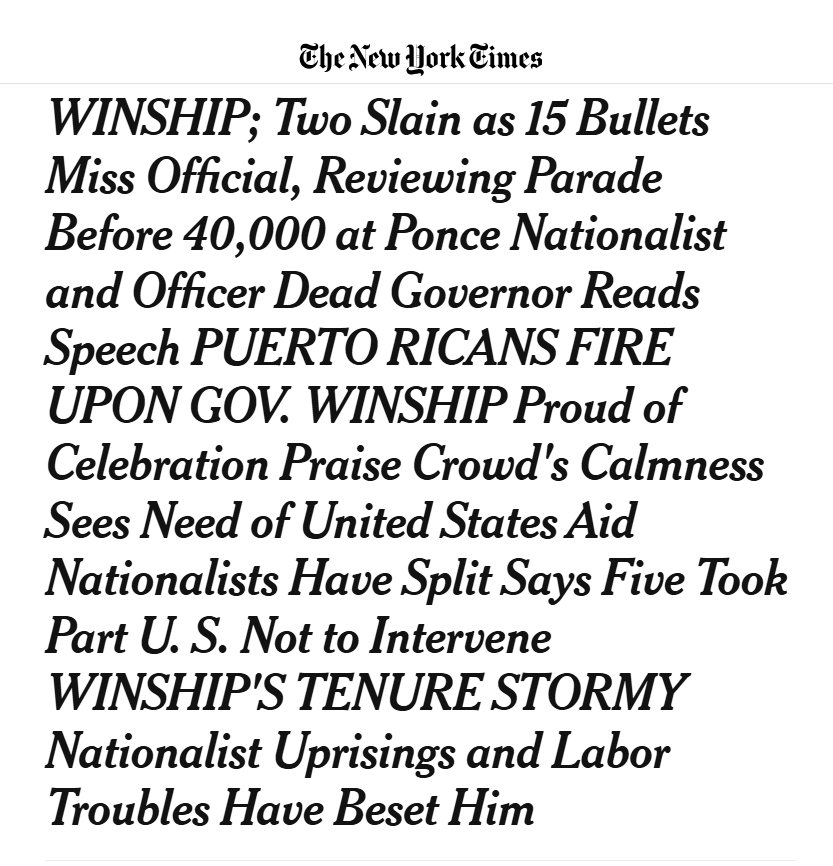
During celebrations marking the 40th anniversary of the U.S. invasion of Puerto Rico, Nationalists opened fire on Governor Winship’s reviewing stand in Ponce. Ángel Esteban Antongiorgi fired multiple shots directly at Winship.
Antongiorgi was killed by a detective. Colonel Luis A. Irizarry, commander of the 296th Puerto Rico National Guard Regiment, killed. 32 people wounded.
The event occurred one year after the Ponce Massacre and was widely viewed as retaliation.
Public opinion turned sharply against the Nacionalistas. Further convictions and weakening of Nationalist leadership. But Washington received the message and soon would remove Winship from office.
III. The Human and Political Costs
The shooting war of the 1930s stands as one of the most tragic episodes in modern Puerto Rican history. Neither side emerged victorious. The Nationalists failed to achieve independence; the colonial state failed to achieve legitimacy. Ordinary Puerto Ricans paid the highest price.
The human cost was substantial. Nationalists, policemen, political activists, and innocent civilians and bystanders lost their lives while hundreds were wounded in a conflict neither side could de-escalate. Families were shattered. Communities were divided. Public life became increasingly polarized and dangerous. Every assassination produced another retaliation. Every act of repression generated another grievance. Every escalation created the conditions for further violence.
The political cost may have been even greater. The Nationalists succeeded in drawing attention to Puerto Rico’s colonial condition, but their growing reliance on bombings, assassinations, political intimidation, and attacks against fellow Puerto Ricans alienated many potential supporters. Rather than building a broad democratic coalition for independence, they increasingly narrowed their movement through coercion and ideological rigidity. Their insistence that only they represented the Puerto Rican nation, combined with efforts to monopolize patriotic symbols and silence opponents, reflected tactics that closely resembled those employed by contemporary European fascist movements.
At the same time, the colonial government repeatedly undermined its own claims to democratic governance. The execution of Rosado and Beauchamp, the repression of political dissent, and most notably the Ponce Massacre demonstrated the willingness of colonial authorities to employ state terror against their subjects. Rather than isolating the Nationalists, these actions often generated sympathy for them and deepened public distrust of colonial institutions.
Ultimately, Puerto Rico lost far more than lives during this period. It lost opportunities for peaceful political dialogue. It lost trust in public institutions. It lost the possibility of a broad-based democratic discussion about the island’s future. The violence of the Nationalists and the repression of the colonial state reinforced one another, creating a cycle that consumed lives while producing little political progress.
Luis Muñoz Marín, who would soon emerge as the dominant figure in Puerto Rican politics, understood this tragedy. Reflecting on the violence surrounding the assassination of Riggs and the colonial response, he lamented that Puerto Rican blood continued to be spilled while the prospects for independence grew ever more remote. History would prove him largely correct. The shooting war did not bring Puerto Rico closer to resolving its political status. Instead, it weakened the independence movement, strengthened advocates of alternative political paths, and left behind a legacy of bitterness, martyrdom, repression, and loss that continues to shape historical memory to this day.
________________________________________________________
Continue to The Gag Law (Ley de la mordaza)…


[…] Despite Muñoz Marín’s warnings, Albizu Campos’s diatribe continued unabated. The Puerto Rican people remembered too well the political violence of the 1930s when Puerto Rico came to be known as the America’s Ireland. […]
LikeLike