The Democrats keep losing. And they’re losing to MAGA, of all things. Stop and think about that for a second.
A movement built on conspiracy theories, grievance politics, and performative patriotism should not be this difficult to defeat.
Yet Democrats continue to struggle because too many within the party have embraced a political strategy centered on validating every grievance, amplifying every identity-based complaint, and treating every self-appointed activist as the authentic voice of an entire community.
Many of these activists, scholars, and pseudo-academics claim to fight racism, colonialism, sexism, xenophobia, and oppression.
But too often their message boils down to something much simpler: America is fundamentally broken, their group is permanently victimized, and belonging is impossible without endless cultural validation.
The result is a politics of perpetual grievance.
People are told they have no voice, no power, and no place in American society—even while voting, holding office, teaching at universities, running businesses, and participating fully in civic life. The message is always the same: you are an outsider, you are a victim, and America is against you.
Most Americans eventually stop listening.
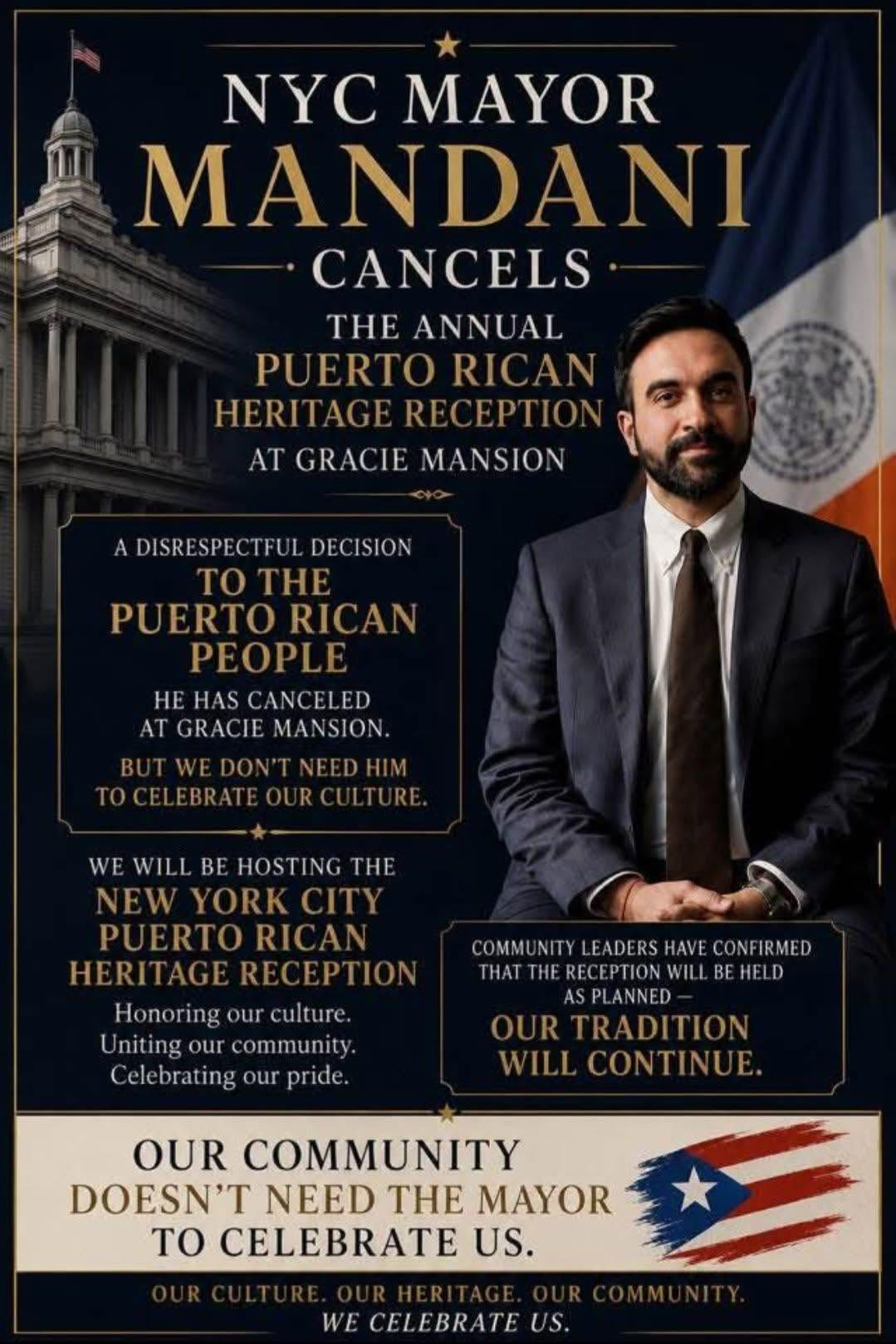
Take the recent controversy surrounding Mayor Mamdani and the annual Puerto Rican reception at Gracie Mansion.
The event itself is largely a networking and self-congratulatory gathering for political insiders. It does little to address housing, education, crime, healthcare, or economic opportunity for Puerto Rican communities.
Yet when Mamdani initially canceled it and later modified its format, portions of the Puerto Rican political establishment reacted as if he had banned Puerto Rican culture itself.
The response was embarrassing.
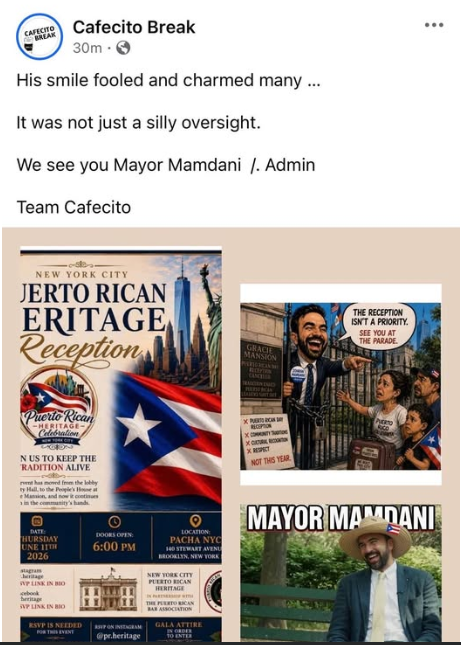
Social media exploded with Islamophobic, xenophobic, and racist attacks against Mamdani. AI-generated memes circulated depicting him as a foreign invader, an extremist, or someone inherently incapable of representing New Yorkers because of his religion and background.
What was most revealing was not the bigotry itself. Every community has bigots.
The revealing part was the silence.
Many of the same self-proclaimed community leaders who spend their days denouncing racism, discrimination, and intolerance suddenly found themselves unable to condemn the racist, Islamophobic, and xenophobic attacks coming from their own supporters.
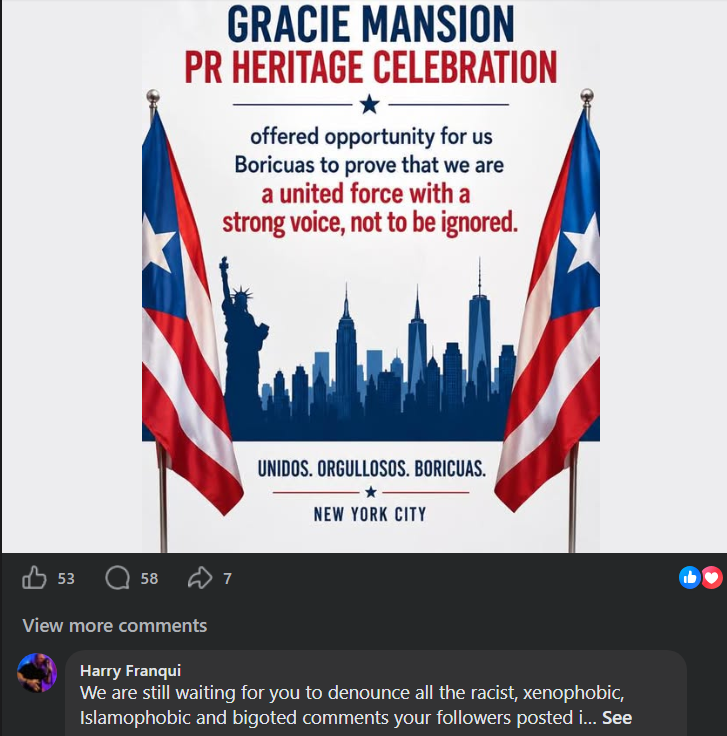
I challenged several of them publicly to denounce those comments.
Not one did.
Apparently bigotry only matters when it comes from political opponents.
Note: if you attend a rally of 10,000 people and a single one is waving a Nazi flag and no one call them out- you attended a Nazi rally.
The lesson is simple: minority communities are not morally superior because they are minorities. Every community contains progressives, conservatives, racists, homophobes, xenophobes, authoritarians, and democrats. Ethnicity does not confer virtue.
And this leads to a broader problem.
The Democratic Party increasingly allows some of its loudest activists to define entire communities and to shape national messaging. These activists often traffic in narratives that are not merely critical of specific policies but openly hostile to the United States itself.
No wonder- it is easy for MAGA to sell false patriotism as an antidote or cure for the “Democrats’ anti-Americanism.”
There is a difference between criticizing injustice and promoting anti-Americanism.
There is a difference between advocating civil rights and portraying the United States as irredeemably racist, colonial, evil, or illegitimate.
Most Americans support reform. Most Americans support equality under the law. Most Americans support civil rights.
Most Americans do not hate their country.
That is why MAGA’s message—however hypocritical and selective its patriotism may be—continues to resonate more broadly than Democrats expect.
One side says America is worth saving. The other often sounds like America is beyond redemption.
The second message loses far more often than Democratic strategists seem willing to admit.
And then comes the truly ironic part.
In what appears to be an effort to placate some of these nationalist groups, Mayor Mamdani has repeated one of the most common myths in Puerto Rican nationalist discourse: that the United States made the Puerto Rican flag illegal.
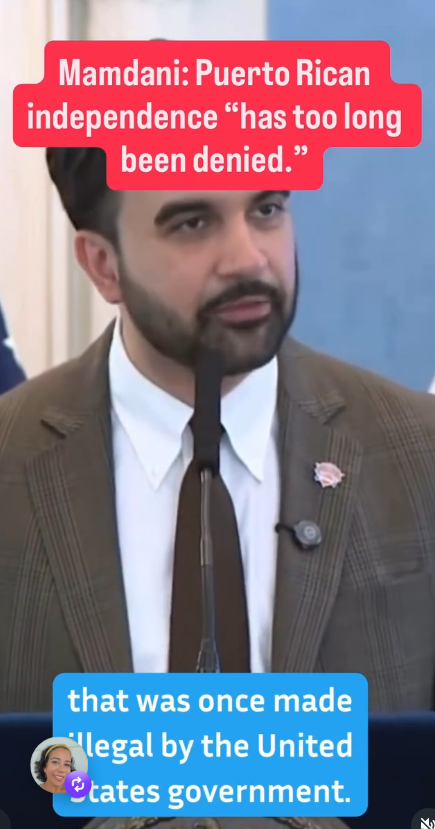
It didn’t.
The claim is false.
Law 53 (Gag law- Mordaza) was an unconstitutional and abusive law that violated freedom of speech and association. It deserved condemnation and repeal. But the law itself did not criminalize possession of the Puerto Rican flag, singing La Borinqueña, or advocating independence. Those claims emerged later through political narratives that completely blur the distinction between police abuses and the actual text of the statute.
Yet here is Mamdani repeating nationalist talking points as historical fact.
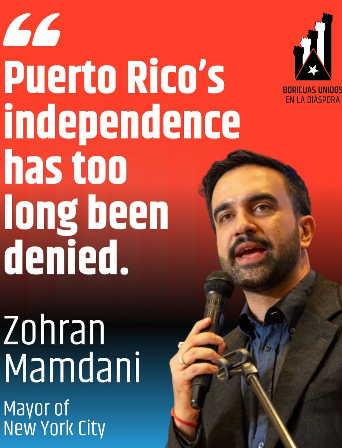
Even more puzzling, he has positioned himself as a champion of Puerto Rican independence, describing it as something “long denied to Puerto Ricans.”
But Puerto Rican voters themselves have repeatedly rejected independence.
In every modern status referendum, support for independence has remained a small minority position. More than 80 percent of Puerto Ricans consistently support some form of continued political association with the United States, whether through statehood or an enhanced commonwealth arrangement, or even the same status it has now.
So who exactly is Mamdani speaking for?
Certainly not the majority of Puerto Ricans much less the people of Puerto Rico.
He appears to be responding instead to a small but highly vocal network of nationalist organizations and activists concentrated in New York City—many of whom spent the previous week denouncing him as a communist, an extremist, or someone who only cared about Muslims.
Think about that.
The same people who smeared him with racist and xenophobic attacks are now being rewarded with political validation.
Make it make sense.
This episode illustrates everything wrong with identity politics when it replaces reality.
A small activist class claims to speak for an entire people. Politicians accept that claim without question. Historical myths become accepted truths. Bigotry is excused when it comes from the “right” communities. And legitimate criticism becomes impossible because anyone who disagrees is accused of betraying the cause.
That is not progressivism. It is tribalism. It is exactly how Trump runs MAGA.
And tribalism always ends in ignorance, grievance, and division.
I catch a lot of criticism for denouncing nationalism. But I do so because ethnic nationalism—whether American, Puerto Rican, or otherwise—encourages people to see themselves as permanent victims, teaches them to interpret disagreement as oppression, and turns political opponents into enemies.
What we witnessed this week was not a celebration of Puerto Rican culture. It was a reminder that an ignorant and bigoted mob is still a mob regardless of its nationality.
And now Mayor Mamdani has rewarded that behavior while ignoring the millions of Puerto Ricans who want better schools, affordable housing, safer communities, economic opportunity, and progressive policies—not another round of nationalist mythology, victimhood politics, and performative outrage.
Democrats can continue empowering these voices if they want.
But if they keep allowing grievance, anti-American rhetoric, and activist maximalism to define their public image, they should not be surprised when voters continue choosing the alternative—even when that alternative is MAGA.


[…] Apparently, some forms of bigotry are unacceptable, while others are excusable if the right person says them. Make it make sense. And this comes following the recent “crisis” and the many racist and Islamophobic attack… […]
LikeLike