Ok, I see so many posts of people trying to out-progressive each other.
Everyone is sharing—with great indignation and self-righteousness—that Rusking Pimentel, a former senior adviser to Rep. Adriano Espaillat, made racist and Islamophobic comments about his primary challenger, Darializa Avila Chevalier.
According to multiple reports, Pimentel accused Avila Chevalier, who identifies as Afro-Dominican and Muslim, of working with others to replace Dominicans in Washington Heights with Muslims and Haitians. The comments were rightly condemned. Espaillat publicly distanced himself from them and explicitly defended Avila Chevalier’s Dominican identity.
Good. That is exactly what should happen when someone engages in ethnic or religious bigotry.
What I find remarkable, however, is how many people are outraged by racist and Islamophobic attacks against Avila Chevalier while simultaneously refusing to acknowledge or discuss statements attributed to Avila Chevalier herself that many would consider racist, ethnonationalist, or religiously intolerant– downright reactionary.
Apparently, some forms of bigotry are unacceptable, while others are excusable if the right person says them. Make it make sense. And this comes following the recent “crisis” and the many racist and Islamophobic attacks visited upon Mayor Mamdani and the Muslim and immigrant community by NYC Puerto Ricans.
But back to the matter at hand: one of Avila Chevalier’s comments that has circulated widely is a social media post stating:
“Black men Arab men fetishizing ugly colonizer women.”
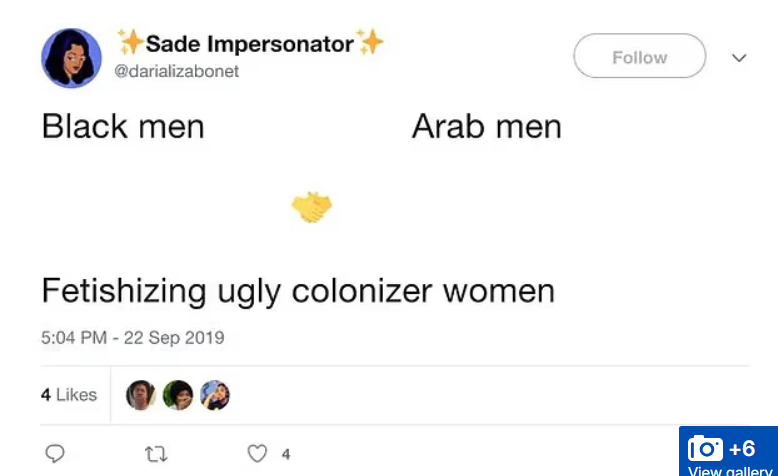
Think about what is packed into a single sentence.
It is a gratuitous attack on interracial relationships. It reduces individuals to racial categories. It demeans women because of their ethnicity. It frames human relationships through the lens of racial loyalty and collective identity.
If someone on the right had written that about Black, Jewish, Muslim or Latino women, progressives would rightly denounce it as racist garbage.
Why should the standard be different here?
For decades, Americans fought to dismantle segregation and anti-miscegenation laws. People marched, organized, litigated, and in some cases died to establish the principle that race should not determine whom you can love or marry.
The struggle that culminated in decisions like the Supreme Court’s ruling in the historical event of the Loving v. Virginia was about expanding freedom and equality, not creating new social pressures for racial or religious separation.
To ridicule interracial or interfaith relationships is not progressive. It is reactionary.
It is a rejection of one of the greatest civil rights achievements of the twentieth century.
Likewise, comments expressing contempt toward the American flag- her tweets about wiping her hands with the it– inevitably carry political consequences. People can criticize the United States. People should criticize the United States when criticism is warranted. That is part of living in a free society.
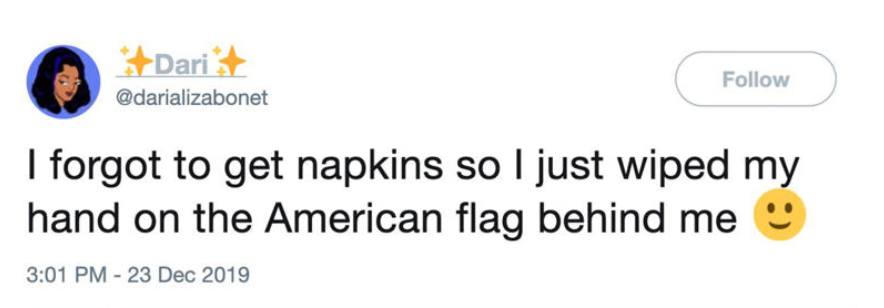
But there is a difference between criticizing the country and expressing contempt for its most recognizable national symbols– particularly when it comes from people running for office!
Whether one agrees with that distinction or not, most Americans interpret such statements as evidence of hostility toward the country itself. Those comments reinforce an existing perception that the Democrats and the poorly called left and progressives– view the United States of America not as a flawed country capable of improvement, but as something fundamentally illegitimate and only deserving of ridicule.
Then people wonder why so many voters become receptive to the argument that progressives dislike the country, its traditions, and the people who identify with them.
Perception matters in politics.
The broader issue is one I have raised repeatedly: modern progressivism often attempts to build coalitions around ethnic, national, racial, and religious identities while simultaneously claiming to champion the universalism which should fuel progressive ideas.
The contradiction is obvious.
Ethnic nationalism does not become enlightened because it comes from a minority group.
Religious chauvinism does not become progressive because it is directed at a majority group.
Racial essentialism does not become anti-racist because it is expressed in activist language.
The reality is that many ethnic and national communities—including communities I belong to and know well—can be deeply protective of their own interests while remaining indifferent or hostile to the concerns of other groups.
Puerto Ricans say bigoted and horrible things about Dominicans. Dominicans say bigoted and horrible things about Haitians. Mexicans say bigoted and horrible things about Salvadorans. And the list goes on.
And they use the same language of “displacement” and “protecting our culture” that far right white supremacist use to refer to non-whites.
And no- they are not simply copying “the Master”.
These are not uniquely conservative impulses. They are human impulses. They emerge whenever identity becomes more important than principle.
That is why I find it so frustrating when people excuse this behavior simply because it comes from someone who identifies as progressive.
No.
If you oppose racism, oppose racism.
If you oppose religious prejudice, oppose religious prejudice.
If you oppose ethnonationalism, oppose ethnonationalism.
Apply the standard consistently.
And before someone reaches for the tired argument that racism only exists when accompanied by structural power, my response is simple: grow the fuck up.
Structural analysis can be useful for understanding institutions. It is not a moral permission slip for individuals to engage in racial hostility, ethnic chauvinism, or religious intolerance.
Bigotry is bigotry.
What worries me most is that figures on opposite ends of the political spectrum increasingly mirror one another. One side embraces racial and religious nationalism in the language of identity politics. The other embraces racial and religious nationalism in the language of patriotism and tradition. But they are the same.
They feed off each other. They justify each other. They strengthen each other.
And they are both toxic.
A healthy democratic society requires universal standards. The same rules should apply regardless of race, religion, ethnicity, nationality, or political affiliation.
The moment we start making exceptions for “our side,” we stop defending principles and start defending tribes.
And tribalism has never been a recipe for justice, equality, or democracy. It leads to an endless contestation of power that only serves to keep old and new elites in power while the people is distracted with petty nationalist grievances.

