[This is the first excerpt from my book in progress: Fighting on Two Fronts: The Experience of the Puerto Rican Soldiers in the Korean War.]
I have always enjoyed listening to elders, for they convey the wisdom, emotions, and feelings that often get lost in history books. In the very early 2000s, during one of those conversations, an elderly Puerto Rican woman who went by the name of Pepita Medina told me about the peculiar Christmas of 1950.
She said it had been the saddest Christmas she could remember. Puerto Rican soldiers—”our boys” (los muchachos), as she put it—were in peril, and no one dared to celebrate. Instead, Puerto Ricans were glued to their radios in private homes, colmados, and bars, while local newspapers sold out almost as soon as they hit the streets, carrying news of los muchachos fighting against overwhelming odds thousands of miles away in Korea.
The fall of 1950 gave the United Nations Command forces fighting in Korea, led by the United States, a rude awakening.
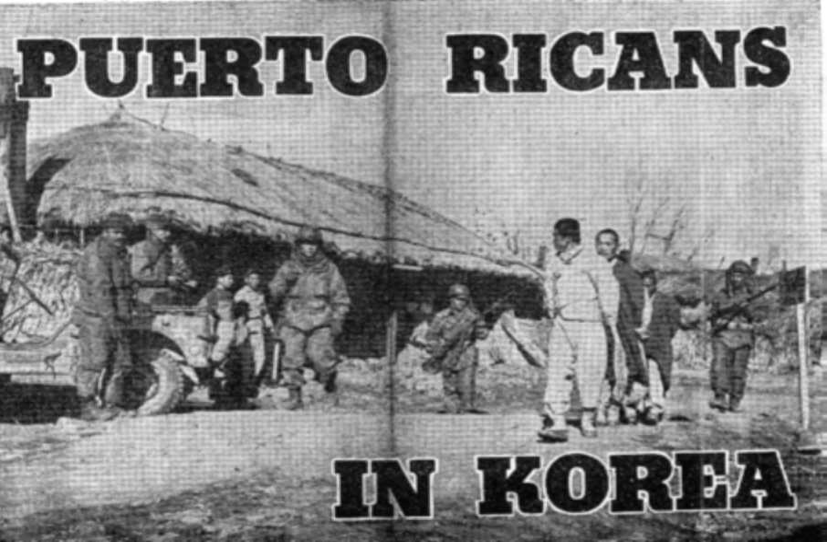
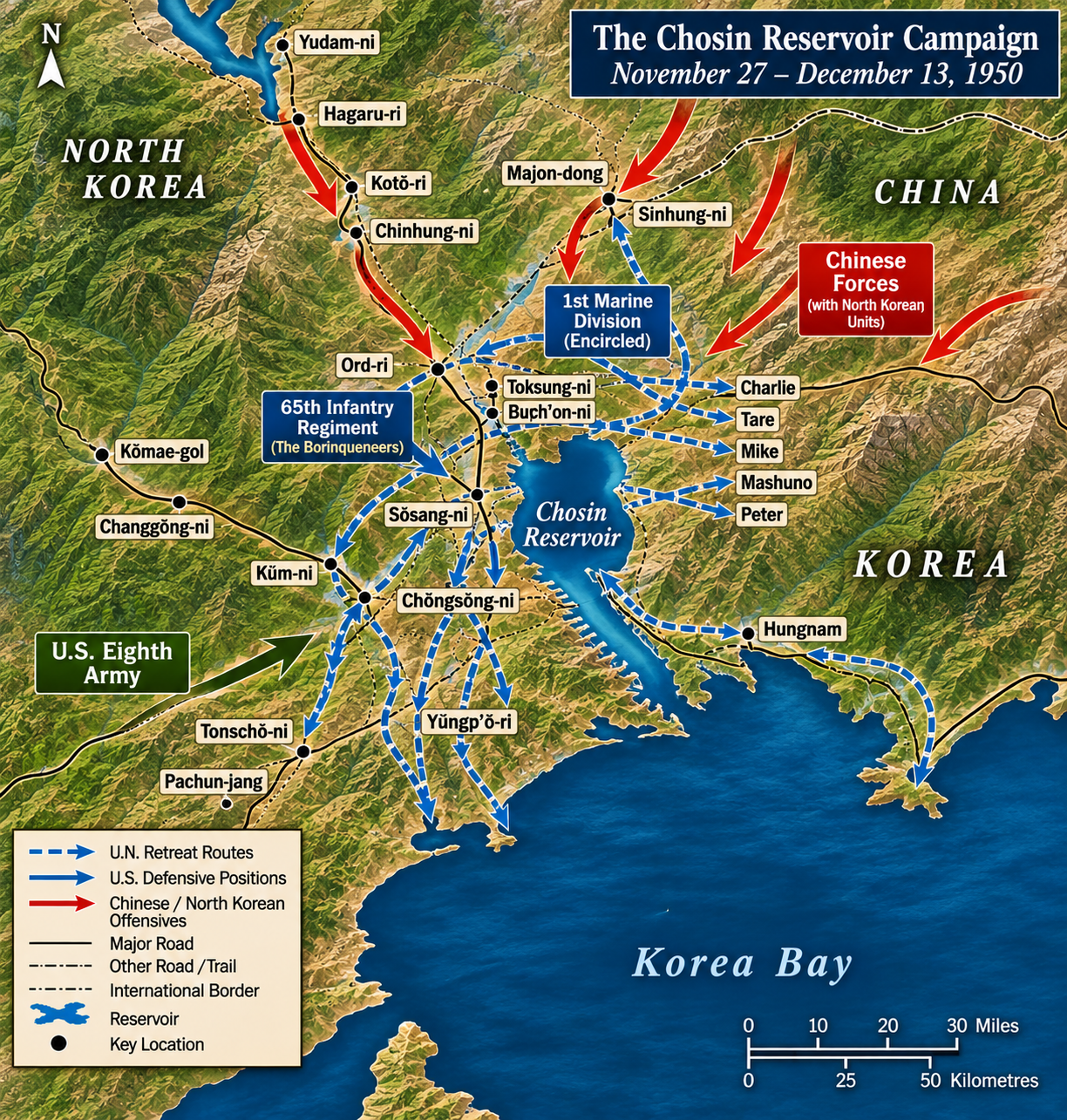
Though the story of the 1st Marine Division and its desperate escape from encirclement at the Chosin Reservoir is well known, and deservedly so, the role played in this ordeal by a U.S. Army infantry regiment composed mostly of Puerto Ricans remains largely unknown beyond the small circles of surviving Puerto Rican soldiers who fought in that battle, their descendants, and a handful of scholars and activists who have studied the Puerto Rican regiment known as the Borinqueneers. And, of course, elders like Pepita who remember those days with a mixture of sadness and pride.
“I wouldn’t go where you are being sent…” In late October 1950, Major General Edward Almond summoned Colonel William W. Harris to X Corps Headquarters, and ordered him to move his regiment back to the port of Pusan in Korea.
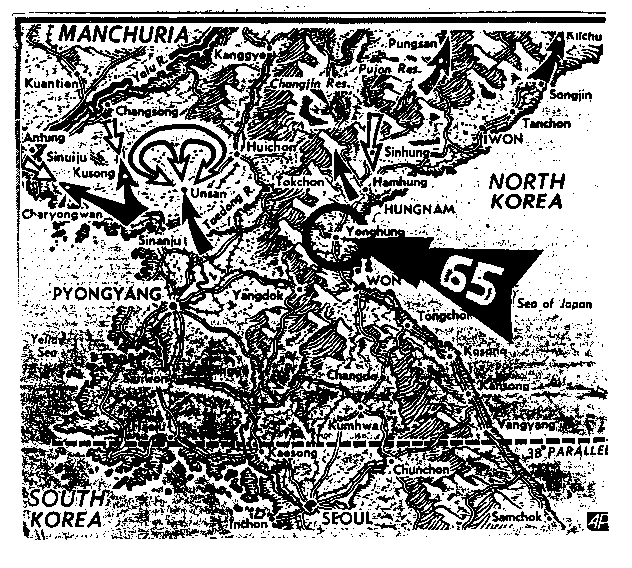
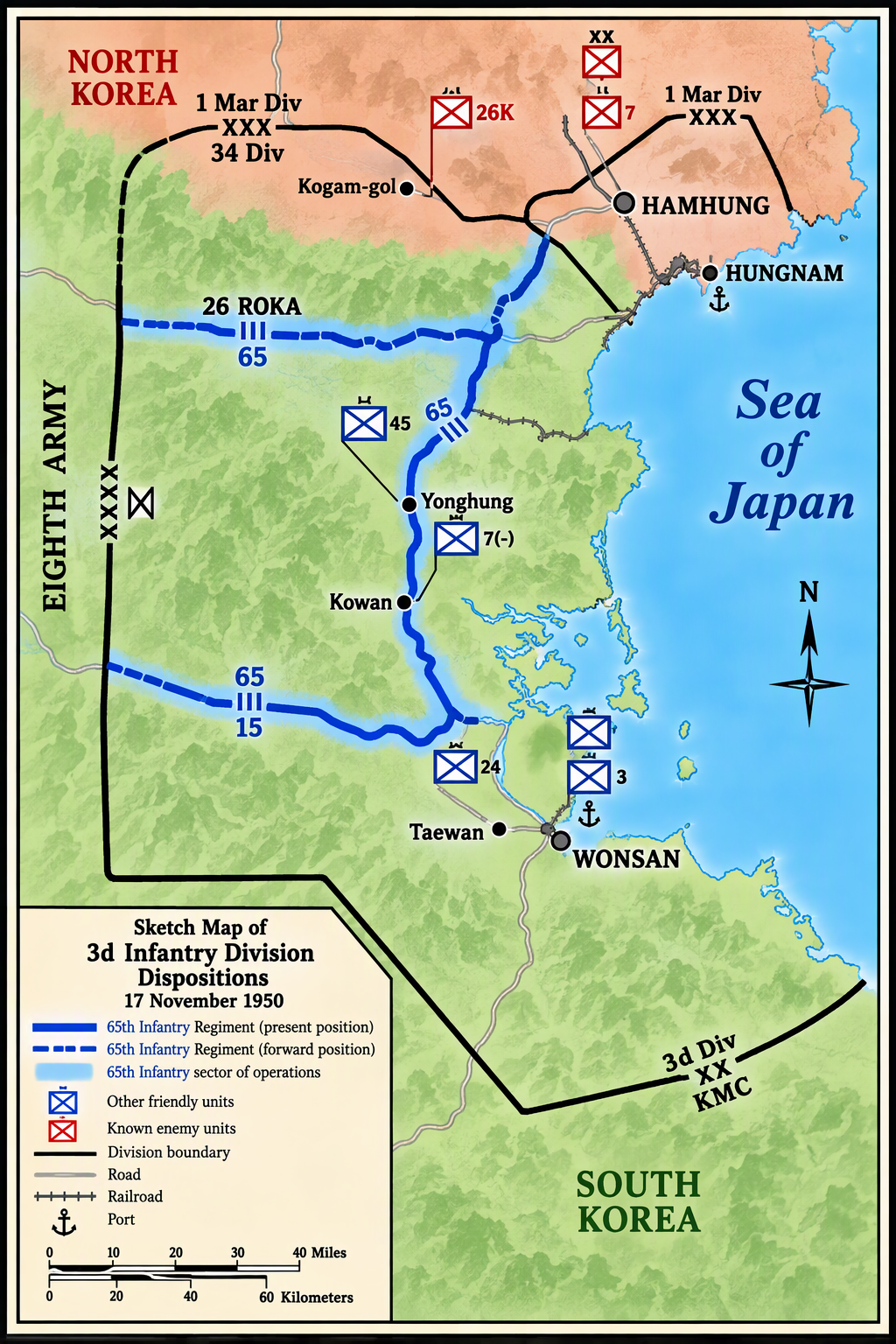
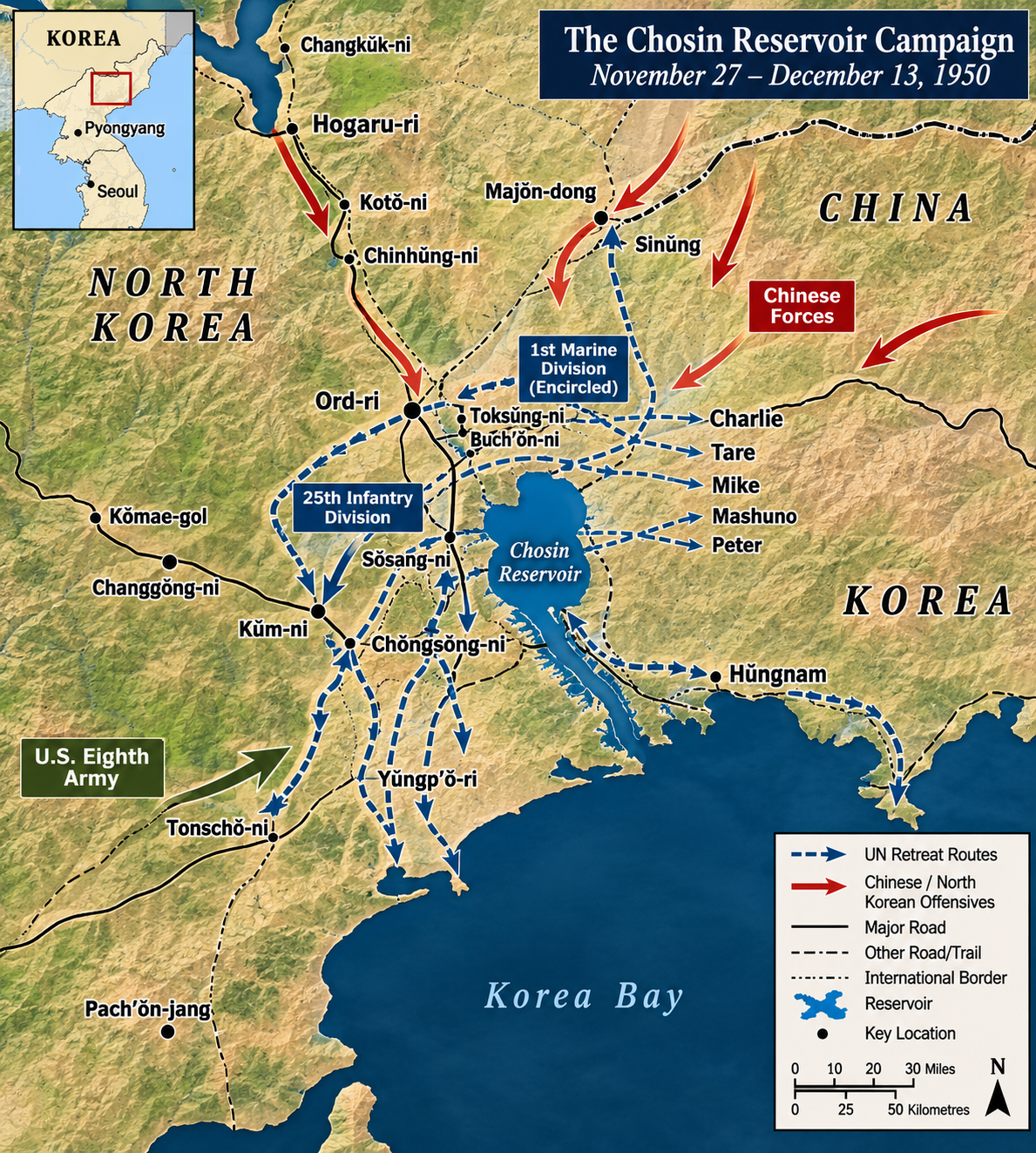
Harris commanded the 65th U.S. Army Regiment of Infantry which was composed of Puerto Rican soldiers and NCOs (sergeants) and junior offices and white “American” officers. The 65th was to embark for Wonsan on the east coast of North Korea. From Wonsan, the 65th was to move immediately north to Yonghung, located midway between Wonsan and Hungnam. Almond ordered Harris to operate in this area and extend to the west to link up with the 1st Cavalry Division on the Eighth Army’s right flank. All the while, the regiment was to engage with enemy in the sector (see map 1 and map 2).[1]
An old friend of Harris, Colonel Aubrey D. Smith, was serving as Almond’s supply officer. When Harris received his orders, Smith barked: “Bill, I wouldn’t go where you are being sent unless the corps gave me written orders to do so and at least four infantry divisions.”[2]
While Almond ignored Smith’s comment, Harris could not. Army intelligence estimated that about 25,000 North Korean People’s Army (NKPA) soldiers were in the area.[3] The 65th Regimental Combat Team (RCT) counted only about 6,000 men. To make matters worse “no one really knew even the approximate location of Eighth Army’s right flank.”[4]
These were desperate times. The United Nations Command was scrambling to support the encircled 1st Marine Division, Republic of Korea (ROK) troops, and other allied forces fighting their way out of the Chosin Reservoir area, while simultaneously trying to prevent a collapse of its main line of resistance elsewhere along the front.
The Chinese intervention had fundamentally altered the battlefield, forcing UN forces to fight on multiple fronts against overwhelming odds. Yet, with its forces stretched thin and the possibility of a general retreat looming, the Command had few options.
Holding the line, preventing further Chinese and North Korean advances, and applying pressure against enemy forces elsewhere along the front were essential to keeping the withdrawal routes open and buying precious time for the encircled troops to fight their way back toward friendly lines. It was a desperate effort to prevent a tactical disaster in the northeast from turning into a broader military catastrophe for the entire UN coalition.
Commanded by Lieutenant Colonel Dammer, the second battalion of the 65th (2/65) left Wonsan on November 6, 1950. Unbeknownst to Harris, Almond had diverted the other two battalions- 1/65 and 3/65, and attached them to the 1st Marine Division. Thus the 2/65 proceeded to Yonghung piecemeal and without adequate ammunition (see map 2).[5]
“Maná del cielo“ On the night of November 6-7, the 2/65 received a rude surprise. Around two o’ clock in the morning, mortar and rifle fire announced the enemy offensive. Instead of the usual North Korean Peoples Army (NKPA) attack, the Puerto Ricans found themselves fighting Chinese Communist Forces (CCF).[6]
The attack started on the west side of the 2/65’s perimeter, but soon the whole perimeter was under intense pressure.[7] An estimated two Chinese regiments participated in the attack. Throughout the night, the Borinqueneers held the line.
By 4:00 in the morning, however, the 2/65 was running out of ammunition. So critical was the situation that Harris sent, in the clear, an operational priority message to Almond’s headquarters asking for an airdrop of basic load rifle ammunition and medical supplies.[8]
With the first light of day came seven C-47s with the much-awaited airdrop. Cheering Borinqueneers came out their foxholes to retrieve the ammunition while yelling “maná del cielo,” or manna from heaven.[9] The Chinese broke contact after the men of the 2/65 retrieved the airdrop. Dammer sent a patrol to maintain contact with the enemy. Scouts reported that the Chinese were holed up in a railroad tunnel. Several platoons were sent to force the Chinese into the tunnel while another platoon blew up both ends with TNT charges.[10] The 2/65 defeated the and completely destroyed the enemy force.
Eager to see what had happened the night before, General Almond flew to the 2/65’s position right after the airdrop. Harris informed him that two to three regiments had attacked the perimeter and that many of his men were wounded but no one killed. En route to the first aid station, Almond, showing a common bias and institutional racism toward non-white troops, told Harris that he “didn’t have much confidence in these colored troops.”[11] Harris replied: “The men of the 65th are white Puerto Ricans.” He added that he had some black Puerto Ricans, and a colored artillery battalion and tank company, but even they “have fought like real troopers.”[12] Even after a fierce demonstration of courage against a superior enemy force, Almond still distrusted the Borinqueneers. The racial discrimination that white and Black Puerto Ricans suffered under their white officers would not end here and in fact eventually be a factor crippling the regiment’s performance. But that lies years ahead.
On November 13, the 1/65 and 3/65 rejoined the regiment. Around the same time, the remaining elements of the 3rd Division, to which the 65th had been permanently attached, arrived in Korea.
Soon after the 3rd Division reached the front, X Corps finally assigned well-defined operating zones for the 7th Infantry, 1st Marine, and the 3rd Infantry divisions.[13]
Escaping from the Chosin Reservoir– Between November 30 and December 1, 1950, the 65th RCT, then stationed in the Hamhung-Hungnam area, received four successive sets of orders. The regiment was ordered to proceed to Yonghung, then south to Wonsan, back to Yonghung, and finally to return to the Hamhung-Hungnam area.[14]
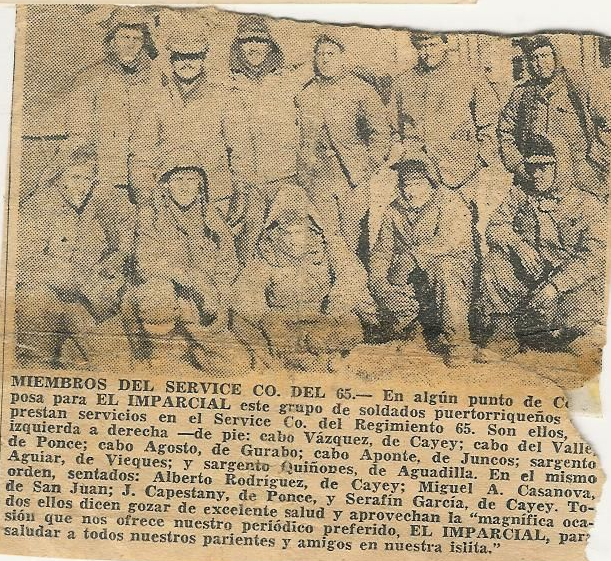
These successive orders and counter-orders reflected the confusion that had gripped X Corps since November 25, when the Communist Chinese Forces (CCF) launched a major offensive that threw both the Eighth Army and X Corps off balance.
In an attempt to escape the CCF onslaught and avoid the destruction of his forces, General Almond had decided to evacuate X Corps through the port of Hungnam in northeast Korea. But first, the 1st Marine and the 7th Infantry Division had to break out of the Chosin Reservoir area and fight their way south.
The Chinese offensive had nearly encircled the 1st Marine Division. By November 27, however, the Marines were already fighting their way southward under relentless pressure. Four Chinese armies, with an estimated 120,000 soldiers, pursued the retreating Allied columns.
Task Force Dog– Recognizing the need to protect their withdrawal, Major General Robert H. Soule, commander of the 3rd Division, dispatched Task Force Dog to meet the retreating forces south of Koto. Task Force Dog included the 65th’s three infantry battalions, the 3/7, and the all-Black “Colored” 3/15. The 65th’s “Colored” tank and artillery units, together with the self-propelled 155-mm guns of the 999th and 92nd FAB, completed the task force. [15]
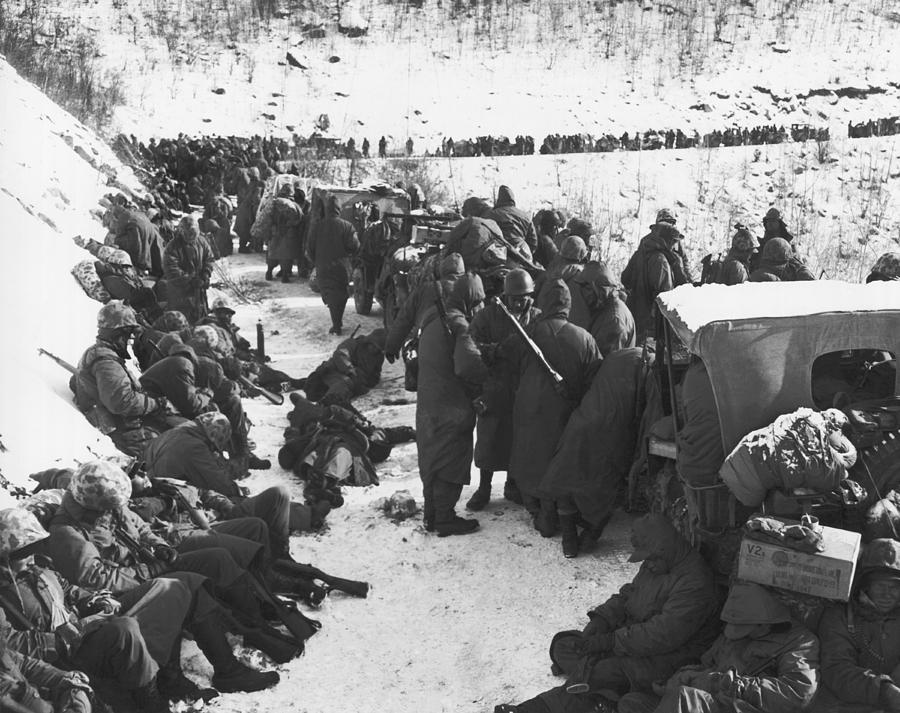
On December 7, Task Force Dog began moving north, with the 65th leading the way. Dammer’s 2/65 advanced to Majon, while Lt. Colonel Jerry Allen’s 3/65 moved to Oro. Farther south, Lieutenant Colonel Howard B. St. Clair’s 1/65 and Lieutenant Colonel Edward L. Farrel’s 3/15 established a defensive line near Oro. That same day, the remaining elements of Task Force Dog, including the 3/7 and G Company of the 2/65, moved out from the 65th’s positions and continued north toward Chinhung.
Located just a few miles from Funchilin Pass, Chinhung was strategically important to the withdrawal. The CCF had blown up a bridge at the pass, forcing the airdrop of eight treadway bridges to allow the retreating Marines to continue south.
From Funchilin Pass to Chinhung, the 1st Battalion of the 1st Marine Regiment and forward elements of Task Force Dog protected the retreating column, helping keep the route open as the Marines fought their way out of the Chosin perimeter.[16]
As the Marines continued south, the Borinqueneers 2/65 and 3/65 provided protection for their withdrawal. Their positions formed part of the covering force that allowed the retreating Marines to move through the area without being cut off by advancing Chinese forces. By December 10, the 1st Marine Division had withdrawn through the positions held by the 2/65 and 3/65. [17]
At Majon, where retreating Marines and soldiers boarded trains and trucks, men of the 65th shared what little food they could spare. More than five decades later, Juan Mercado Santana, a 65th veteran from Barranquitas, still saddened by the sight of the battered marines commented: “They came through our lines when we were heating our rations. We felt so bad for them that we gave them our food, some cigarettes, and tried to cheer them up.” [18]
Last to Get Out, últimos en salir– By December 13, the entire covering force had withdrawn within the protective lines established by the 65th Infantry and the 3rd Battalion, 15th Infantry Regiment. From that point onward, the 65th’s three infantry battalions and the 3/15 secured the roads leading to Hungnam, protecting the approaches to the port as the evacuation continued.
On December 15, the battered 1st Marine Division finally sailed from Hungnam. The fighting had exacted a heavy toll on the 65th. During December, the Borinqueneers lost thirty-six men killed in action (KIA), seventy-five wounded, and twelve missing in action (MIA)—casualties that, according to Colonel Harris “compared to almost eight times that many lost by the enemy in their engagements with the regiment.”[19]
The evacuation of Hungnam, however, was not yet over. General Almond deployed his 3rd and 7th Divisions along an arc-shaped perimeter to defend the port and protect the remaining forces awaiting embarkation.
Army engineers demolished Hamhung on December 16. The next day, I Corps of the Republic of Korea’s Army (ROKA) evacuated Hungnam.
On December 18, the 3rd Division assumed responsibility for the entire perimeter, while the 7th Division departed Hungnam on the twenty-first.

The next day, December 22, the 3rd Division began its own withdrawal.
The last infantry formation of the 3rd Division left Hungnam on Christmas Eve.
Lupercio Ortíz, a sergeant from the 65th’s headquarters company, was the last man to leave the beachhead. [20]
On December 26, the Puerto Rican newspaper, El Mundo revealed the extent to which Puerto Ricans had followed the fate of their soldiers during those difficult weeks. “Now the island can breathe easy and receive the New Year with greater optimism and hope than it had at Christmas,” the newspaper reported.
Its editorial added: “The 65th is safe and back in Pusan and has covered itself with glory by its valiant service in protecting the embarkation of marines and soldiers.” [21]
More was in store for the Puerto Rican regiment and the Borinqueneers. But the news that they were safe and had been the last ones to evacuate the besieged port brought much relief and pride to a colonized people whose hijos were fighting in a distant land to protect freedoms they didn’t fully yet enjoyed.
Remembering los muchachos– In the early 2000s, Pepita could not contain her smile as she finished telling me her story. She was reliving the relief and joy she had felt upon reading the newspapers and listening to the radio: “Our boys” were safe. After all those anxious weeks, that was what mattered most. Her smile said it all. The sadness of that Christmas had finally given way to relief, and the memory of those days remained with her, a mixture of sorrow, pride, and gratitude.
Almost two decades after Pepita shared the story of her triste Navidad with me, an American graduate student studying in the Netherlands sent me an email. She wanted to share something about her grandfather, a Marine who had been among those retreating from Chosin and who, upon reaching the safety of American lines, was met by soldiers from Puerto Rico.
She wrote that she and her grandfather would forever be grateful to those men. Her grandfather could hardly understand what these Spanish-speaking American soldiers were saying, but he understood something far more important, their camaraderie, their brotherhood, and the sense of safety they offered him as he made his way back home.
There is something profoundly human about these two stories. In Puerto Rico, families had spent weeks anxiously awaiting news of los muchachos, praying that they would make it through the ordeal and return safely.
Far away in Korea, Marines who had endured the horrors of Chosin found themselves in the care of soldiers whose language and cultural backgrounds were different from their own. Yet, in the midst of war, none of those differences mattered. What mattered was that they were fellow soldiers who had endured the same hardships, and men who understood the meaning of looking after one another when survival was at stake.
That is the kind of brotherhood that can only be forged under the most difficult circumstances. It transcends race, ethnicity, language, and cultural barriers. And sometimes, decades later, it finds its way back through the memories of an elderly Puerto Rican woman, the gratitude of a Marine’s granddaughter, and the stories of our muchachos.
Being entrusted with these stories and histories has been and remains the highest privilege of my life.
Continue reading:
The Korean War in Puerto Rican History and Memory – in cOHERENT Thoughts
Pride and Courage: A Borinqueneers’ Story – in cOHERENT Thoughts
The Borinqueneers: The Forgotten Heroes of a Forgotten War – in cOHERENT Thoughts
___________________________________________________________________________
[1] See Roy B. Appleman, U.S. Army in the Korean War: South to the Naktong North to the Yalu (Washington D.C.: Office of the Chief of Military History, 1966), 722-23; Blair, The Forgotten War, 407-408; and Harris, Puerto Rico’s Fighting 65th, 88.
[2] Harris Puerto Rico’s Fighting 65th, 87-88.
[3] Appleman, South to the Naktong North to the Yalu, 725.
[4] Harris, Puerto Rico’s Fighting 65th, 85-86.
[5] Blair, Forgotten War, 409; Harris Puerto Rico’s Fighting 65th, 91.
[6] Joseph Stalin, the leader of the Soviet Union, supported North Korea’s aggression thinking that “it would benefit the geopolitical position of the USSR in the Far East.” In a gross miscalculation, Stalin believed that the United States would not intervene. Immediately after the U.N. forces crossed the 38th parallel and with Kim Il-Sung’s regime crumbling, Stalin “dictated a telegram to Mao Zedong [Communist China’s leader] advising the Chinese to mobilize five or six divisions to the 38th parallel.” On October 25, 1951, the Chinese Communist Forces (CCF) launched their first phase offensive of the Korean War. Intelligence reports, however, disregarded the presence of large numbers of Chinese soldiers in North Korea until the CCF launched a large scale offensive on November 25, 1951. Vladimir Zubok, and Constantine Pleshakov, Inside the Kremlin’s Cold War: From Stalin to Khrushchev, (Cambridge Massachusetts: Harvard University Press, 1996), 54, 65.
[7] Harris Puerto Rico’s Fighting 65th, 97-99.
[8] Ibid., 99.
[9] Maná del cielo is a biblical reference to the manna that fell on the Hebrews during their exodus from Egypt. Vargas Interview; Harris, Puerto Rico’s Fighting 65th, 102-103.
[10] Harris, Puerto Rico’s Fighting 65th, 105.
[11] Harris, Puerto Rico’s Fighting 65th, 104. Luis Raul Rodríguez commanded Company F of the 2/65 from December 12, 1950, to January 29, 1951. Rodríguez did not like Almond because he referred to the 65th as the Rum and Coke outfit. See Luis R. Rodríguez, interview by author, audiocassette, Miami, Florida, 27 September 2001. Not only did Almond distrust black troops, but he also opposed racial integration. Twenty years after the Korean War, in a letter to the Joint Chiefs of Staff, Almond continued to condemn the integration of the armed forces based on his belief that “the basic characteristics of Negro and White are fundamentally different.” He added: “There is no question in my mind of the inherent differences in races.” See McGregor, Integration of the Armed Forces, 440-41.
[12] Harris, Puerto Rico’s Fighting 65th,105.
[13] Ibid., 109.
[14] Ibid., 119.
[15] Ibid., 119-20.
[16] Blair, Forgotten War, 541-42.
[17] Ibid.
[18] Mercado Santana Interview.
[19] Harris, Puerto Rico’s Fighting 65th, 135.
[20] See Blair, Forgotten War, 542-44; Lupercio Ortíz Interview. Lupercio Ortíz still had a picture of himself and his assistant as they left the beachhead. The picture was first published on Life Magazine and reprinted by the press in Puerto Rico. See El Imparcial de Puerto Rico: Periódico Ilustrado, 27 December 1951.
[21] Periódico El Mundo (San Juan), 27 December 1950.


[…] The Chosin Reservoir, the Borinqueneers, and triste navidad in Puerto Rico – in cOHERENT Thoughts […]
LikeLike
[…] The Chosin Reservoir, the Borinqueneers, and triste navidad in Puerto Rico – in cOHERENT Thoughts […]
LikeLike
[…] The Chosin Reservoir, the Borinqueneers, and triste navidad in Puerto Rico – in cOHERENT Thoughts […]
LikeLike
[…] The Chosin Reservoir, the Borinqueneers, and triste navidad in Puerto Rico – in cOHERENT Thoughts […]
LikeLike