Pedro Albizu Campos remains one of the most mythologized figures in Puerto Rican political history, enshrined in public memory as a liberator, martyr, and anticolonial prophet of near-messianic stature.
For generations, nationalist discourse has elevated him beyond the realm of ordinary political leadership, transforming him into a secular saint whose symbolic power often overshadows critical scrutiny.
Yet serious archival scholarship increasingly reveals a far more troubling, contradictory, and deeply complex figure—one whose politics, rhetoric, and worldview frequently aligned less with democratic liberation than with authoritarianism, ultranationalism, patriarchal conservatism, and notable fascist sympathies.
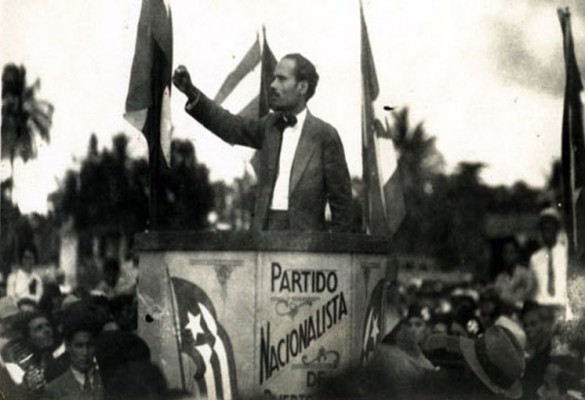
The historiography surrounding Albizu, Puerto Rican nationalism, and the broader machinery of colonial repression—particularly the Gag Law—therefore reflects far more than simple disagreements over one man’s legacy.
It represents an ongoing struggle over Puerto Rico’s historical memory itself.
At stake is not merely how Albizu is remembered, but how Puerto Ricans interpret resistance, nationalism, colonial trauma, and political legitimacy.
When examined across the broader body of scholarship—from rigorous archival historians and economic analysts to nationalist memorialists, ideological defenders, and revisionist critics—a far more complex and unsettling picture emerges. The divide between documentary evidence and popular nationalist mythology is stark.
Rather than the flawless liberator of nationalist legend, Albizu increasingly appears as a charismatic but deeply authoritarian political figure whose anticolonial resistance coexisted with reactionary social thought, cult-like leadership, militarism, delusions of grandeur, messianic self-perception and ideological affinities with some of the most dangerous political currents of the 1930s.
Thus, the study of Albizu Campos is not simply about recovering the life of a nationalist leader, but about confronting the profound tension between myth and history, symbolism and evidence, liberation and authoritarianism.
Puerto Rican historiography continues to wrestle with this contradiction, as Albizu remains suspended between political sainthood in public imagination and the far darker, more complicated reality increasingly uncovered by serious scholarship.
Luis Ángel Ferrao’s Pedro Albizu Campos y el nacionalismo puertorriqueño remains the most serious, methodologically rigorous, and deeply researched examination of Albizu Campos to date. Unlike hagiographic nationalist portrayals that elevate Albizu into an untouchable revolutionary saint, Ferrao cuts through decades of political sanctification to reveal a far more flawed, contradictory, and troubling political figure. His scholarship demonstrates that Albizu was not simply an anticolonial leader, but one whose ideological commitments frequently leaned toward authoritarian structures, militarized nationalism, patriarchal hierarchy, conservative Catholicism, and notable admiration for fascist and strongman models emerging in Europe during the interwar period.
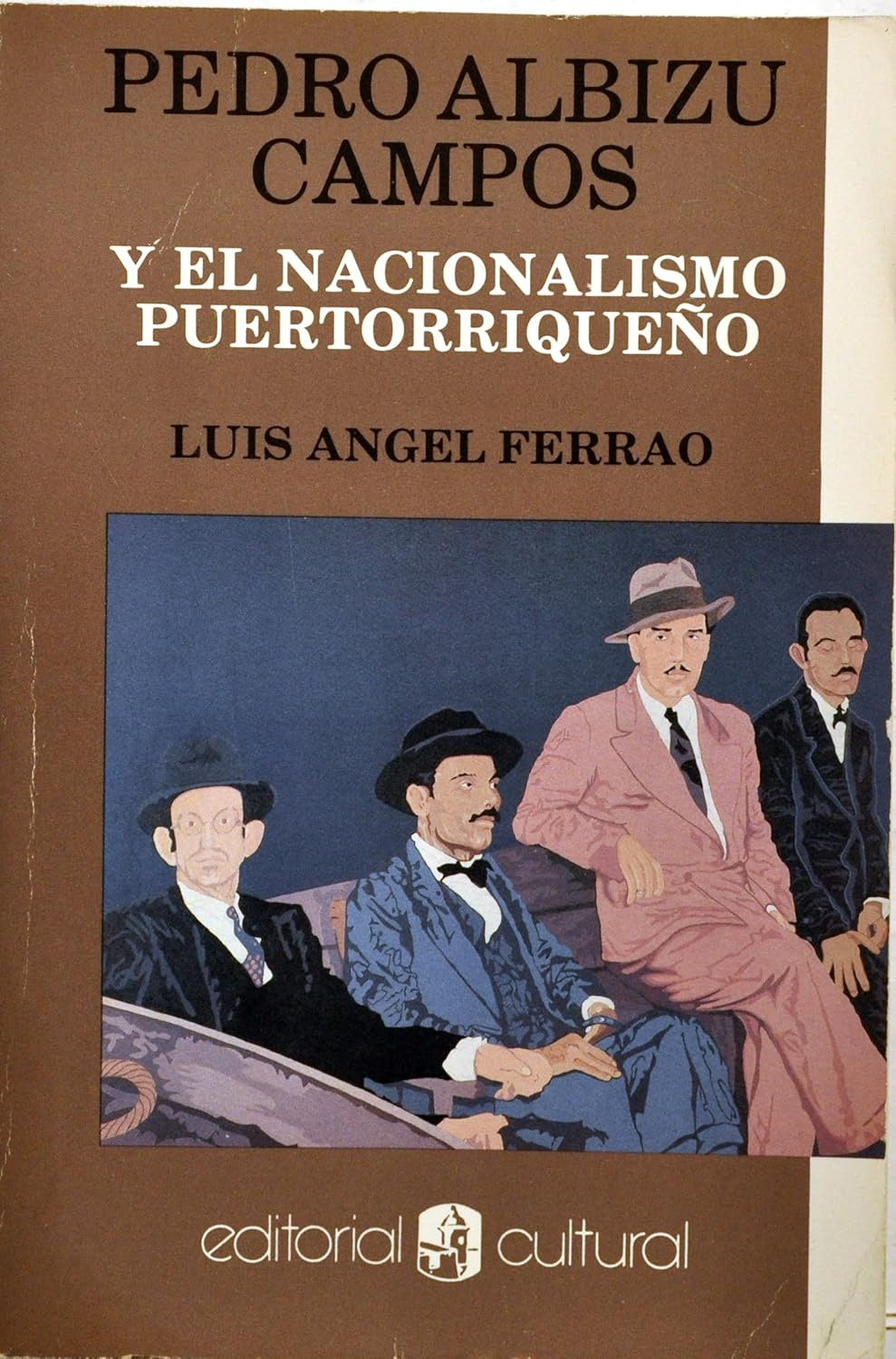
Through careful analysis of Albizu’s speeches, political organization, ideological influences, and broader political context, Ferrao shows that Puerto Rican nationalism under Albizu was not merely a liberation movement, but one often infused with hierarchical, ultraconservative, and quasi-fascistic frameworks. Rather than isolating Albizu as a uniquely Puerto Rican phenomenon, Ferrao situates him within the broader global rise of militant nationalism, charismatic authoritarianism, and reactionary political currents that defined much of the 1930s.
What makes Ferrao’s work foundational is precisely this balance: he neither demonizes Albizu through colonial caricature nor romanticizes him through nationalist mythology.
Instead, he documents how Albizu’s movement fused legitimate anti-imperial resistance with deeply reactionary political tendencies, exposing the dangerous ideological contradictions at the heart of his leadership. Ferrao is indispensable because he strips away myth and places Albizu squarely within the volatile and often authoritarian political currents of his era, rather than allowing him to remain insulated within the comforting moral simplifications of nationalist memory.
Ruth Vasallo & José A. Torres Martino (eds.), Pedro Albizu Campos: Reflexiones sobre su vida y su obra (1991), occupies an ambiguous and transitional position within the historiography of Albizu Campos. As a collection of essays, it reflects the broader tensions that define Puerto Rican historical writing on nationalism: the uneasy coexistence of commemoration, political memory, and critical scholarship. While the volume makes a meaningful contribution by bringing together multiple perspectives and encouraging renewed engagement with Albizu’s life and legacy, it ultimately stops short of fully confronting the deeper ideological and political problems embedded in his leadership.
A central limitation of the work lies in its uneven critical rigor. Several contributions remain partially embedded within the traditional nationalist framework that treats Albizu as a symbol of resistance rather than as a historically contingent political actor. As a result, there is often a tendency to soften, sidestep, or insufficiently interrogate key issues such as Albizu’s authoritarian tendencies, his admiration for hierarchical and strongman political models, and the broader fascist-adjacent currents influencing his thought during the 1930s. The volume engages with Albizu, but not always at the level of critical distance required to dismantle the mythology that has long surrounded him.
This is not to say the work lacks value. On the contrary, Reflexiones is useful precisely because it captures a historiographical moment in transition—where elements of nationalist reverence begin to encounter more critical, revisionist pressures. It opens space for questioning without fully committing to demythologization. In doing so, it reflects the broader struggle within Puerto Rican historiography: the difficulty of disentangling historical analysis from deeply rooted political and cultural symbolism. Ultimately, the volume contributes to the conversation but does not decisively reshape it. It remains partially constrained by the very commemorative impulses it seeks, at times, to interrogate.
More recent popular works by José A. Torres Ramírez (The Puerto Rican Myth, 2026), further dismantle the carefully constructed mythology surrounding Albizu. Torres challenges longstanding nationalist claims that Albizu was an unparalleled intellectual genius, exposing instead a far more ordinary academic record. Rather than the superhuman scholar of nationalist folklore, Albizu appears as a relatively average student whose legend was inflated over decades for political symbolism. This matters because Albizu’s mythos has often depended on portraying him as intellectually exceptional, morally pure, and politically visionary. Torres demonstrates how nationalist memory deliberately manufactured these exaggerations.
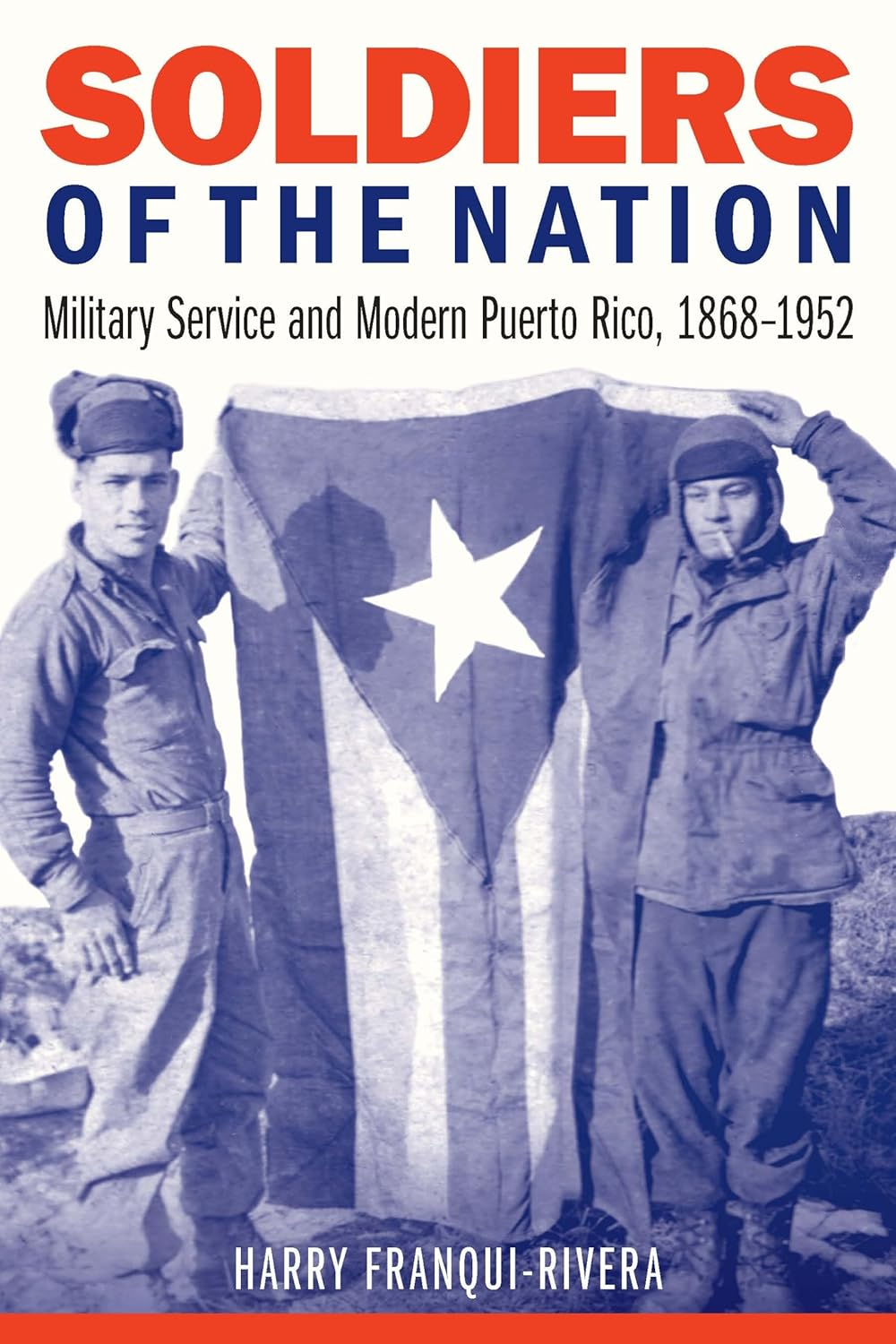
My own scholarship (Soldiers of the Nation 2018,2021) similarly offers crucial corrective insight into Albizu’s military background, another area often shrouded in exaggeration.
Nationalist narratives frequently present Albizu as a seasoned military leader and strategic genius, yet my archival research and work show his military service was limited, his training relatively minor (basic infantry platoon leader), and his placement within a segregated “colored” Puerto Rican unit indicative of the racialized constraints of U.S. military structures. The latter being a reason for Albizu’s radicalization and development of anti-Unites States feelings as he realized his own limits for ascendancy within the American framework.
Rather than a grand military strategist, Albizu’s service was far more modest than nationalist mythology suggests. However, that same experience in the military influenced Albizu’s beliefs. This included the need for armed struggle to forge or birth the nation alongside the creation of paramilitary units which would both symbolically and militarily challenge the U.S. Army Puerto Rican units in the island and their role in the formation of Puerto Rican identities. My work aims to place Albizu within the broader structures of empire, race, and masculinity without succumbing to either nationalist romanticism or simplistic dismissal.
Isabelle Anderson’s Quién es el Puertorriqueño: Debates of Race, Class, and Status in Puerto Rican Nationalism (2025),provides a nuanced but ideologically revealing middle ground within the broader historiographical debate. Unlike overt nationalist hagiographies that portray Albizu as an unblemished liberatory prophet, Anderson presents him as a deeply contradictory political figure—one whose nationalism simultaneously contained genuine anti-imperialist dimensions while remaining profoundly constrained by conservative social thought, Hispanophilic mythmaking, patriarchal ideology, and unresolved racial contradictions.
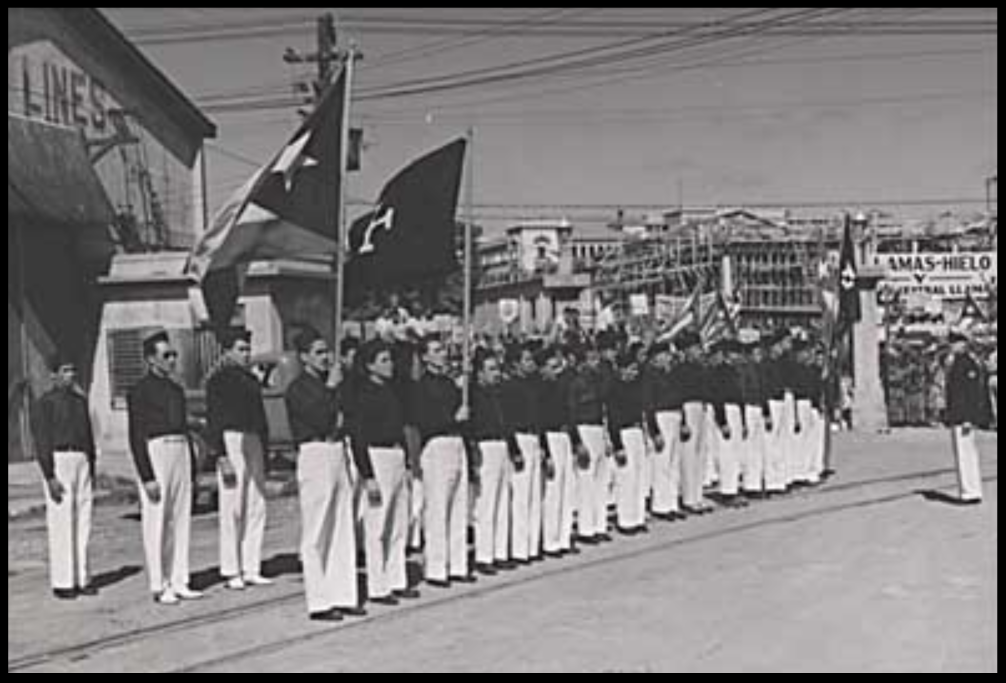
Anderson’s greatest contribution lies in her willingness to seriously engage the racial, class, and ideological complexities that many nationalist scholars either romanticize or ignore. She correctly identifies Albizu’s lived experiences with racialization—particularly through his U.S. military service and encounters with American white supremacy—as central to understanding his anti-imperial politics.
In this sense, Anderson places Albizu within broader global anticolonial struggles and acknowledges his genuine condemnation of U.S. racism and colonial domination. This framing allows her to position Albizu as more than simply a reactionary nationalist; he emerges instead as a figure who, at least rhetorically, understood the colonial entanglements of race and empire.
However, Anderson’s analysis is equally significant for exposing the profound limitations and internal contradictions of Albizu’s worldview. She highlights how his anti-Americanism often reinforced idealized visions of Hispanic civilization, Spanish Catholic social order, and racial harmony myths that obscured Puerto Rico’s own entrenched inequalities- which, as Franqui-Rivera (2018) argues didn’t seat well among the Puerto Rican masses for they knew that romanticized past had not been kind to them.
Albizu’s rhetoric, while condemning Anglo-American racism, frequently romanticized Spanish colonial structures and promoted a conservative, patriarchal, and bourgeois-centered vision of national liberation. Anderson correctly underscores that Albizu’s views often failed to address internal systems of racial hierarchy and class inequality, even as it challenged external imperial domination.
Particularly important is Anderson’s recognition that Albizu’s movement was not socially revolutionary in any fully emancipatory sense. His support for organized labor and anti-capitalist rhetoric did not translate into coherent socialist transformation, but rather into a paternalistic political project centered on petty bourgeois leadership, conservative Catholic morality, and “traditional” social structures. His opposition to birth control, promotion of rigid gender roles, and defense of Christian social order place him firmly within socially regressive currents, even as his anti-imperialism appealed to marginalized sectors.
Where Anderson fits within the historiographical debate is as a partial corrective to both nationalist sanctification and purely reactionary dismissal. She neither wholly demonizes Albizu nor absolves him. Instead, she presents him as a politically hybrid figure: radical in his anti-colonial resistance yet regressive in many of his social, racial, and ideological commitments.
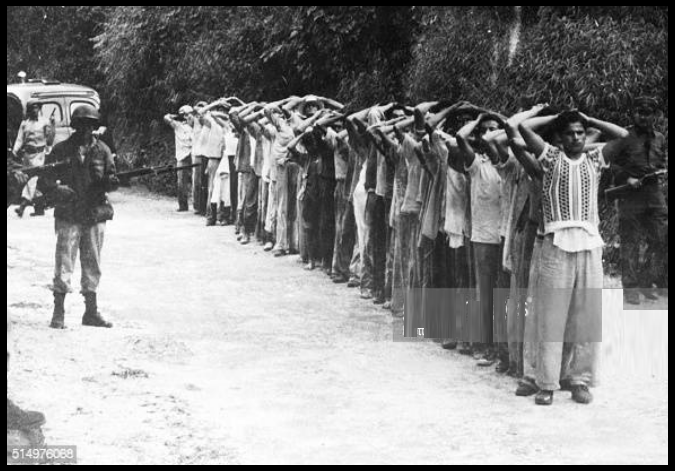
By stark contrast, Nelson Denis’s War Against All Puerto Ricans stands as perhaps the clearest modern example of nationalist mythmaking masquerading as serious history. While politically charged, emotionally compelling, and effective in drawing attention to real episodes of U.S. colonial repression, FBI surveillance, and state violence, Denis’s work is profoundly compromised by its overwhelming ideological bias, selective evidence, exaggerated claims, and near-complete abandonment of historical nuance- and worse yet- a distortion of the record intended to fit decontextualized narratives.
Rather than offering critical scholarship, Denis constructs a hyperbolic, messianic, and frequently historically dubious narrative in which Pedro Albizu Campos is transformed into a near-superhuman anticolonial redeemer—an infallible prophet heroically battling an omnipotent empire.
Denis’s portrayal relies heavily on hagiography, political romanticism, and symbolic nationalism, consistently inflating Albizu’s intellectual brilliance, strategic coherence, military significance, and universal popular support while minimizing or outright ignoring his authoritarian tendencies, fascist sympathies, ideological contradictions, internal party failures, and political extremism. Complex historical realities are routinely subordinated to a simplistic moral binary of pure nationalist virtue versus colonial evil. In doing so, Denis often reproduces nationalist folklore rather than interrogating it.
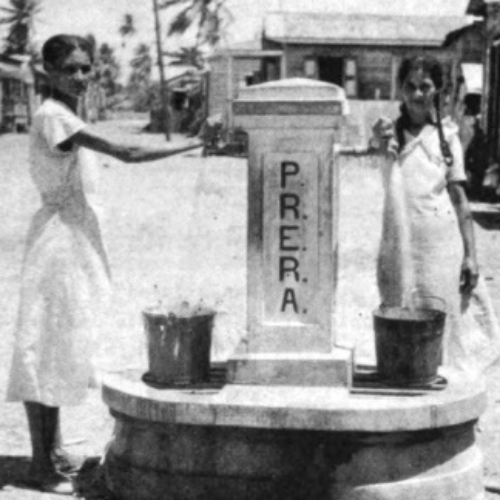
His methodological weaknesses are significant: selective sourcing, insufficient critical engagement with contradictory archival evidence, dramatized narrative choices, and an overt political agenda that privileges emotional resonance over documentary rigor and evidence. Albizu becomes less a historical figure and more a secular saint, while the Nationalist movement is sanitized into an almost exclusively heroic liberation struggle, stripped of its reactionary, exclusionary, and authoritarian dimensions.
Though Denis succeeds in popularizing awareness of colonial repression, his work should be approached far more as political mythology, nationalist scripture, or activist fictional narrative than as reliable historiography. Its greatest fault lies not in exposing imperial violence, but in replacing one distorted historical narrative with another—substituting critical complexity for heroic fiction- and committing the cardinal crime of tampering and misrepresenting the evidence. Ultimately, War Against All Puerto Ricans does not serve as history but as ideological canon, where symbolic redemption consistently overrides factual precision and reality.
Economic historians such as James Dietz further undermine the image of Albizu as a visionary national leader by exposing the absence of any substantive independent economic program. Albizu offered little concrete economic planning beyond variations of existing reformist frameworks like Plan Chardón or proposals later associated more effectively with Luis Muñoz Marín. His strength was rhetorical nationalism, not economic governance.
This gap is critical, as genuine liberation movements require not only symbolic resistance but practical state-building strategies—something Albizu largely lacked. This absence exposes one of the major weaknesses of nationalist historiography: its tendency to prioritize symbolic resistance over practical governance. Albizu’s movement excelled in rhetoric, sacrifice, and political theater, but remained economically underdeveloped.
César Ayala and Rafael Bernabe, (Puerto Rico in the American Century) though invaluable for broader structural analysis of Puerto Rican colonialism, often move too quickly past Albizu’s troubling fascist sympathies. Their tendency to mitigate these tendencies by noting that Albizu also received praise from Soviet or Cuban socialist sectors offers little real defense. Fascist leaders throughout history have often found opportunistic allies across ideological boundaries; external support does not erase or excuse authoritarian inclinations.
Albizu’s own rhetoric, political organization, cult of personality, and admiration for certain nationalist strongman models deserve more direct confrontation than they sometimes receive. Their efforts to contextualize his ideology within broader anticolonial frameworks can at times soften the seriousness of his reactionary tendencies.
Pointing to occasional support from socialist or anti-imperialist sectors does little to negate the deeply conservative, militarized, and strongman elements embedded in Albizu’s own rhetoric and organizational style.
Margaret Power’s Solidarity Across the Americas: The Puerto Rican Nationalist Party and Anti-imperialism provides a scholarly intervention that highlight the anti-colonial, transnational, and gendered dimensions of Puerto Rican nationalism, particularly by emphasizing international solidarity, women’s participation, and anti-imperialist networks often overlooked in more traditional political histories. Her work offers a valuable corrective to simplistic portrayals of nationalism as inherently xenophobic or purely exclusionary, repositioning aspects of the Nationalist movement within broader hemispheric struggles for liberation.
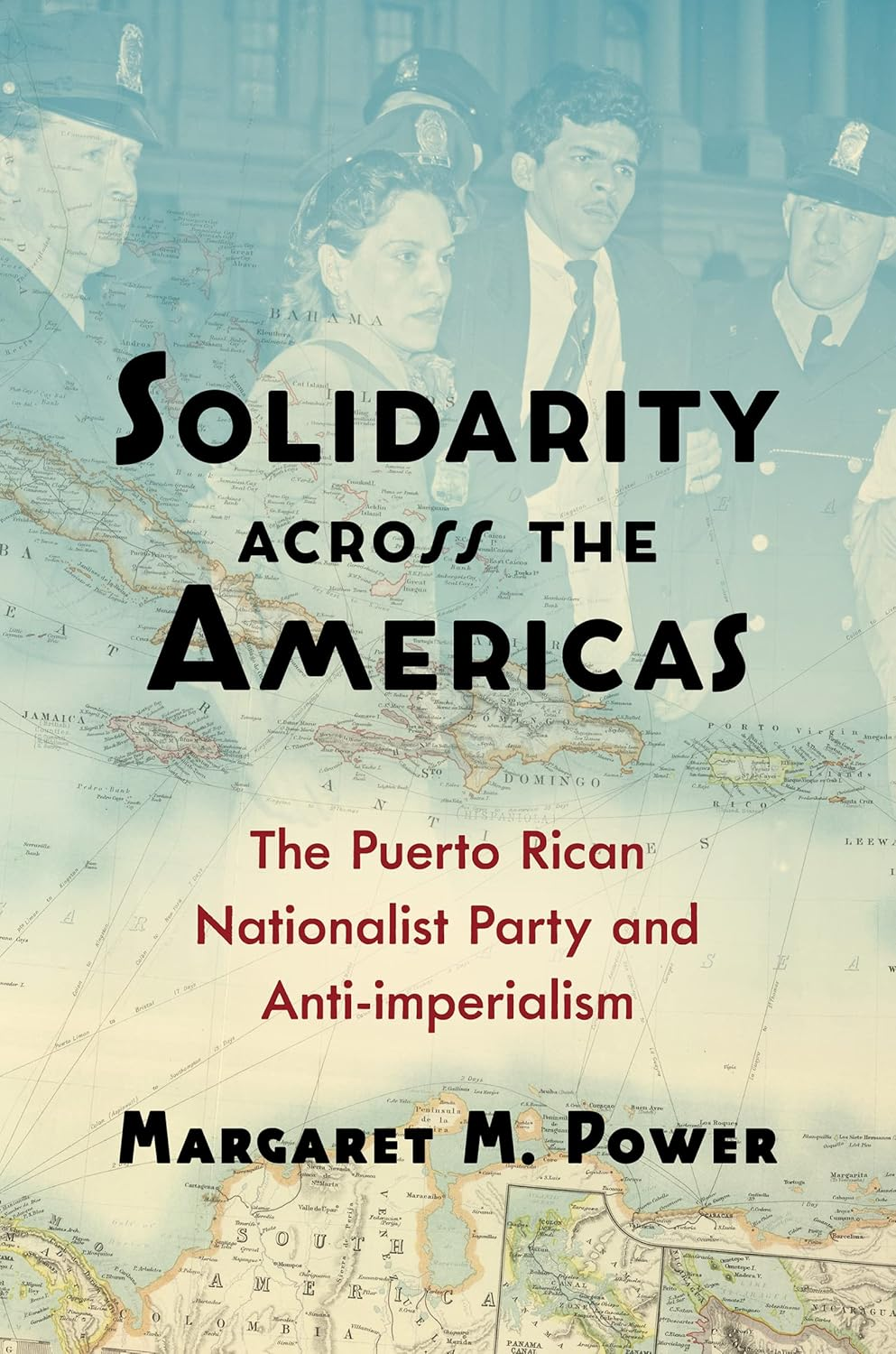
However, Power’s scholarship begins from a distinctly ideologically sympathetic premise: namely, that Albizu’s nationalism was fundamentally liberatory rather than deeply compromised by reactionary political tendencies. This framing, while intellectually significant, can at times obscure rather than critically interrogate the substantial body of evidence pointing to Albizu’s authoritarianism, racial essentialism, patriarchal conservatism, exclusionary rhetoric, and broader alignment with hierarchical and ultraconservative political currents.
By over-focusing on anti-imperial solidarity, Power occasionally risks minimizing or softening the darker ideological features embedded within Albizu’s worldview—particularly his conservative social thought, messianic leadership style, patriarchal structures, and flirtations with fascist-adjacent political models. While her work is valuable in expanding the conversation beyond reductive colonial narratives, its interpretive lens can sometimes function more as ideological rehabilitation than full critical assessment. Power’s contributions are significant, but her framework must be approached with caution. In seeking to rescue Puerto Rican nationalism from charges of xenophobia or reactionary politics, her scholarship can understate the deeply troubling authoritarian and exclusionary dimensions that serious archival evidence increasingly associates with Albizu Campos and his political movement.
This pattern becomes even more pronounced in works by Pedro Aponte, Ivonne Acosta (La Mordaza: Puerto Rico, 1948-1957, (1987), and Miñi Seijo Bruno, (La insurrección nacionalista en Puerto Rico, 1950, (1989) whose contributions often function more as nationalist memory preservation than rigorous critical historiography. Aponte frequently reinforces heroic nationalist narratives while underexamining Albizu’s ideological extremism. Acosta’s work on repression and the Gag Law is invaluable for documenting colonial state violence, yet often implicitly treats repression itself as sufficient validation of nationalist politics. Seijo Bruno similarly contribute important documentation of nationalist activism and Puerto Rican political memory, but often frame nationalism in commemorative, morally simplified terms that insufficiently interrogate fascist aesthetics, cult-like structures, or exclusionary political impulses.
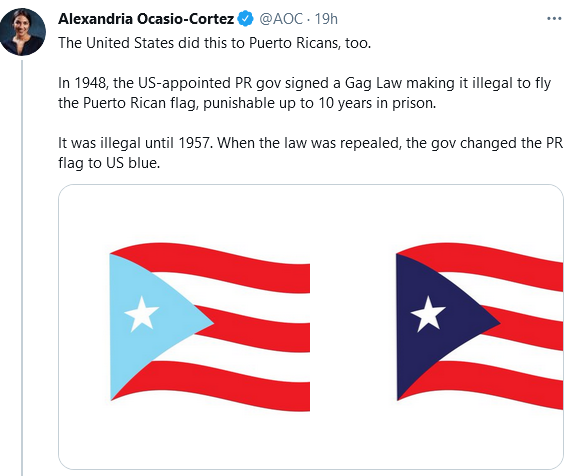
The Gag Law itself remains a central point of historiographical tension. There is no serious dispute that Law 53 represented a profound assault on civil liberties and democratic expression under U.S. colonial rule in Puerto Rico. However, a significant body of nationalist-oriented scholarship has tended to use the law primarily as a moral instrument to sanctify Pedro Albizu Campos and the Nationalists, rather than as an object of critical historical analysis situated within the broader political context of the period—including nationalist militancy, fears of insurrection, Cold War repression, and the strategic calculations of the colonial state.
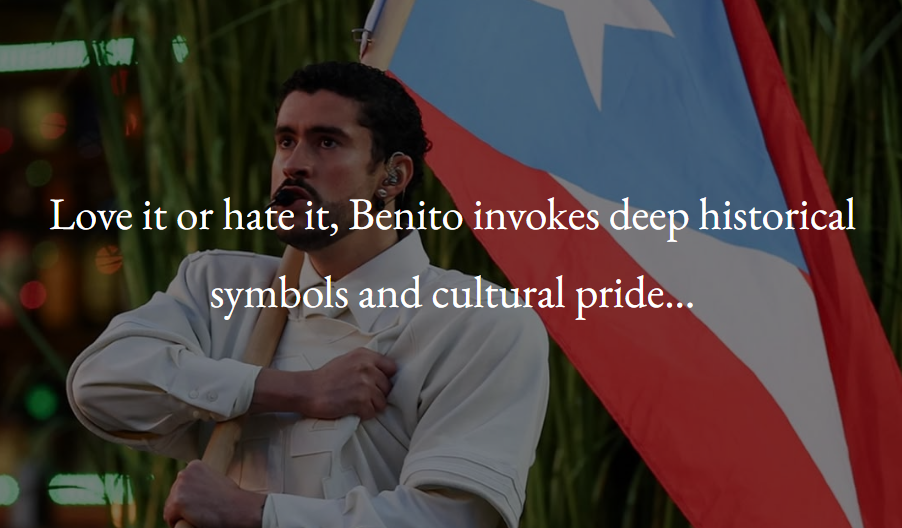
In doing so, much of this scholarship has also failed to adequately interrogate persistent and demonstrably false claims—such as the widespread myth that the law imposed ten-year prison sentences simply for owning or displaying the Puerto Rican flag or for singing or whistling the national anthem. These distortions, repeated across activist and academic spaces alike and by elected officials such as congress woman Alexandra Ocasio Cortez, and even influential artists like Bad Bunny, have become part of a larger commemorative narrative in which repression is not only documented but rhetorically amplified to reinforce a sanctified image of Albizu and the Nationalist movement precisely because of the ongoing struggle over Puerto Rico’s historical memory itself. At stake is not merely how Albizu is remembered, but how Puerto Ricans interpret resistance, nationalism, colonial trauma, and political legitimacy.

More fundamentally, scholars who refuse to critically engage Albizu’s ideological contradictions, authoritarian tendencies, and constructed mythologies often do so because Albizu functions less as a historical subject than as a symbolic vessel for anticolonial identity. In this framework, he is not analyzed so much as affirmed.
This intellectual posture has, in effect, made segments of the academic and activist community complicit in the reproduction and preservation of nationalist mythology, selectively privileging narratives that sustain Albizu’s heroic image while sidelining or rationalizing evidence that complicates it.
Colonial repression was real, severe, and historically documented—but opposition to repression alone does not automatically confer democratic legitimacy on those who opposed it. Nor does it justify the uncritical adoption of political myths, some of which were actively constructed, exaggerated, or strategically circulated by Albizu himself and his devoted followers, and later reinforced by sympathetic historiographical traditions.
The weight of archival evidence, serious scholarship, and Albizu’s own speeches and actions increasingly points to a figure who was not simply neither the flawless liberator of nationalist mythology nor merely a colonial caricature of extremism. He was a politically significant, charismatic anticolonial leader, but also an ultraconservative, authoritarian nationalist with fascist sympathies, delusions of grandeur and a profound messianic self-conception. His political style often resembled that of charismatic authoritarian populists more than democratic revolutionaries. It is not a stretch to conclude that in Albizu’s mind le nation c’est moi.
The persistence of Albizu’s saint-like public image despite mounting scholarly complexity mirrors broader global patterns in political memory, where charismatic figures become symbols that transcend documentary scrutiny. Hence, public memory remains stubbornly resistant to his complexity.
Albizu persists in popular imagination as an almost sacred figure, particularly within sectors of Puerto Rican nationalism, much in the same way modern political cults can transform deeply flawed leaders into symbols of salvation. Like the MAGA movement’s perception of Donald Trump, Albizu’s followers and admirers often interpret criticism as heresy, historical revision and correction as betrayal, and myth as truth. Emotional identification overrides documentary evidence. Much like modern populist cults of personality, Albizu’s mythology often depends on emotional identification, symbolic grievance, and selective historical memory rather than balanced analysis.
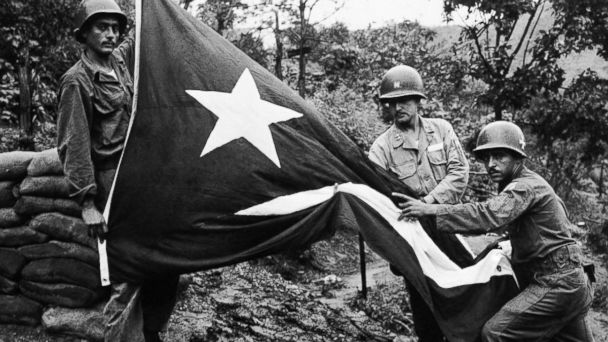
Puerto Rican soldiers retrieve a PR flag riddled with bullet holes in Korea, 1952
This enduring myth reveals as much about Puerto Rico’s unresolved colonial condition and trauma as it does about Albizu himself. Albizu thus, more than a historical figure—he has become an ideological vessel for national trauma, dignity, and resistance. In a colonized society, symbols of resistance can become so powerful that they transcend factual scrutiny.
But historical maturity demands confronting uncomfortable truths: anti-colonialism alone does not equal democracy, nationalism does not inherently mean liberation, and resistance to empire can coexist with deeply reactionary politics. Intellectual and emotional maturity requires disentangling liberation symbolism from political reality. Serious scholarship increasingly demonstrates that anti-colonialism, while morally significant, does not inherently equate to democratic pluralism or progressive idea, nor does resistance to empire absolve authoritarianism.
Albizu Campos remains historically important, but historical importance should not be confused with political sainthood. The story of Albizu Campos is not the history of Puerto Rico- he is just part of it. The cumulative evidence points toward a far more unsettling conclusion: Albizu was a complex, deeply flawed leader whose legacy must be understood not only through the lens of colonial oppression, but also through the dangerous authoritarian impulses embedded within his own vision of Puerto Rican nationalism. Only by confronting both dimensions can Puerto Rican historiography move beyond myth and toward genuine historical clarity. And that would be a great step in the long road to decolonizing our minds and our people.
Continue reading: Race and the Myth Surrounding the Military Service of Pedro Albizu Campos


[…] Continue Reading: The Deification of Pedro Albizu Campos in Public Memory, Nationalist Discourse and Historiography […]
LikeLike
[…] myth. For many of his followers, he was transformed into something approaching a messianic figure—a martyr who had suffered for the nation, endured imprisonment, illness and persecution, and never s…of Puerto Rican […]
LikeLike