Secretary of Defense Pete Hegseth’s brand of Christian nationalism—and his dangerous self-conception as someone doing God’s work, even accelerating the “end of times”—has no place in our society. It has no place in our government. And it absolutely has no place in the U.S. Armed Forces.
From leading public prayers in official settings and coercing military and civilians leaders into attending to invoking God’s blessing over wars of choice, to wrapping militarism in a language of divine mission—this is not faith, but the weaponization of faith. And when he casually throws around terms like “Pharisees” to describe critics of himself or Donald Trump, it crosses from ignorance into something far more troubling and dangerous.
That language is not just sloppy—it distorts scripture and veers into rhetoric with antisemitic undertones. More than that, it elevates Trump into a messianic figure- the second coming of Christ. Whether intentional or not, the implication is clear: to oppose Trump is to oppose God. That is not Christianity. That is political idolatry- and a sin against God in the Christian faith.
But that is something that Trump’s MAGA followers have being doing for years- and just recently Trump himself reposted an image depicting him as Christ. The image, however, had been going around among his followers since at least February.
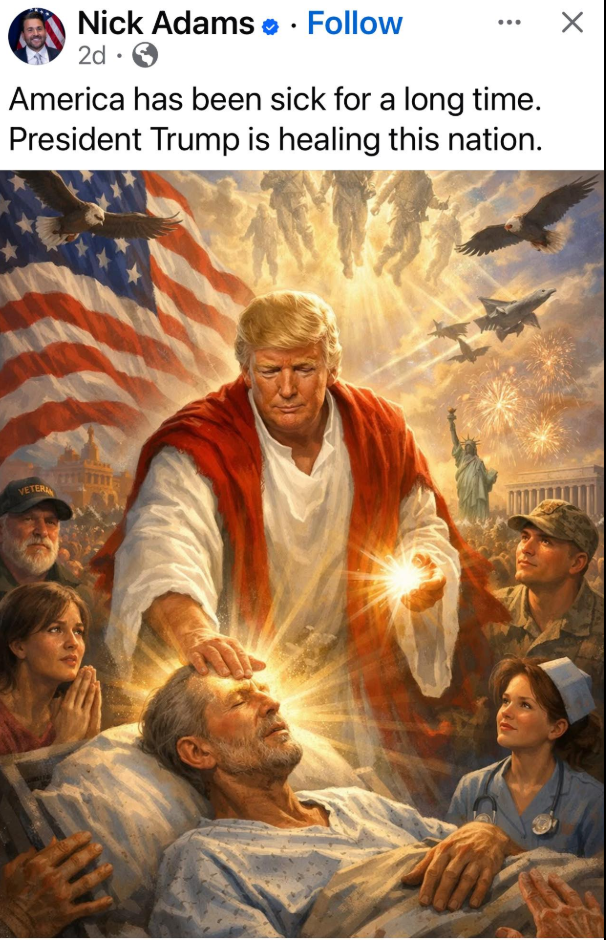
Nick Adams, the Australian-American MAGA commentator currently serving as the Special Presidential Envoy for American Tourism, Exceptionalism, and Values- posted this image on February 4, 2026 (Facebook)
Any serious Christian tradition should reject all of this outright.
But what we’re seeing instead is a strain of American evangelicalism that has so entangled itself with power that it can no longer distinguish faith from political loyalty.
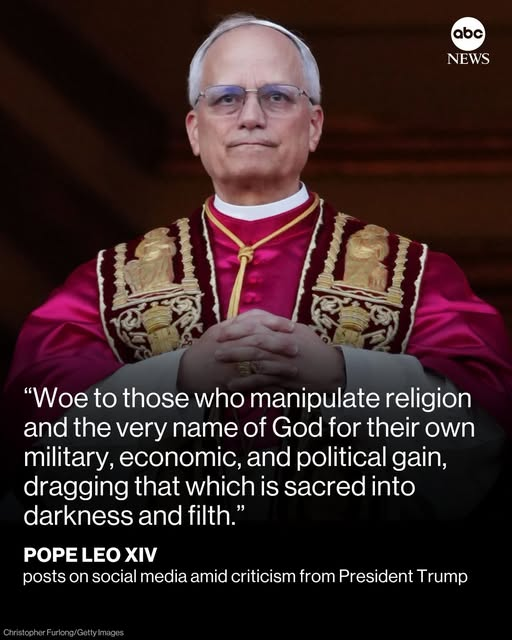
The recent spectacle of media figures like Sean Hannity publicly breaking with long-standing religious affiliations (his Catholic faith), over political disagreements only reinforces the point: for many, religion has become instrumental—useful when it aligns with power, disposable when it doesn’t. It also shows they never were people of faith.
And then came the April 15 Pentagon cultist worship service in which Hegseth took almost directly from the film Pulp Fiction. “This prayer was recited by Sandy One, which is one of the Sandies, to all Sandies, all those A-10 crews prior to all CSAR missions, but especially this CSAR mission that happened in real time,” Hegseth said. “They call it CSAR 25:17, which I think is meant to reflect Ezekiel 25:17.”
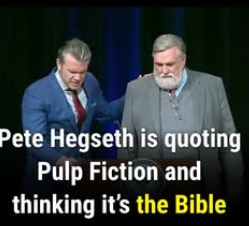
Hegseth now claims that he didn’t say or imply it was a bible verse and that he just read the A-10s’ crew members’ pray. Not only is he throwing them under the bus (no surprise her) but he is also letting us know that these crewmembers follow a perversion of Bible verses- one in which God is giving them impunity and a self-righteous mandate to kill without mercy.
Congress confirmed Hegseth to lead the Department of Defense. Sit with that for a second: a Secretary of Defense who frames dissent as impiety (while fomenting racial, gender, and political dissent among the troops). In a democracy, that is a dangerous line to cross.

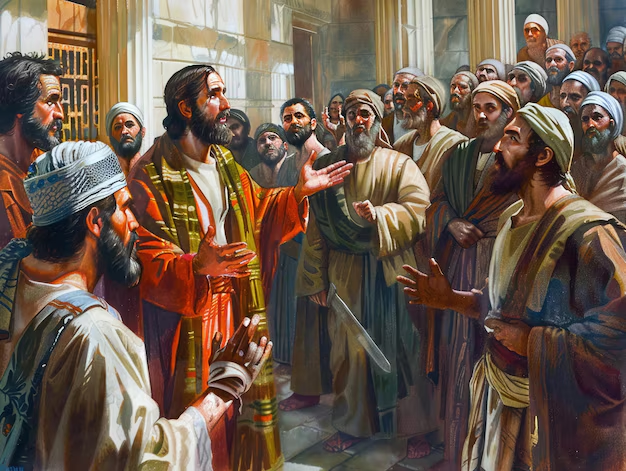
What’s even more striking is the total lack of self-awareness. Because if you actually read Christ’s rebukes of the Pharisees in the Gospel of Matthew—especially chapter 23—you don’t get a defense of power. You get a warning against exactly this kind of behavior.
Christ’s critique was not of Judaism—it was of hypocrisy, arrogance, and the corruption of religious authority. And ironically, those critiques map far more cleanly onto figures like Trump, Hegseth, and the circle that surrounds them than onto the critics they dismiss.
Take the first and most obvious:
Hypocrisy.
“They do not practice what they preach” (Matthew 23:3).
The gap between proclaimed righteousness and actual conduct—marked by bullying, dishonesty, and a glorification of violence—is not incidental. It’s defining.
Moral distortion.
“You strain out a gnat but swallow a camel” (Matthew 23:24).
Obsessing over symbolic or bureaucratic infractions while ignoring justice, mercy, and human dignity. You see it in policies that punish the vulnerable—immigrants over paperwork errors, veterans neglected, the poor dismissed—while claiming moral high ground.
Performative religion.
“Everything they do is done for people to see” (Matthew 23:5).
Public displays of piety—prayers, symbolism, religious language—used not as acts of devotion but as political theater. Faith becomes branding.
Outward purity, inward corruption.
“You clean the outside of the cup… but inside they are full of greed and self-indulgence” (Matthew 23:25).
The image is almost too fitting: a veneer of righteousness masking ambition, grievance, and the pursuit of power.
Spiritual pride.
“They love the place of honor…” (Matthew 23:6).
Humility—central to Christian teaching—is recast as weakness. Power, dominance, and notoriety are elevated instead.
Selective morality.
Rules and scripture are applied when convenient, ignored when not. The same voices that invoke Christianity to justify exclusion or aggression will dismiss core teachings—care for the poor, the stranger, the sick—when those become politically inconvenient (see also Gospel of Matthew, Matthew 25).
This is the core contradiction: the very people invoking the Pharisees as an insult are reenacting the behavior Christ condemned.
Hegseth, like many in this movement, projects righteousness while sidestepping the most basic Christian premise: that all are fallen, all are sinners, and that repentance is not a performance. Christ explicitly warns against public displays meant to signal virtue rather than embody it (see Gospel of Matthew, Matthew 6).
When faith becomes spectacle, it ceases to be faith.
And here’s the uncomfortable truth: Trump and Hegseth are not anomalies. They are symptoms. Symptoms of a broader crisis in which segments of American Christianity have been captured—repurposed into a vehicle for power, grievance, and cultural dominance.
No institution damages itself more effectively than from within. And right now, the loudest voices claiming to defend Christianity are doing more to hollow it out than any external critic ever could.
If you’re part of a Chrisitan community that resists this—good. But you are increasingly the exception, not the rule. And the longer people look the other way, make excuses, or minimize the danger, the harder it will be to reclaim the line between faith and idolatry.
At some point, that line has to be drawn clearly.
Forget MAGA and let’s Make Christianity Christian Again.


[…] Continue reading: Hijacking Christianity: From the “Bible of Pulp Fiction” to “Pharisees”- it is a Cult. – i… […]
LikeLike