I grew up believing that when the United States took over Puerto Rico, it confiscated most of the people’s wealth by giving Puerto Ricans 25 cents per each peso they had and that this somehow explained why we called the U.S. 25 cents coin- “peseta”. Popular wisdom, a few of my teachers, and at least one history professor at the UPR, Mayagüez told me so. So, like most Puerto Ricans- I was being indoctrinated into our common national mythology of outmost oppression, dispossession, displacement and disenfranchisement. But then, there is reality.
When the United States seized Puerto Rico, it immediately started to shape its new colony in accordance with American standards. And One of the many things changed was the local ocurrency.
But unlike popular claims part of Puerto Rican mythology- Puerto Rico did not lose 40% of its wealth overnight due to the currency exchange rate and conversion established by the American administration. An exchange rate is a price between currencies. Wealth is the value of assets minus liabilities. Changing the monetary unit does not destroy the assets.
This is what is found in the actual report by the Government of United States.
“Section 2 of the act of Congress approved April 12, 1900, contained provisions authorizing the Secretary of the Treasury to redeem the Porto Rican coins in circulation and to substitute therefor the coins of the United States at the previously authorized rate of exchange (60 United States currency for 100 Porto Rican currency, Executive Order of January 20,1899). The act limited the exchange to Porto Rican silver and copper coins in circulation on February 1, 1900.”
The report continues:
“The Porto Rican peso has a relative value to the United States silver dollar of 93.5 to 100.

As the bullion value of the American dollar in 1900 was about 46.5 cents in gold, the Porto Rican is worth only about 43.5 cents gold.
The United States paid for these coins in gold sixty one-hundredths of their face value.
So the Government paid for the Porto Rican money nearly $903,000 more than it was worth as bullion, and also met the cost of the exchange, which for salaries, etc., had reached $12,409 in August, 1900.
It therefore appears that it has already cost the United States about 915,000 to substitute our own for the local coinage in Puerto Rico, and when the whole operation is completed the cost will probably reach $1,000,000.”
Reports of the War Department. 1900. Civil affairs in Porto Rico. Oct. 18,1898 – April 30,1900 56th Congress, 2nd Session 1900-1901. Annual Reports of the War Department for the Fiscal Year Ended June 30, 1900. Part. 13. Report of the Military Governor of Porto Rico on Civil Affairs. (1902) (San Juan, P.R.: Reprint by Academia Puertorriqueña de la Historia, Ediciones Puerto, 2003), 171, 173.
The report main points are:
- U.S. silver dollar bullion value: about 46.5¢ gold
- Puerto Rican peso bullion value: about 43.5¢ gold
- U.S. government redemption price: 60¢ U.S. currency
The U.S. government effectively monetized the existing Puerto Rican silver currency at a premium over its bullion value. Suppose 100 pesos contained: $43.50 in silver, but Washington exchanged them for: $60 in U.S. currency. That’s a $16.50 premium, or about 38% above bullion value.
So, to the claim that the “the United States converted Puerto Rico’s currency at 60 cents and therefore confiscated 40 percent of its value (or wealth)” just don’t hold water. One should ask: Value according to what measure? If “value” means the nominal face value of the peso, yes, the legal conversion was 60 cents. If “value” means silver content, the United States paid more, not less. If “value” means purchasing power in Puerto Rico, you must establish the peso’s actual exchange/purchasing value immediately before the reform. And if “value” means a person’s wealth, you must examine assets, debts, wages, prices and contracts rather than the coin itself.
Here is how it has been interpreted by economic historians.
“The U.S. first confronted the problem of silver currencies in a Third World Country when it seized control of Puerto Rico from Spain in 1898 and occupied it as permanent colony. Fortunately for the imperialists Puerto Rico was ripe for currency manipulation…
[“Third World Country” is an anachronism for the concept of a Third World did not exist until the post-WWII era when the non-aligned movement emerged in response the bipolarized world of the Cold War Era]
Only three years earlier, in 1895, Spain had destroyed the full-bodied Mexican silver currency that its colony had previously enjoyed and replaced it with a silver “dollar,” worth only 41 cents in U.S. currency. The Spanish government had pocketed the large seigniorage profits from the debasement…
[The difference between the face value of the coins and the cost of acquiring the metal and minting them generated a financial benefit for the State treasury, is known as seigniorage.]
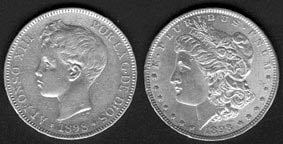
The U.S. was therefore easily able to substitute its own debased silver dollar, worth only 45.6 cents in gold.
Thus the U.S. silver currency replaced an even more debased one and the Puerto Ricans had no tradition of loyalty to a currency recently imposed by the Spaniards.
There was therefore little or no opposition in Puerto Rico to the U.S. monetary takeover…
The major controversial question was the exchange rate the American authorities would fix between the two debased coins, the old Puerto Rican peso and the U.S. silver dollar…
The heavy debtors in Puerto Rico- mainly sugar planters- naturally wanted to pay their peso obligations as cheap a rate as possible; they lobbied for a peso worth 50 cents American. In contrast the Puerto Rican bankers-creditors wanted the rate fixed at 75 cents. Since the exchange rate was arbitrary anyway, [Economist, Jacob] Hollander and the other American officials decided in the time-honored way of governments; more or less splitting the difference, and fixing a peso equal to 60 cents.” Murray N. Rothbard, History of Money and Banking in the United States: The Colonial Era to World War II, 220-21.
The most important distinction is between currency conversion and wealth destruction. When the United States established the exchange rate at 60 cents per Puerto Rican peso, it did not decree that every house, farm, business, crop, savings account, wage, or other asset in Puerto Rico had suddenly lost 40 percent of its economic value. It established the rate at which the existing monetary unit would be converted into the new U.S. currency.
Consider a Puerto Rican coffee farmer or hacendado who owned a property worth 10,000 pesos and owed a mortgage of 5,000 pesos. At the new conversion rate, his property would be expressed as $6,000 and his debt as $3,000. His net position would therefore be $3,000. The fact that the numbers changed from pesos to dollars does not, by itself, demonstrate that 40 percent of his wealth had disappeared. To establish an actual loss of wealth, we would have to demonstrate what happened to the dollar value of his property, his debt, his income, and the prices of the goods he purchased.
This is important because the Puerto Rican peso was not a gold dollar masquerading as a peso. It was a recently introduced silver-based currency whose economic value had already diverged substantially from its nominal face value.
The U.S. government’s own 1900 report stated that the Puerto Rican peso had a relative value of 93.5 to 100 compared with the U.S. silver dollar, while its silver content was worth only about 43.5 cents in gold. The United States nevertheless redeemed the peso at 60 cents—considerably above its bullion value.
The government itself calculated that- based on this rate- it paid nearly $903,000 more for the Puerto Rican coins than their bullion value.
The 60-cent rate therefore represented a 40-percent reduction from the peso’s nominal face value, but it did not represent a 40-percent destruction of the wealth represented by the coin. Indeed, compared with the peso’s metallic value, the U.S. government was paying a substantial premium.
There was nevertheless a genuine economic struggle over the exchange rate. The important question was not simply “How much was the peso worth?” It was also- who would gain or lose when peso-denominated contracts were translated into dollars.
DEBTORS (mostly the Puerto Rican criollos) generally had an interest in a lower conversion rate, while CREDITORS had an interest in a higher one. A 10,000-peso debt, for example, became $5,000 at a 50-cent rate, $6,000 at 60 cents, and $7,500 at 75 cents. The lower the rate, the fewer dollars the debtor needed to extinguish the same nominal peso obligation. The creditor, of course, experienced the opposite result.
That is why the hacendados and farmers “lobbied for a peso worth 50 cents American. In contrast the Puerto Rican bankers-creditors wanted the rate fixed at 75 cents.” Rothbard, History of Money and Banking in the United States, 220-221.
That is why the exchange-rate controversy should be understood partly as a struggle over the distribution of wealth between debtors and creditors— (and one that benefitted the indebted farmers and hacendados) not as the disappearance of 40 percent of Puerto Rican wealth overnight.
Bottom line: Puerto Ricans’ did not lose 40% of its wealth overnight. Nor did Puerto Rico lose control over monetary policies- for it never had it to begin with.


Not a single ounce of critical thought from this poser. I have read multiple post by Mr. Franqui-
Rivera and not once has he taken a critical stance that accurately utilizes critical thinking. Best way to describe his post are PROPAGANDA!
LikeLike
And here you are trolling. You start by stating that I’m a poser. Yeah, I guess that being a professional historian, professor of history, published author in peer-reviewed journals and presses (meaning my arguments and evidence are validated by experts- just like scientists do) makes me a poser.
But then again, it is interesting that you mention critical thought- yet you show your inability to engage in critical thinking. On the contrary- you do exactly what you accused me of. You engage in ad hominem attacks; provide no evidence (for crying out loud) and call my posts propaganda when it is you the one talking with no evidence to back your seriously stupid personal attacks. That, son, is the definition of propaganda.
Here you have a logical argument backed by professionally cited EVIDENCE and you call it propaganda because it goes against the myths you choose to believe, the myths that make your life simpler to understand.
Find a historian and an economist who can explain to you the arguments in this post- it is obvious that you don’t understand the difference between argument and opinion; facts and myths; analysis and propaganda.
LikeLike
I understand your point but if everything cost more from one day to another because the “merchants”, hence the economy, didn’t adjust the prices to reflect the real value after the exchange, isn’t the same as losing 40% of their wealth? At the end, was it an automatic inflation or nothing changed?
LikeLike
That is not what I meant. Commodities didn’t become more expensive over night. What I meant is that some merchants took advantage of the people’s ignorance as they have always done. There is no evidence that it was systemic either. The point remains that this “erasing 25 to 40%” of the Puerto Ricans’ wealth is a myth, part of nationalist talking points.
LikeLike