By Harry Franqui-Rivera
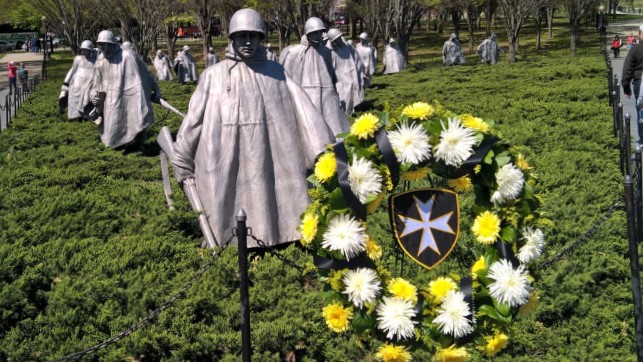
Content
Prologue. The Boys Are Gone, Adios a los muchachos…
Chapter 1. Of Ghosts and Family
Chapter 2. Dishonoring the Motherland
Chapter 3. A Boricua’s Heart
Chapter 4. Miracle at Outpost Kelly
Chapter 5. Far from Home
Chapter 6. Before the Fall
Chapter 7. Jackson Heights
Chapter 8. The Fall
Chapter 9. Camila’s Plea
Chapter 10. Separate and Unequal
Chapter 11. The Way Home
Introductio
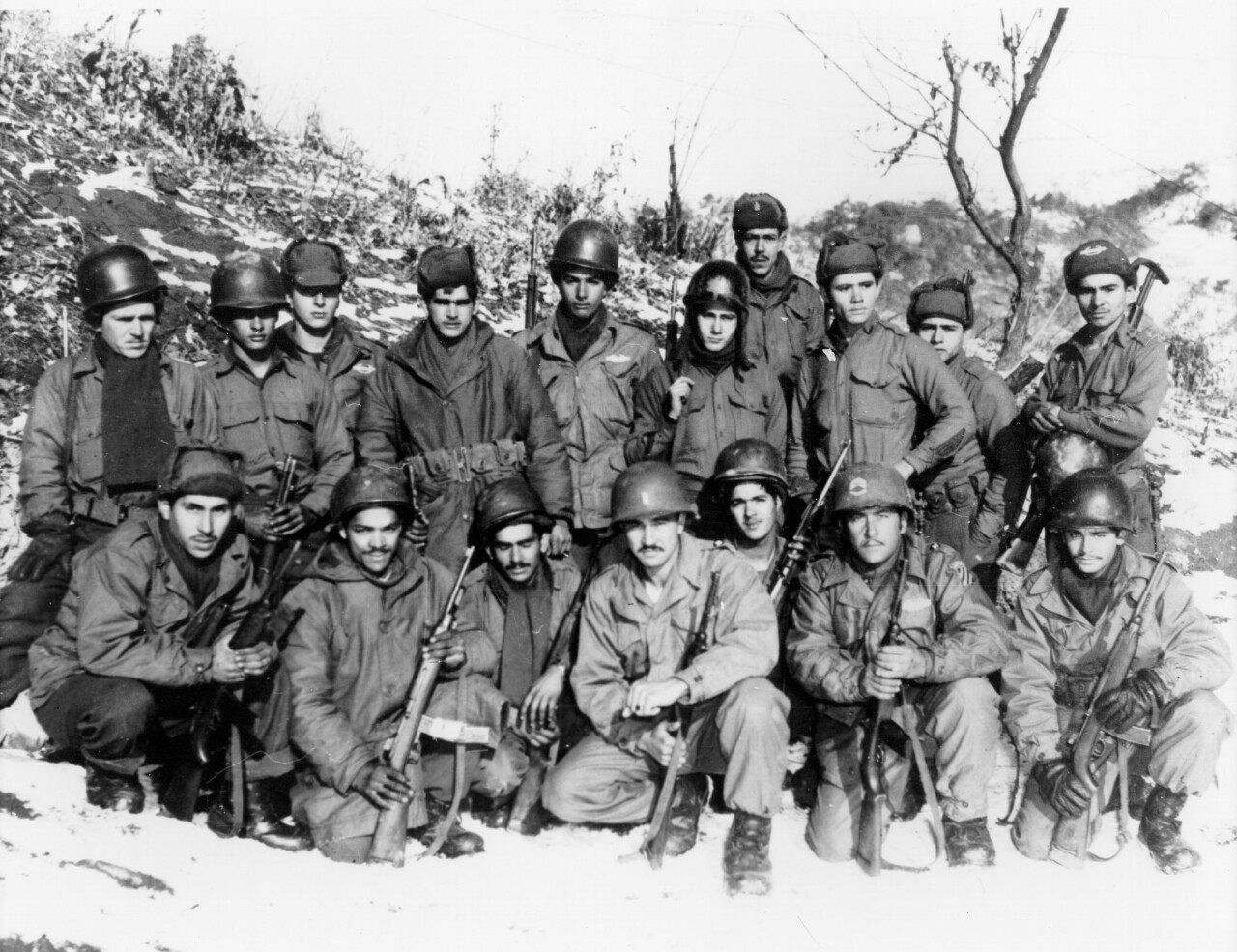
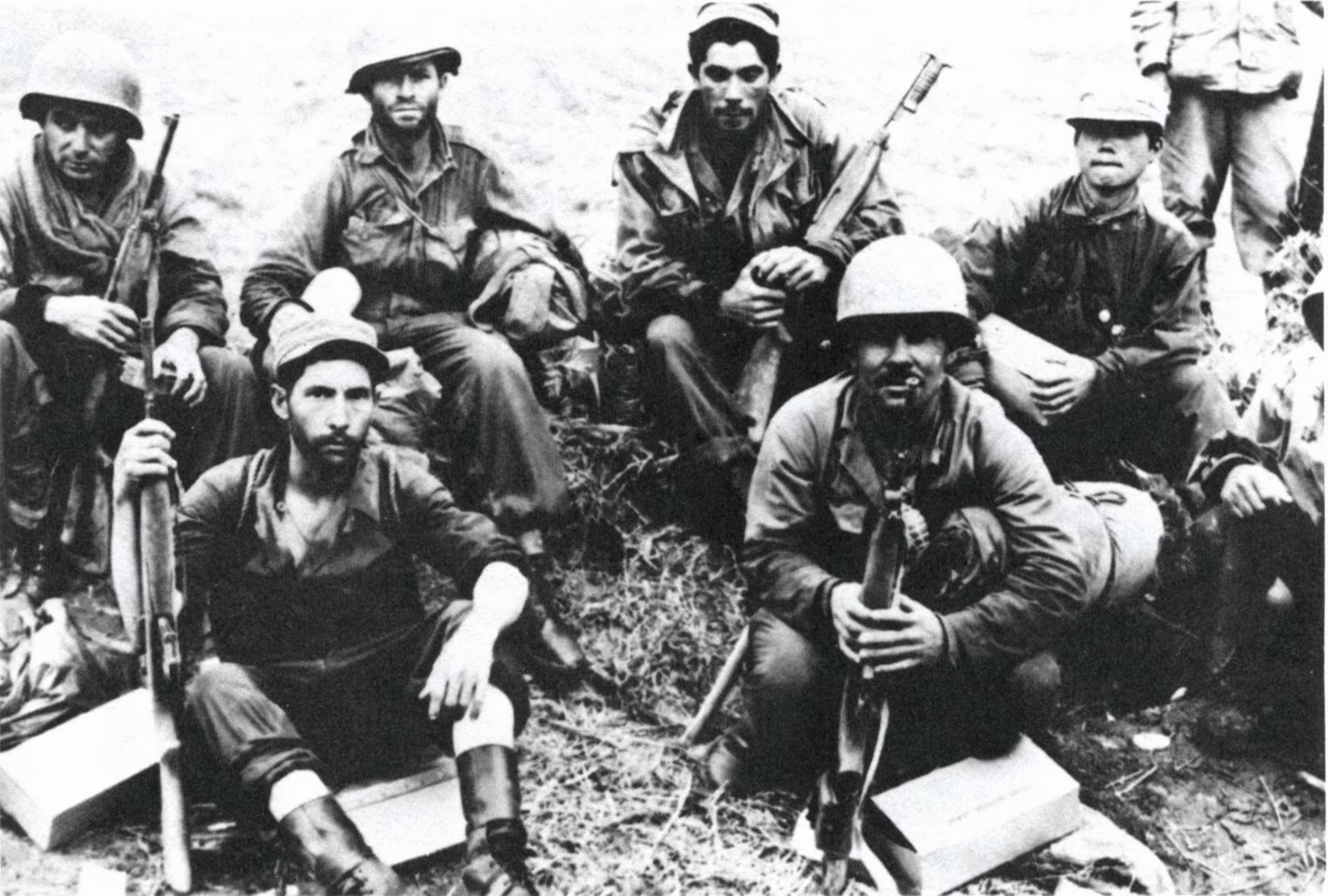
Tens of thousands of Puerto Ricans fought in the Korean War as front-line combat troops — the first time they served in such numbers in direct combat since their incorporation into the United States military.
The vast majority volunteered. Many served in the 65th U.S. Army Infantry Regiment — an all-Puerto Rican unit known as el sesenta y cinco, the Puerto Rican Regiment, and immortalized by the name the world would come to know them by: the Borinqueneers.
In Korea, they confronted the full measure of war. They faced the armies of North Korea and Communist China, the merciless brutality of entrenched combat, and a harsh and unforgiving climate. Yet they also endured another enemy — the distrust and institutional racism of an era whose shadows reached deep into the ranks of the military itself.
Against all odds, los hijos de este país fought with courage, dignity, and valor. They carried their duty with solemn resolve, ever mindful that their conduct reflected not only upon themselves, but upon Puerto Rico and Puerto Ricans as a people.
What follows is a work of historical fiction based on true events— a narrative of their ordeal, their sacrifice, and their enduring spirit during the Korean War.
On August 20, 1940, as a handful of Royal Air Force pilots defended Britain against the might of the Luftwaffe during the Battle of Britain, wartime Prime Minister Winston Churchill declared before Parliament:
“Never in the field of human conflict was so much owed by so many to so few.”
It was true then.
And for the Borinqueneers in Korea and all the Puerto Rican communities— it was truer still.
Prologue: The Boys Are Gone, Adios a los muchachos…
Mario ran jalda arriba as fast as he could — more goat than man, leaping over rocks and loose dirt, lungs burning, heart racing. He was supposed to be in class. That is what his mother wanted. He would be the first in his family to finish high school — not fourth grade or even eighth grade like the enlightened erudite in their barrio in Naranjito — but real high school, all the way to twelfth grade. And perhaps, if God allowed it, he might even attend one of the vocational schools sprawling all over the island.
He knew his mother would not be happy to see him out of school.
But he had a good excuse.
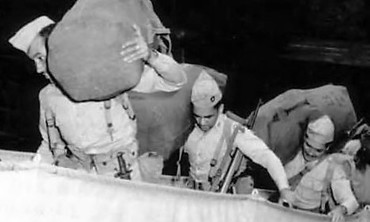
It was October 12, 1950. Puerto Rican newspapers and radio stations announced that the men of the 65th (el sesenta y cinco) were fighting in Korea, and the whole island seemed to erupt in celebration.
Horns. Sirens. Whistles. This time in full celebration.
Professional and amateur musicians played Danile Santos’ “La despedida” on every corner, in every bar and tavern.
Vengo a decirle adiós a los muchachos
Porque pronto me voy para la guerra
Y aunque vaya a pelar en otras tierras
Voy a salvar mi derecho, mi patria y mi fe
Ya yo me despedí de mi adorada
Y le pedí por dios que nunca llore
Que recuerde por siempre mis amores que
Yo ya de ella nunca me olvidare
Solo me parte el alma y me condena
Que deje tan solita a mi mamá
Mi pobre madrecita que está viva
Quien en mi ausencia la recordara
Quien me le hará un favor si necesita
Quien la socorrerá si se enfermara
Quien le hablara de mi si preguntara
Con este hijo querido quizás volverá
Quien me le rezará si ella se muere
Quien pondrá una florera en su sepultura
Quien se condolerá de mi amargura
Si yo vuelvo y no encuentro a mi mamá, si yo vuelvo y no encuentro a mi mamá, si yo vuelvo y no encuentro a mi mamá…
Government officials, politicians, and patriarchs made announcements and delivered patriotic speeches filled with pride, certainty, and the hubris of those who have not known the brutality of war. The day resembled a holiday more than anything else.
The island’s newspapers overflowed with stories and photographs of the 65th and the ceremonies held before their secret departure. One local paper proclaimed:
“As it was yet another symbol of the United Nations, under the American flag flies the flag of the 65th Infantry Regiment; this flag flies today in Korea.”
Yes — the public tone was celebratory. Someone unfamiliar with Puerto Rican and indomitable strength and resilience might have thought the news announced the end of the war, not that the island’s sons, los hijos de este país, had just been sent into combat, into war, into valleys and hills of death.
Mario finally reached his mother’s rustic house. She was returning from the yard carrying a chicken she had just killed, the main ingredient for several meals that week. Blood still dripped from its neck.
“Mamá — the men are gone, the men are gone!”
Camila’s heart sank.
Her husband had left for Michigan almost six months earlier to work in the beet fields. Another man gone trying to do right by his family- no matter the cost. She knew exactly why Mario’s voice trembled with excitement.
“Mamá, they are recruiting men for the war, everyone is going, Paco and Alberto went down to join —I’m going to volunteer!”
Camila did not even let him finish.
“You are only sixteen years old. You are going to finish high school like you promised me and your father. You can join the army when you are done with school.”
“But mamá, the war will be over by then.”
She stared at him — not with anger, but with a weary certainty born of a life that had seen too much hardship.
“There will always be another war, Marito.”
She said it hoping this one would end before she could no longer stop her only son from joining the army.
Mario knew his mother’s word was final. Her authority was absolute, her will immovable. For now, joining the celebrations and giving los muchachos a proper farewell was all he could do.
He would cheer.
He would sing.
He would watch the men march away.
And he would wait.
For his time would come.
Chapter 1. Of Ghosts and Family
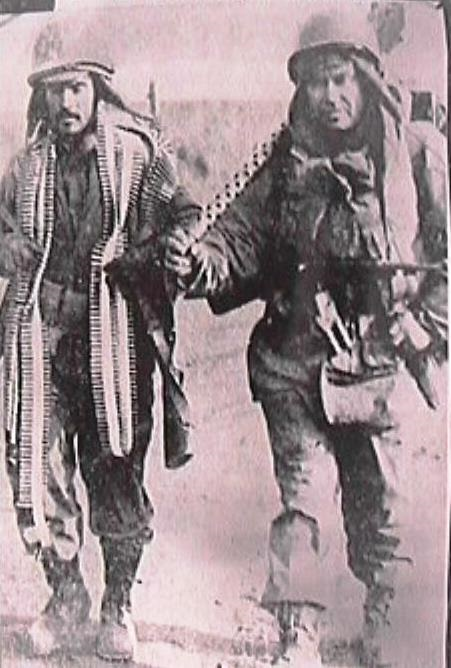
Sergeant Camacho sat in the back of an Army two-and-a-half-ton truck — the deuce and a half — part of a convoy grinding its way north. Army engineers had done their best to flatten the Korean landscape and carve roads out of the stubborn earth.
Their best was not good enough.
The ride was violent, bone-shaking. The truck lurched and bucked like a wounded animal. But Camacho was used to it. After two years going up and down the Korean peninsula, he could sleep anywhere — even in the back of a moving truck, his helmet serving as a hard pillow.
But this time he did not sleep.
He kept peering through the flapping green canvas.
The long line of trucks, jeeps, halftracks, and tanks stretched beyond sight — a spectacle of iron and dust. It seemed the entire U.S. Army and the United Nations command were rushing toward the Main Line of Resistance.
How things had changed.
The first time he had seen a convoy this large, he believed the war would soon be over. How could the North Koreans withstand such power? How could anyone?
But the war had not ended in 1950. The Chinese volunteers had intervened, halting victory and turning certainty into stalemate and entrenched vicious warfare. Now, two years after arriving in Korea, Camacho carried no illusions that the next battle would bring the war closer to its end.
He forced the thought away.
Instead, he fixed his eyes on the Korean hills — hundreds, maybe thousands of hills, rolling endlessly into the horizon. These hills were now the object of desperate struggle for both the United Nations forces and the Chinese and North Koreans. They were stained with the blood of hundreds of thousands of men from every corner of the world.
And yet, despite all that death, the hills always reminded Camacho of Sierra Bermeja — the hills where he had escaped as a boy, what now felt like a lifetime ago, back in Puerto Rico.
Two years.
In that time, Camacho had watched men killed and maimed — some close friends, others strangers. Some were veterans of World War II who, like him, received their true baptism of fire only in Korea.
Most of those veterans were gone now.
Some had earned battlefield commissions — a rare and coveted distinction for enlisted men. Many had been rotated back to Puerto Rico. Points. Everyone counted their points. They counted them obsessively, hoping rotation would come before death — or worse, before mutilation, before being rendered useless, before becoming a broken man and a carga for their loved ones.
Camacho had more than twice the points required for rotation.
He had fulfilled his enlistment contract and then reenlisted on one condition: that he be allowed to remain with the regiment.
For most men it was the opposite. Many reenlisted only after securing assignments elsewhere, serving as garrison soldiers far from the front. Others stayed in Korea believing combat would advance their careers.
Camacho stayed because the regiment was the closest thing to a family — to a home — he had ever known.
He was the son of a perpetually unemployed drunk. His mother died when he was ten. From that moment on, he learned to survive alone.
He avoided becoming a ward of the state through cunning and desperation. Whenever a social worker came investigating rumors of a child living alone among the sugar cane cutters, Camacho dragged his drunken father home and propped him upright, presenting him as proof of parental care. Other times he persuaded a cane worker to pretend to be his father. When neither option worked, he simply disappeared into the hills for days.
Eventually, the social workers stopped coming.
Between the sugar plantation and the mountains, Camacho grew into a man — his skin darkened by the sun, his body thin and hardened, his bones carrying a quiet but formidable strength.
He had been among the last recruits to join the 65th Infantry — the Puerto Rican Regiment — before it left the island during World War II. For over three years he trained, ate, and lived with the men of B Company.
Like most of the regiment, he never saw combat during the war. They were not trusted under fire. Ironically, this meant the 65th returned to Puerto Rico with very few casualties. Many veterans therefore remained with the regiment after the war. Others reenlisted as soon as the unit was ordered to Korea.
Camacho stayed because those three years had given him something he had never known — belonging. The men of B Company, the regiment itself, had become his family.
The 65th was his home.
And so, even as veterans departed and replacements arrived by the boatload, even as the original rank and file were rotated out, Camacho remained. The regiment was still his family — even the green replacements who now filled its ranks.
But war changes everything.
Camacho was no longer the untested corporal who had landed at Pusan in the summer of 1950. He had fought in battle after battle. He had watched life leave the eyes of dying men — friends and enemies alike.
He did not sleep for days after killing his first man.
The face of the anonymous North Korean soldier he killed in close combat still visited him at night. At first the visits had been torment. Now he almost welcomed them.
The enemy reminded him of the cane cutters of his youth — peasants, poor men trapped by forces beyond their control. They were not so different from him, nor from many Puerto Rican soldiers in the regiment.
The ghost served as a reminder.
As platoon sergeant of B Company, his men depended on him. His duty was simple and absolute: to keep his men from becoming someone else’s ghosts.
The convoy stopped abruptly.
Camacho did not need to be told what it meant. They would march the last miles to their positions.
He ordered his men out.
Soldiers fell into formation, burdened with weapons and equipment, looking more like pack mules than men. Soon the regiment was moving toward the front.
The Main Line of Resistance appeared deceptively calm. The warm late-summer air carried only the sounds of shovels, hammers, and loud conversation. Men dug foxholes, fortified bunkers, filled sandbags, and prepared defensive positions.
It was peaceful.
But this was the front.
The men of the 65th would not have many more days like this one.
Chapter 2 — Dishonoring the Motherland
Colonel Cordero frantically issued commands and counter commands over the radio, broadcasting in the clear. Anyone listening—from American top brass to Chinese intelligence—could hear the strain, the desperation cracking through his voice.
“Hold the hill to the last man!” he demanded.
No answer came from the men fighting desperately at Outpost Kelly. Only static.
Colonel Juan César Cordero had assumed command of the regiment on the first day of February, 1952. The men welcomed him with genuine pride. At last, the All Puerto Rican Regiment—the Borinqueneers—had one of their own leading them.
Cordero quickly earned their loyalty, their respect, even their affection. He spoke their language, understood their humor, their silences, their fears. He understood what the previous commanders never quite grasped—that these men carried an island in their hearts.
With Cordero arrived Puerto Rican flags, copies of the new constitution being drafted for Puerto Rico, newspapers from home, Puerto Rican food, and rum—hundreds of cases of rum. He counted on their national spirit, on the fierce pride they felt as Puerto Ricans, to sustain the regiment and push it to perform as it had under American commanders.
He believed pride could harden men more effectively than discipline alone.
For a time, he seemed right.
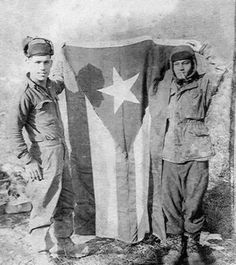
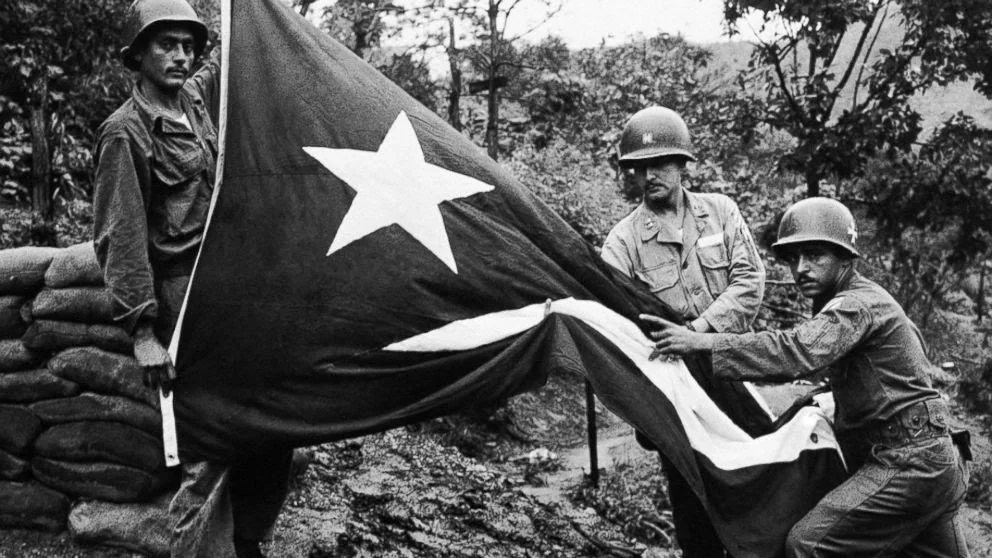
In August, beneath exploding Chinese artillery and the swelling strains of the Puerto Rican national anthem, a group of Puerto Rican soldiers raised their homeland’s flag beside the Stars and Stripes on a mountainous battlefield in South Korea.
The moment felt sacred.
Smoke drifted across the ridgeline. Shells burst in the distance. And there, against the violence of war, the Puerto Rican flag rose.
Cordero delivered a speech thanking his men for making the moment possible. His voice trembled—not from fear, but from emotion. For a brief instant, the war seemed distant.
They had to abandon that hill soon after.
But the moment endured.
The Puerto Rican flag could be seen all along the Main Line of Resistance. The instant it rose, the entire regiment erupted in celebration. Soldiers embraced one another. Guitars appeared as if summoned by memory. Singing carried through trenches and bunkers. Turks, South Koreans, Brits, Belgians, and American units fighting alongside the Borinqueneers joined in the cheering.
A casual observer might have believed the war had ended.
Sergeant Camacho stood among them, watching his island’s flag ripple against the Korean sky. His heart felt too large for his chest. The battle-hardened veteran tried to remain composed, but he could not stop smiling.
Then discipline returned.
The war was still going on. More would die.
He wiped the smile from his face, restored order along his perimeter, and urged the other sergeants to do the same. Soon the singing faded. The trenches grew quiet again.
The war was far from over.
On September 7, Company F took control of Outpost Kelly.
The position was deceptively simple: a circular waist-deep trench ringing the crest, four bunkers, and a squad-sized command post. A small hill. A simple defense. A killing ground.
Captain Cronkhite’s men held the outpost for six days. By the time they were relieved on the 14th, Company F had lost half its strength.
On the night of the 17th, a full Chinese regiment attacked.
The Borinqueneers repelled wave after wave, only to face larger assaults. Close to midnight, two Chinese companies struck again. After nearly an hour of brutal fighting, with their defenses collapsing and the enemy closing in, Company C called artillery fire on its own position.
The bombardment broke the assault.
It also killed many of their own.
At 0245 hours on the morning of the eighteenth, Lieutenant Nelson’s B Company relieved the shattered defenders of Kelly.
The Chinese relentlessly shelled the outpost throughout the day.
At 2100 hours, under the cover of darkness, two Chinese infantry companies—supported by mortar and artillery fire—attacked from the southwest, northwest, and northeast. The assault from the northeast caught the defenders off guard. The machine-gun position there fell quickly.
The company commander, several platoon leaders, the artillery liaison officer, and the forward observer were meeting in the command bunker when the Chinese overran it.
The attackers moved through the trenches, closing in hand-to-hand combat.
Less than an hour after the attack began, the 65th’s 2nd Battalion Headquarters lost all communication with the outpost.
Chaos consumed the position.
Scouts later reported Chinese troops herding prisoners down Kelly’s slopes.
Outpost Kelly had fallen.
A handful of Borinqueneers escaped.
Thirteen wounded men staggered back to friendly lines. Among them were Sergeant Camacho and Corporal González.
They were all that remained of B Company.
Puerto Rican scouts returned to the hill with grim reports. Many of the dead had been bayoneted or shot inside their sleeping bags. The Chinese had infiltrated the position before launching the full assault.
Cordero was furious.
Camacho, the highest-ranking survivor, and González were summoned and immediately rebuked.
“Your men are dead because you were sleeping on the job!” Cordero shouted. “You killed your men!”
The accusation struck Camacho like a physical blow.
He felt a rage unlike any he had known—not even during the savage hand-to-hand fights where he had killed to save his men and himself. Yet alongside the rage came shame, a crushing shame deeper than the first time he realized he had taken a life.
He had not been sleeping. Neither had his men.
The Chinese had overrun the position too quickly. The northeast flank had collapsed in moments.
Still—
Had someone failed? Had exhaustion claimed them? Had they, even for a moment, surrendered to sleep?
The doubt burned.
Cordero cut through his thoughts.
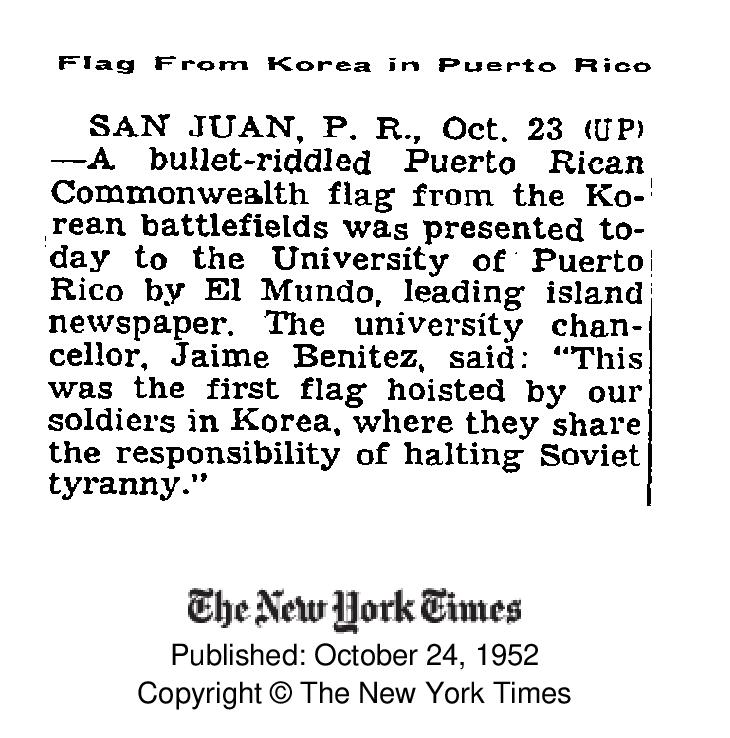
“See this flag?” he demanded, holding up a Puerto Rican flag riddled with bullet holes.
“This is what you did. You let down your men and your country. You will go back to that hill—and our flag will fly again. Understood?”
“Sir, yes, sir!” Camacho and González replied in unison.
Their voices were steady. Their hearts were not.
The counterattack did not come immediately. Division command had begun to doubt Cordero’s composure under pressure, and every plan he proposed was now scrutinized by higher headquarters.
During the delay, the battle-scarred flag was sent back to Puerto Rico. New flags arrived at the front—symbols meant to inspire the Borinqueneers and restore their fighting spirit.
Outpost Kelly had to be retaken.
Puerto Rican units leading the assault would have the honor of carrying their flag to the hill’s crest.
The word “honor” lingered heavily among the men.
The worst was yet to come.
Chapter 3. A Boricua’s Heart
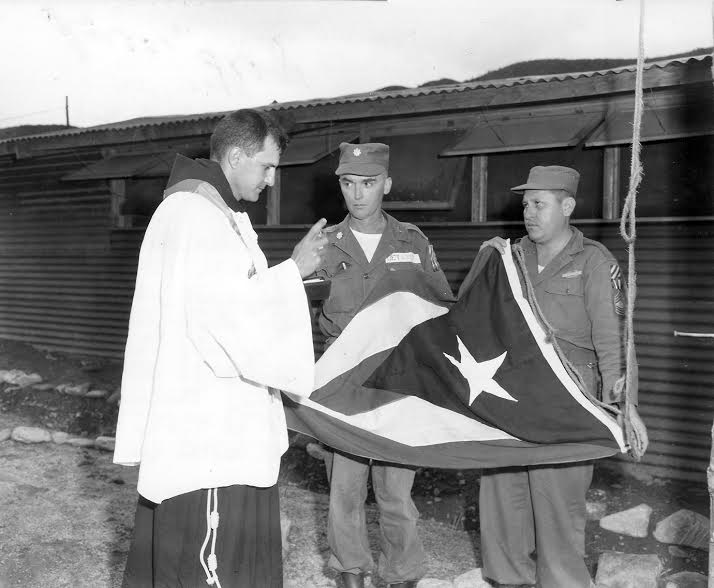
The colonel assembled the regiment at first light. Before them, carefully unfolded by an aide, hung a bundle of new Puerto Rican flags—the cloth still stiff, the colors raw and untested by smoke or blood. He raised one slowly, letting the fabric catch the cold wind, then read aloud the message that had accompanied their arrival.
“The Communist enemy does not have enough ammunition to tear down the Puerto Rican flag. We are sending you another flag to replace our glorious colors now under fire. The flag will continue to fly as long as it continues to inspire a Boricua’s heart.”
A roar rose from the men—sudden, fierce, almost desperate. The sound rolled across the hills like artillery.
From somewhere in the ranks a voice shouted, “We will retake Kelly and rename it Los Jíbaros!”
The cry ignited something primal. A chant surged forward, gathering force.
“Jíbaros! Jíbaros! Jíbaros!”
!Diablos de la Montana!
The entire regiment joined, boots pounding, rifles lifted, voices breaking the brittle morning air.
Cordero seized the microphone, his voice slicing through the thunder of the crowd.
“And as Los Jíbaros shall be known forever!”
He understood spectacle. He understood what men needed to hear before being sent toward death.
Then, raising the flag higher for the cameras and correspondents—more for the observers from the island and the waiting readers of The Stars and Stripes than for the soldiers themselves—he declared:
“From this point onward, if you have the honor to be chosen to spearhead an attack, you will carry our flag to victory.”
The implication hung unspoken but clear: there would be no retreat. No surrender. No dishonor. No force on earth could defeat Puerto Ricans defending their flag.
Many cheered, swelling with pride, ready—eager—to retake Kelly and raise their island’s colors above the shattered ridge for the world to see.
Camacho and González cheered meekly. The colonel’s words unsettled him. A flag could inspire men—but it could also send them to die- and for what?
They exchanged a glance and bared their teeth in something that was not quite a smile. There was no new strategy. They had already seen the operational plans; they were part of the mission.
It would be another massacre.
The Attack
The next night, two platoons from E Company advanced toward the outpost under the cover of darkness and started their attack with the first lights of the day. By late afternoon, one platoon had clawed its way to the summit, exhausted and exposed, while the second struggled upward through fire-scarred terrain, inching toward the crest.
Chinese reinforcements arrived swiftly, their counterfire precise and relentless. The second platoon stalled. Those who had reached the top soon found themselves trapped under a storm of machine-gun bursts and plunging mortar shells. The ridge erupted in flame and shattered earth.
After more than thirty casualties, both platoons were ordered to withdraw, stumbling back to the main line of resistance under a rain of fire and steel.
Cordero had already prepared his answer.
The First Battalion stood ready to launch a full counterattack.
As darkness settled over the broken landscape, A Company moved toward the hill from the south, shadows advancing through the ravines, while C Company pushed forward to the base of Kelly. Enemy artillery awakened almost immediately, shells walking methodically across the approaches, the ground trembling with each impact.
Then came B Company.
Reconstituted only days earlier—patched together from survivors, cooks, mechanics, and a surplus of replacements still raw from arrival—it now fell under the command of Camacho and González. The assignment carried the bitter taste of punishment more than honor.
They were ordered forward to support the ascent of A and C Companies.
Chinese artillery found them quickly.
Direct hits tore through their formation. The earth exploded beneath their boots. Men vanished into smoke and fragments. The path before them was the same one two companies had already taken—a corridor of fire, marked by the dead.
Who would order a third company to walk it?
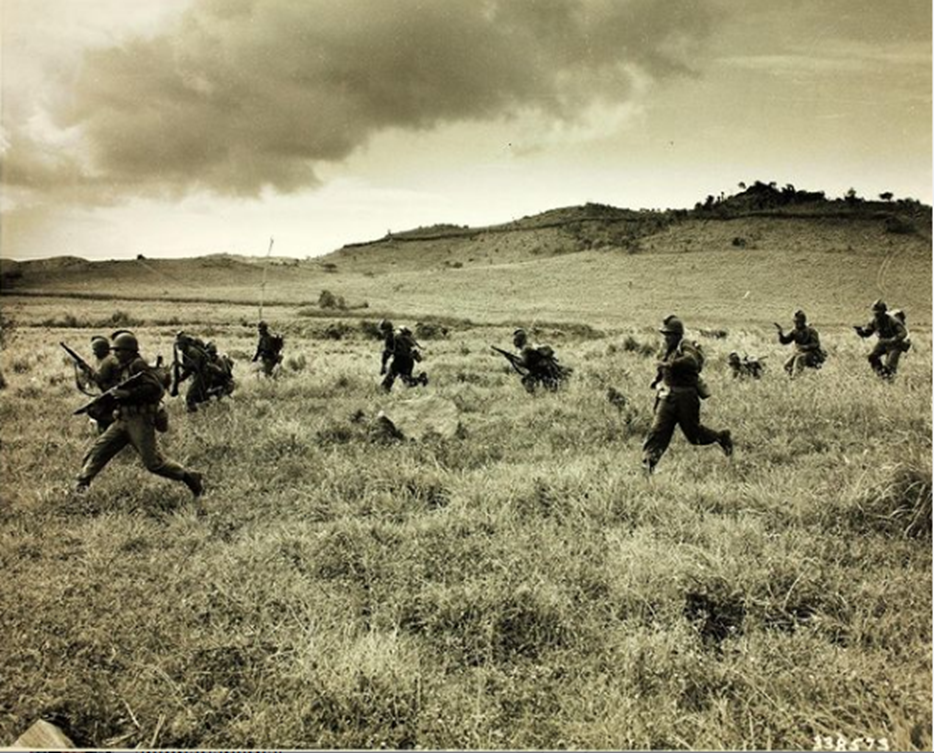
“Battling Baker” was reduced to twenty-six men in minutes.
No command Camacho shouted could restore order. No effort González made could gather the scattered survivors. They had been given less than two days to rebuild a fighting unit from shattered remnants and terrified newcomers—boys whose eagerness could not conceal their inexperience, whose hands still trembled on their rifles.
The company dissolved into chaos.
B Company’s mission was cancelled. Cordero reluctantly called it off.
Camacho ensured that what remained of his green company withdrew to safety. He watched the last of them disappear into the smoke-clouded darkness, stumbling but alive.
Then he turned back toward Kelly.
Without a word, he began walking toward the hill again.
González followed.
Camacho did not look back.
“End of the road, kid,” he said quietly.
González’s answer came without hesitation.
González smiled faintly. “We crossed that road long ago, sargento.”
For a moment, only the distant thunder of artillery filled the silence.
Camacho nodded once.
“Fine,” he said. “Keep your eyes open.”
Together, they walked toward Outpost Kelly.
That night the hill would drink again.
Chapter 4. Miracle at Outpost Kelly
Chinese machine-gun fire never ceased. And endless ra-ta ta-ta ta…
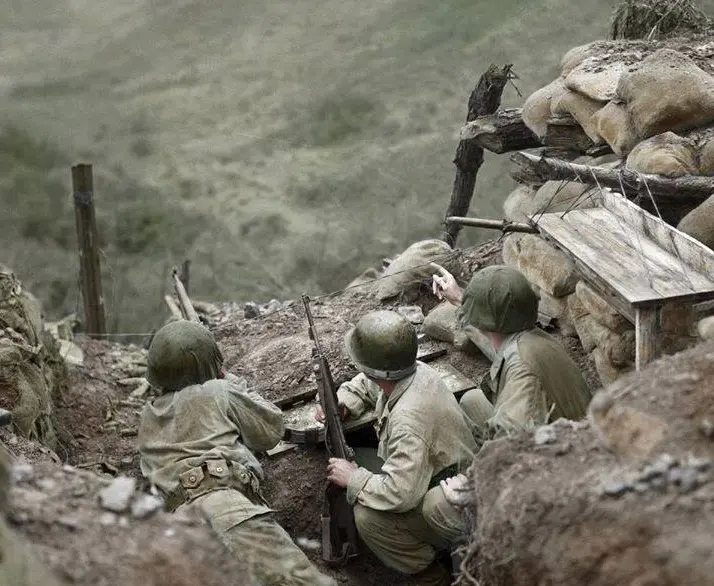
Mortars fell with a sickening rhythm, plunging into the earth with hollow thuds before erupting into fire and frozen dirt. Time-fused artillery burst overhead, shredding the air itself, showering the hill in steel and smoke. The bombardment devoured A and C Companies positions inch by inch.
Most of A Company fell back to reorganize, dragging their wounded, stumbling through craters slick with mud and blood. C Company held on—if holding could be said of men clinging to a torn fragment of earth no wider than a grave.
A handful of Borinqueneers from both companies carved out a small perimeter near the crest. They held it through the night.
It was a long night. A night without warmth. A night in which death was the only certainty.
Darkness pressed against them like a living weight. Every shadow suggested movement. Every whisper of wind carried the promise of death. Chinese probing attacks came again and again—brief bursts of gunfire, sudden shapes in the fog, footsteps approaching and vanishing. Each time the Borinqueneers fired into the dark and waited for the next assault.
They did not sleep.
They endured.
And they held.
With the first pale light of dawn came the roar of American artillery. The bombardment hammered Chinese positions along the slopes, the entire ridge trembling as shells tore open the mountainside.
Then came the order.
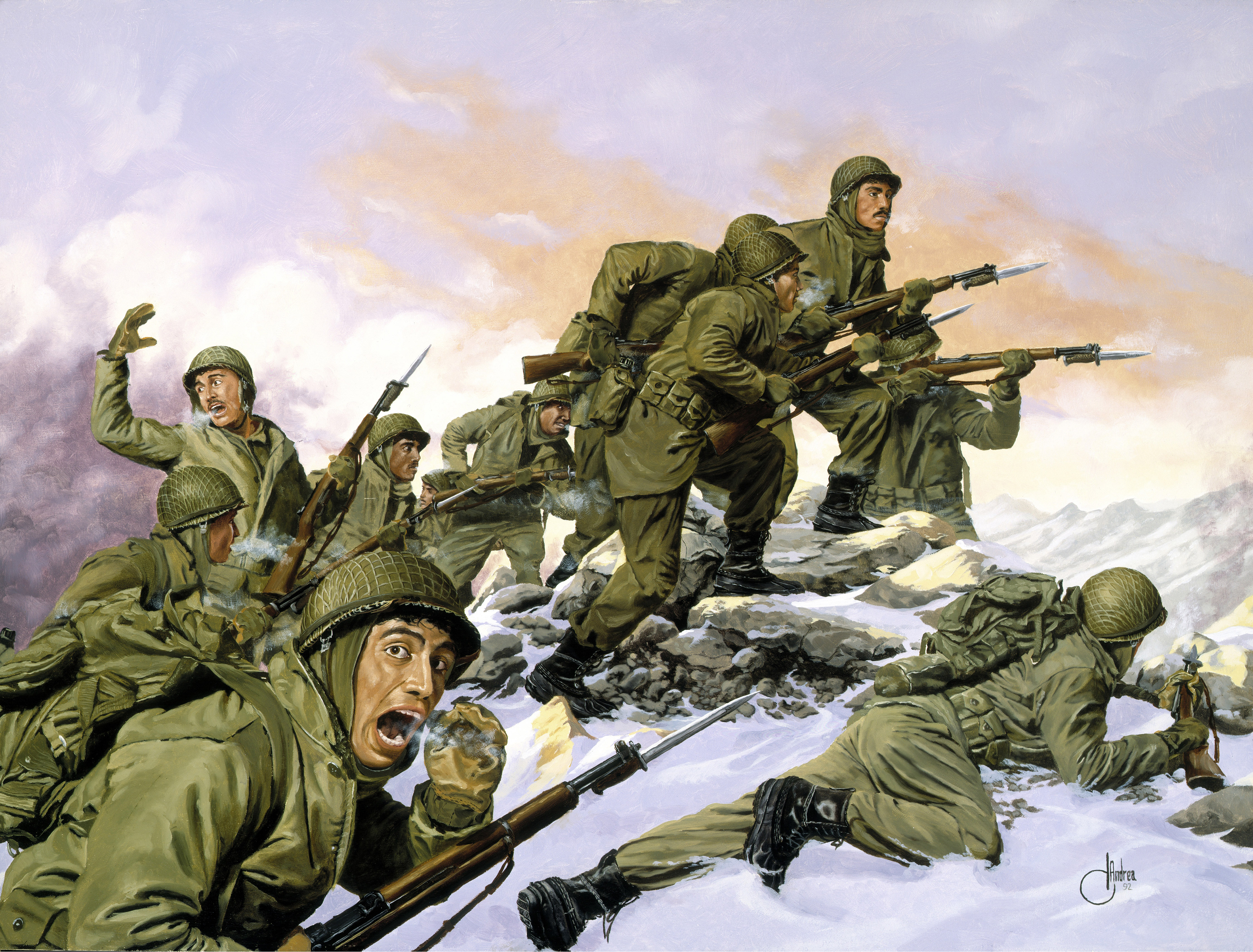
Fix bayonets.
No explanation was needed. Steel slid onto rifles with a single metallic language every soldier understood—the language of the final advance.
When the artillery lifted, the men rose from the earth and resumed their ascent.
They climbed through smoke and shattered rock, stepping over bodies, slipping on frozen soil stained black with blood. Machine-gun fire cut them down in rows. Mortars erupted among them, hurling limbs and debris into the air.
By the time they reached the crest, half of them were dead or wounded.
But the rest arrived.
The Chinese defenders withdrew down the southern slope, disappearing into the haze.
For a moment, the hill was theirs.
“The flag,” Sergeant Aguilar demanded, his voice hoarse. “Where is the flag?”
Two privates rushed forward. With trembling hands they unpacked the cloth, its colors bright against the gray ruin of the hill, and handed it to him.
Aguilar raised it quickly.
The Puerto Rican flag unfurled against the morning sky.
From the main line of resistance below, Borinqueneers watching through field glasses erupted in cheers. The colors waved above Outpost Kelly—defiant, radiant, alive.
Aguilar and the two privates turned and ran for the trenches.
They never made it.
A burst of machine-gun fire cut them down in the open. Their bodies collapsed together, limbs entangled, only a few feet from shelter.
The flag continued to move in the wind above them.
It was no longer cloth. It was a command. A promise fulfilled. A sentence.
Twenty men remained alive on Kelly.
They crouched inside the shallow trenches, pressing themselves against the frozen earth as Chinese fire returned with terrifying force. Mortars fell without pause. Artillery shattered the ground around them. Dirt and bone and metal rained down.
They could not fight back.
They could only endure.
And then they understood what they were lying among.
The trenches were filled with the dead from previous days—men of B Company. Frozen bodies still sealed in their sleeping bags. Faces pale, eyes wide-open to a sky they would never see again.
The Chinese had used them. Used their bodies as cover. As shields. As steps to climb the trenches.
The living now pressed against the dead, shoulder to shoulder with brothers who had died in the dark.
The smell of rot lingered beneath the cold air.
A few soldiers could not bear it. The horror of being surrounded by their fallen comrades broke something inside them.
Better the open air than this.
Five men rose from the trench and ran toward the flag, desperate to lower it—desperate to make the killing stop.
Machine-gun fire cut them down before they reached it. The Chinese had the whole hill zeroed in. For them it was more like target practice than a battle. Los hijos de este país were more than moving targets in an overly saturated range.
Panic spread.
It moved like fire through dry grass. Men screamed. Some wept. Others stared silently, their minds already gone. They were dying without fighting, buried alive under steel and terror.
Then came the sound.
Bugles.
Horns.
Low, rising calls echoing from the southern slope.
The Chinese infantry was coming back.
Private Colón—eighteen years old, a replacement from Brooklyn—gripped his rifle until his hands ached. His lips trembled as he whispered a prayer.
“Santa María, Madre de Dios… ruega por nosotros…”
He finished, then kissed the small medallion of the Virgin of la Candelaria hanging at his chest. His mother had pressed it into his hand before he left for Korea.
He had never believed it would matter.
“They are coming,” he said, rising slowly. “Get ready.”
He looked at the men around him—terrified, broken.
“Don’t die on your knees.”
He seized a BAR and opened fire.
The Chinese formation was so dense he scarcely needed to aim. The weapon roared in his hands, recoil slamming against his shoulder again and again. Soldiers fell, but more replaced them, wave after wave advancing through the smoke.
Bullets struck Colón—tearing into his shoulders, grazing his face, ripping past his neck. Blood ran down his uniform.
He did not stop.
He fired. Reloaded. Fired again.
For a moment it seemed one man alone could held back an army.
Then a single shot struck his chest.
He collapsed instantly, vanishing into the trench as if swallowed by the earth.
Something changed in the survivors.
Colón’s words lingered. His defiance lingered.
The sight of him standing alone against the tide burned itself into their hearts.
Fear gave way to fury.
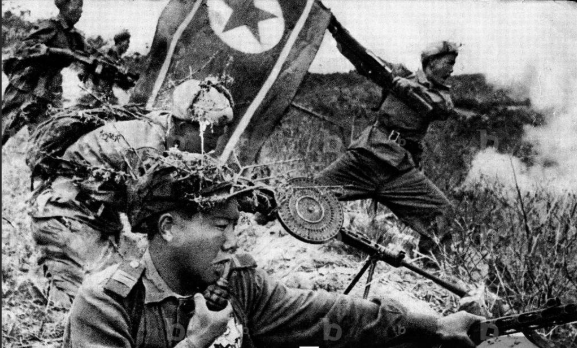
The twelve men still alive fought with everything they had. They fired until their rifles clicked empty. They seized abandoned Chinese weapons and turned them back on the attackers. They hurled grenades, rocks, anything their hands could grasp.
But the Chinese kept coming.
Some reached the trenches.
Hand-to-hand combat followed—brutal, wordless, intimate. Steel against flesh. Rifles used as clubs. Men locked together in mud and blood.
The Borinqueneers held.
But they knew the truth.
They would die here.
But they would die standing.
Then came a strange sound from beyond the enemy ranks—the sharp, unmistakable crack of BAR and M1 Garands rifle fire.
Not from the trenches.
From within the Chinese formation itself.
Confusion rippled through the attackers.
All night, Camacho and González had maneuvered across the broken terrain, crawling through ravines, moving like ghosts through the darkness. Now they struck from the rear and the western flank, pouring fire into the exposed Chinese ranks.
The attackers could not locate them.
On the open crest of Kelly there was almost no cover. The Chinese now found themselves trapped in the same killing ground they had created. Men fell in rows, cut down by unseen fire.
They had fallen into their own trap.
Yet still the Chinese kept coming —brave, relentless, advancing in wave after wave.
But the pressure on the trenches eased.
And in that brief moment of confusion, Camacho and González reached the survivors.
“Who is in charge here?” Camacho demanded.
“You are, sergeant,” Private Rivera answered.
“We’re leaving. Now.”
“We have orders to hold to the last man.”
Camacho’s voice hardened.
“You already did. All of you are wounded. We have no ammunition. You will not die in this trench. Move.”
For the first time in the war, Camacho chose his men over orders.
Rivera hesitated, then pointed toward the fallen Colón.
“We can’t leave him behind, sergeant. He saved us. It’s a miracle.”
Camacho stared at the body. Carrying the dead would slow them—perhaps doom them all. But he saw in their faces that argument would be useless.
He nodded once.
“Ok. Bring him.”
They began their withdrawal.
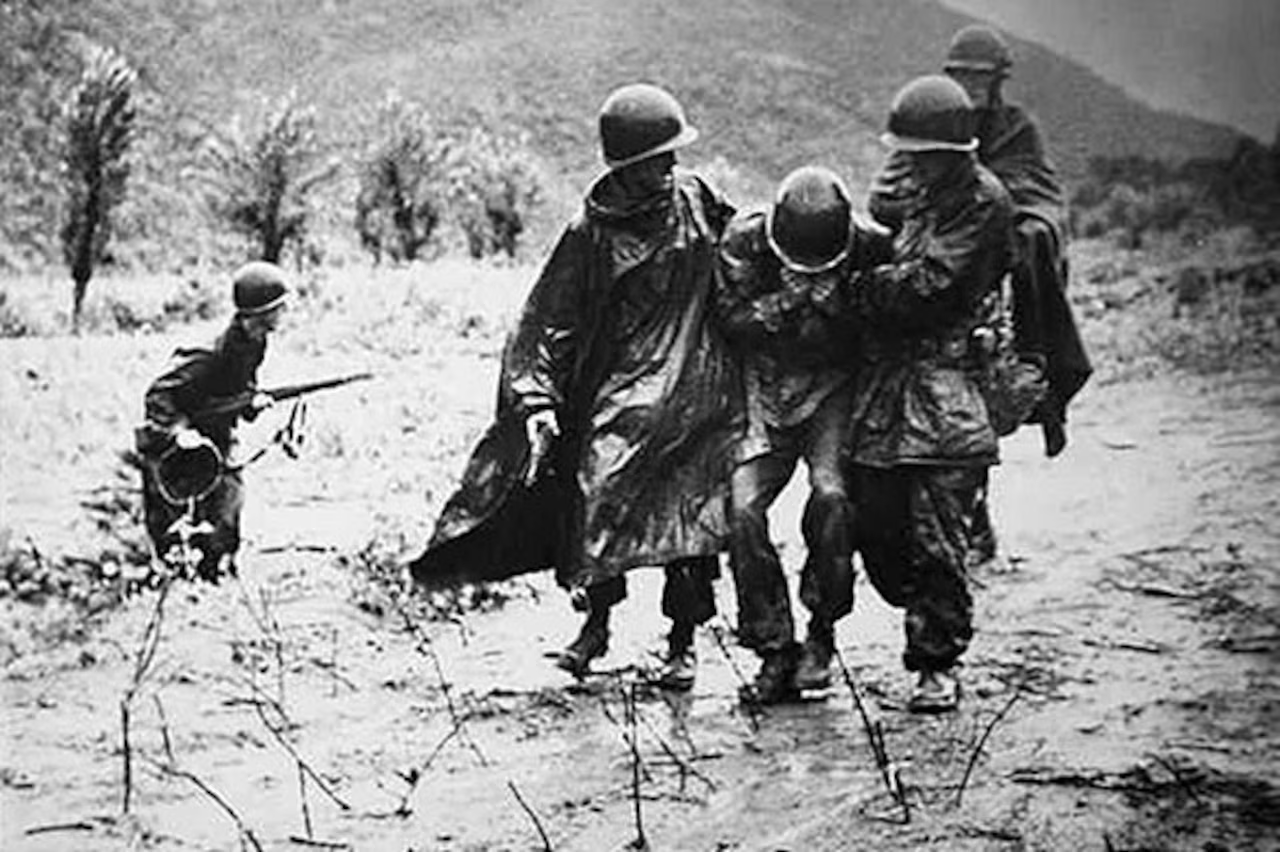
González paused only long enough to run to the pole and seize the flag, wrapping it tightly before following the others.
The hill crawled with Chinese patrols. Every step downward risked discovery. They moved through craters and shattered rock, carrying their wounded and their dead, each breath a struggle against exhaustion and fear.
Then, behind them, a voice emerged.
“Where are we?”
The men froze.
Rivera turned, eyes wide. “Dios mío… we thought you were dead.”
Colón struggled upright, clutching his chest, his face pale with pain.
“What happened?” he whispered.
He pulled the medallion from beneath his uniform. The metal was crushed and split. Embedded within it was a flattened bullet.
Silence fell over the group.
Colón stared at the object, unable to speak. Until that day, he had never been a religious man. Yet in that moment he felt only one certainty—his mother and God had saved him.
A quiet, overwhelming gratitude filled him.
In that moment the war seemed smaller than a mother’s prayer, and death itself uncertain.
Camacho broke the silence.
“Move,” he said. “We need to get out of here—or your miracle will be wasted.”
No one argued.
They followed him.
González brought up the rear, guarding the flag.
Night had fallen by the time they reached friendly lines.
They had walked out of death itself.
It was called a miracle.
And for the moment, they were safe.
They had survived the hill.
The war would not forgive them for it.
Chapter 5. Far From Home
Camacho slept for two full days.
The aid station was a world suspended between life and death—canvas walls breathing with the wind, the smell of antiseptic mingling with blood, sweat, and damp wool. Somewhere nearby men groaned in their sleep. Others did not move at all.
He had only minor wounds, but exhaustion had hollowed him out. Three days of fighting without sleep had stripped him of strength. Dehydration left his body weak, his thoughts drifting like smoke.
When he finally stirred, music reached him first.
González sat on a stretcher nearby, a guitar resting across his lap, fingers moving slowly over the strings. The melody was soft, melancholic—an island song carried across an ocean of war.
The sound pulled Camacho to a lost home.
To Lajas.
In his dreams he was barefoot again, a skinny boy running along dirt roads beneath a relentless Caribbean sun. He played with nothing but a stick, chasing shadows, inventing battles in the dust.
Then came the war.
He saw himself rushing to the recruiting station—hope burning in his chest—only to be turned away.
“You are too skinny, muchacho,” the officer had said, barely looking at him. “How can you possibly carry a rifle? Put on weight and come back.”
He came back.
Again and again.
Each time the same answer.
The world was already at war. German submarines stalked the Caribbean, choking supply routes, threatening to starve Puerto Rico. Food was scarce. Hunger was common.
But Camacho was resourceful.
El monte had always provided.
He knew where to find tubers hidden beneath stubborn earth. A mound of yucca here. Wild yams tangled in roots there. Eels in the creek, slick and writhing in muddy water. What others would not eat, he consumed without hesitation.
He worked wherever he could—messenger boy, porter, errand runner—anything that earned a few coins. With every penny he bought lard. Every meal he drowned in grease, swallowing it with determination, forcing his body to grow.
The weight gain eventually came.
He traveled to Cabo Rojo to enlist, having exhausted every recruiting station in Lajas. The journey took him an entire day under a merciless sun.
After hours of examinations and measurements, an officer finally called him forward.
“Name?”
“Carlos.”
The officer looked up sharply. “You are not a boy anymore. Full name.”
“Carlos Camacho.”
The officer studied his records in silence, then raised his eyes.
“Welcome to the United States Army, Private Camacho. You leave in four days for Tortuguero. Put your affairs in order and report back here Friday at 0400.”
Camacho hesitated. “Sir, excuse me—when—”
“Four A.M., private. Four…”
The guitar stopped. The music dissolved, and the present returned.
González leaned forward, smiling faintly. “Hey—you’re awake, sergeant. Welcome back. You slept for two full days.”
Camacho pushed himself upright, suddenly alert. He searched for his uniform, his boots, his gear. A nurse approached and gently insisted he was not cleared to leave—that he needed rest.
González agreed aloud.
But he knew Camacho would not stay.
Outside, as they walked toward their tent, González spoke quietly.
While they had been at the aid station, Colonel Cordero had ordered the entire First Battalion to attack Outpost Kelly again. Even the division commander had been present to witness the assault.
They had thrown everything at the hill—full artillery support, a company of tanks, the entire battalion.
And still they had been destroyed.
The Chinese no longer defended Kelly directly. They allowed American companies to seize the crest—then annihilated them with artillery. Wave after wave of Borinqueneers had been sent forward only to be torn apart.
Five hundred casualties.
Five hundred men—dead or wounded—for a useless outpost that could not be held.
González spoke steadily, but Camacho heard only fragments. A dull pressure grew inside his chest.
Five hundred.
For nothing.
Absolutely nothing.
Inside the tent, Camacho moved quickly to his footlocker. He opened it with trembling hands and retrieved his sidearm—a Colt .45, Model 1911. The cold metal steadied him.
Without a word, he turned toward Colonel Cordero’s command post.
González followed, speaking urgently, but Camacho did not hear him.
Someone had to answer for this.
On his way to the command post, a memory surfaced unbidden.
Sergeant Guilloti.
Back in 1950, before Camacho had ever truly landed in Korea, Guilloti had died from “friendly fire.” He had not even set foot on Korean soil. The moment the troop transport lowered its ramp, a shot rang out. Guilloti fell with a bullet in his back.
A soldier claimed his weapon had discharged accidentally.
But Guilloti had been an abusive sergeant. He had humiliated his men, beaten them, broken them. The soldier who fired the fatal shot had often been the target of Guilloti’s rage.
Maybe it had been an accident.
Maybe not.
The chaos of those early days—the breakout from the Pusan perimeter, the relentless advance, the shifting lines—left no time for investigation. The shooter was quietly transferred. Corporal Camacho was promoted to squad sergeant.
He had hated that promotion.
It had come wrapped in death.
But this—this was different.
Guilloti had been cruel, but he had not wasted lives.
Cordero had.
Five hundred men for a hill of frozen earth.
A useless outpost.
All for Cordero’s pursuit of glory.
Camacho pushed through the flap of the command tent. The two guards posted outside Cordero’s tent didn’t even try to stop him in some kind of quiet solidarity.
“What the hell are you doing in my tent, sergeant?” a voice demanded, thick with a Southern accent.
Camacho stiffened. “I’m looking for Colonel Cordero, sir.”
The officer turned—a tall man with cold, measuring eyes.
“He’s gone, son. Count yourself lucky.” The man smiled thinly. “I’m Colonel De Gavre. There are going to be changes around here. We are not in the business of losing wars.”
He circled Camacho slowly, studying him.
“You’ve been pampered by Cordero. That’s why you’ve grown weak. He treated you like children—not like American soldiers. But we can still make men out of you. Maybe even good soldiers.”
Camacho felt heat rise through his body.
Make men out of them?
He thought of the frozen trenches at Kelly. Of Colón standing alone against an army. Of men dying with the flag in their hands.
His hand moved instinctively toward his sidearm.
González stepped forward quickly.
“Yes, sir. Thank you, sir.”
De Gavre nodded, satisfied.
“One more thing, boys. You’ll shave off those mustaches. Prove yourselves in combat and you may grow them again. Orders have already been issued. By the end of the day they’re gone.”
“Yes, sir,” González replied, gripping Camacho’s arm and guiding him outside.
“Sargent, you need to let it go,” González said quietly. “Cordero is gone.”
“It’s not Cordero,” Camacho answered, his voice tight with anger. “De Gavre wants to humiliate us—for losing a battle. You were there. Are we cowards? Are we boys?”
González shrugged, weary.
“It doesn’t matter, sargento. Hair grows back.”
Camacho stared at the ground.
“I know,” he said.
But something inside him had shifted.
The regiment had been his family since 1942. It had given him purpose, identity, belonging. After two years in Korea, even the battlefield sometimes felt like home—the rhythm of patrols, the voices of comrades, the shared hardship.
But now the illusion had shattered.
They were not home.
They had never been.
They were strangers in a distant war, fighting and dying on foreign mountains, far from the soil that had raised them.
They were very far from home.
Chapter 6 — Before the Fall
Sergeant Camacho would not protest. He would obey.
“It is an order,” the officer repeated. “You will shave your mustaches by the end of the day or face disciplinary action.”
No one moved.
No one spoke.
The men stood frozen in formation, stunned into silence. The wind cut across the frozen ground, but the cold was nothing compared to the humiliation settling over them.
Camacho, a veteran of two wars, stepped forward.
Without a word, he poured cold water from his canteen cup into his mess kit. His hands trembled only slightly as he lathered his face. With a straight razor, he began shaving the mustache he had worn for years — a mark of manhood, of home, of belonging.
One by one, the soldiers of B Company followed.
Steel scraped against skin.
No one looked at anyone else.
When Camacho finished, nausea rose in his throat. He stepped outside the tent into the thick October snow and walked blindly toward the tree line, desperate to escape the eyes of his men.
There, alone among the skeletal trees, he collapsed.
He vomited into the snow, fell to his knees, and struck the frozen earth again and again until his fists throbbed with pain.
He had always led by example.
But this was different.
He was a good sergeant. He knew discipline. He knew obedience. His duty was to enforce orders — even foolish ones. But this was something else. This was not discipline. This was erasure.
His men were not cowards. They were not boys.
They had fought without sleep, without rest, without relief. They had been pushed back, yes — but so had the Turks, the British, the Americans, the South Koreans. Defeat ran along the entire front.
Why, then, were they singled out?
Why them?
For the first time since he had enlisted, Camacho felt something inside him fracture. He had always believed he could be both — American and Puerto Rican. Now that certainty dissolved like breath in winter air.
Perhaps he had never been both no matter how hard he had tried- and how proud he was of being both.
He returned to the lines, briefed his men, and lay down to sleep — as always the last to rest, the first to rise.
Tomorrow would come.
But something had changed.
The catastrophe at Outpost Kelly had shattered the regiment. Worse calamity still waited.
And this time, they would not hold to the last man.
Chapter 7 — Jackson Heights
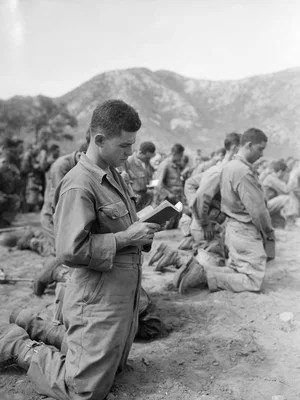
On the night of October 23, the 65th Infantry Regiment moved back into the line to relieve the 51st Republic of Korea Regiment.
War rarely granted mercy.
The Borinqueneers had barely left the front after the disaster at Kelly. Ten days of “rest” — ten days of drills, inspections, and replacements too young and too green to understand what awaited them. Ten days without healing.
Then they were sent forward again.
But something had changed.
When the 65th returned to the line, it no longer looked like the Borinqueneers.
The mustaches were gone.
The white “Borinqueneers” markings once painted proudly on their vehicles had been covered with dull Army green. The regiment’s beloved Mambo Boys, whose music had lifted spirits in the rear, were disbanded. Their piano had been hauled outside and used for target practice until splinters replaced melody.
With Colonel De Gavre, Jim Crow had arrived at the 65th.
Puerto Rican officers were barred from showering with Continental Americans.
The men understood what this meant.
But the damage went deeper than policy. War demanded moments of refuge — brief spaces where men could gather themselves, remember who they were, remember why they fought. De Gavre stripped those spaces away. He erased their symbols, questioned their courage, and demanded they abandon everything that sustained them.
They were now fighting two wars: one against the enemy before them, another against the doubt behind them.
Trust dissolved. Los hijos de este país weren’t safe anywhere in Korea.
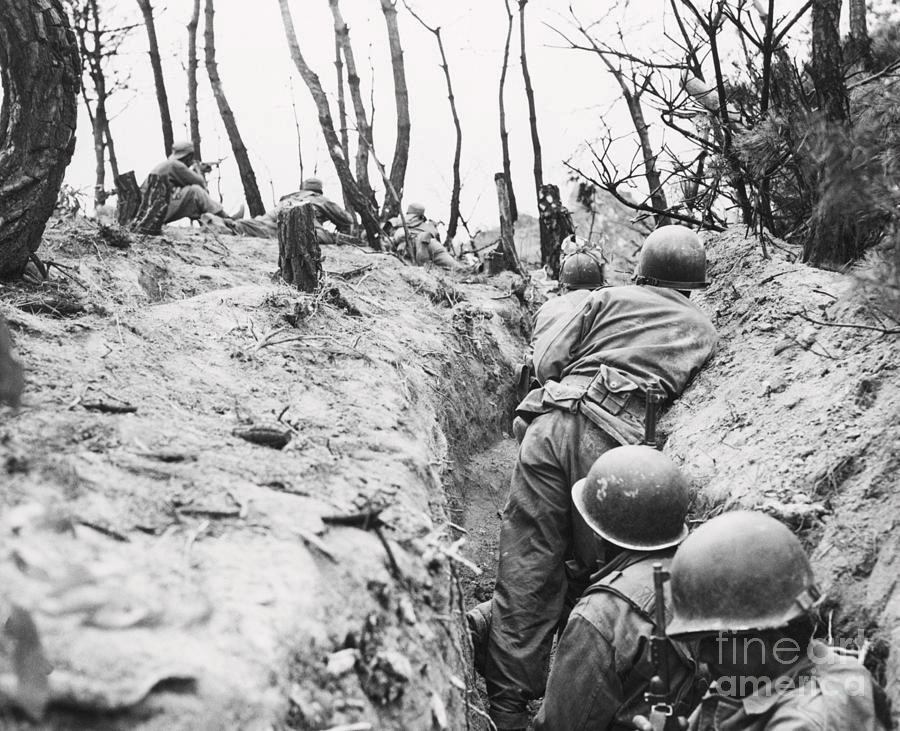
New Positions
As B Company advanced toward the Main Line of Resistance, they encountered an omen.
A South Korean colonel sat drunkenly atop a crate of .45 ammunition, firing his pistol at empty ration cans. His soldiers — battered, hollow-eyed — sat nearby in silence.
An American lieutenant asked where they had come from.
The colonel pointed toward Hill 391, drew his finger across his throat, and resumed firing.
Soon Hill 391 would be called Jackson Heights.
It was a death trap.
Two Chinese-held elevations — Hill 386, known as Iron Horse, and Hill 488, called Camel’s Back — completely dominated the position. Jackson Heights itself rose only 360 meters. There was no cover, no concealment, no place beyond enemy observation. The ground was solid rock; trenches could barely be scratched into it.
Another indefensible hill.
Another sacrifice.
The Defense
Captain Jackson’s G Company first occupied the outpost.
On October 25, Chinese artillery began to fall — first 76-mm shells, then mortars of heavier caliber. Night brought probing attacks. Daylight brought more fire. The defenders could not see their enemy, could not strike back except when infantry emerged from the smoke.
Isolation settled over them.
Communications failed. Casualties mounted. The men begged permission to withdraw but were ordered to remain until the dead and wounded were evacuated.
Then came the bombardment.
A direct hit destroyed the mortar ammunition supply. The mortar platoon was reduced to seven men and two tubes. As sunset approached, the Chinese barrage intensified — the unmistakable prelude to assault.
Captain Jackson requested smoke cover.
The smoke never came.
The Chinese did.
Wave after wave surged against the hill. Mortar crews fired until their weapons were destroyed. By 2200 hours the enemy had overrun the crest, cutting off entire platoons. Jackson called final defensive fire on his own position.
By night’s end G Company was shattered — fifteen killed, seventy wounded, two missing.
At last, permission to withdraw came.
The survivors fought their way down through hand-to-hand combat, stumbling through darkness toward Outpost Harry and the main line of resistance.
Stars and Stripes reporters, watching the carnage, named the struggle the Battle for Jackson Heights.
The Borinqueneers knew what would come next.
They would be ordered back.
Hopelessness spread quietly through the ranks.
Chapter 8 — The Fall
The order for counterattack came immediately.
Lieutenant Porterfield’s A Company would retake Jackson Heights. A volunteer squad from B Company joined them. Captain Cronkhite’s F Company would lead the assault. C Company would stand ready in reserve.
At dawn, after a brief artillery preparation, the attack began.
F Company crossed into no man’s land and climbed the barren slope. Resistance was light. Within two hours they reached the crest with minimal casualties.
Then the Chinese guns opened from Camel’s Back.
Jackson Heights became a killing zone.
Confusion
A Company advanced behind them but was caught repeatedly in devastating artillery barrages. Platoons became separated. Orders were confused. Communications failed.
Porterfield and Cronkhite had never coordinated their roles.
Each assumed the other would hold the hill.
The mistake would prove fatal.
By midmorning the two companies were intermingled in chaos. Shells fell continuously. Casualties mounted. When A Company’s officers gathered to plan their next move, a single mortar round struck their position, annihilating the company’s command.
Leadership vanished in an instant.
Men began drifting down the slope in small groups.
The Crest
Some retreating soldiers passed through Lieutenant Guzmán’s isolated platoon at the base of the hill. Others reached the crest, where Sergeant Camacho was gathering the remaining survivors.
There was no defense to organize.
The Chinese were not attacking.
They did not need to.
Artillery alone was enough. Each shell shattered the rocky ground, transforming pebbles into lethal shrapnel. The hill itself had become a weapon.
For the first time since arriving in Korea, Camacho did not know what to do.
He saw men curled into themselves, trying to shrink from death. He saw one soldier wandering aimlessly, mind broken by terror. Rivera and Colón wrestled him to the ground. González dragged wounded men down the slope, then climbed back up again and again.
“What are we doing here?” the shocked soldier screamed. “What are we doing here?”
Before Camacho could answer, a shell exploded beside them.
Rivera and Colón vanished in the blast.
Camacho tried to run toward them, but his legs would not move. Time dissolved. Smoke filled the air. Tears streamed down his face. The regiment was his family — but González had become something more, a brother forged in fire.
Then the smoke parted.
González emerged, limping, legs shredded by shrapnel but alive.
“Sargento!” he shouted. “We need to get out of here!”
Camacho could barely hear him over the thunder of explosions.
“We need to get out!”
At last Camacho found his voice.
“Yes,” he said. “Everyone move out. Help the wounded. We are leaving.”
It was not an order of retreat.
It was a decision.
Withdrawal
They descended the hill with twenty-two wounded men, crawling through darkness while Chinese patrols hunted survivors. Hours later they reached the main line of resistance.
They had escaped.
But the war had not finished with them.
Refusal
F Company soon received orders to return to Jackson Heights and retrieve any remaining survivors.
The exhausted men stared in disbelief.
“What?” someone whispered. “We just escaped from there.”
Rifles fell to the ground.
Camacho dropped his weapon first.
“We are done, sir,” he said quietly. “We are not cowards. But we will not go back to be killed without a chance.”
The others followed.
Colonel Betances stood rigid.
“Pick up your weapons and return,” he ordered.
No one moved.
The silence was heavier than artillery.
“Sargent Macías,” Betances said coldly, “collect these men’s weapons. Place them in the stockade.”
The battle for Jackson Heights was over.
Their real ordeal had only begun.
Chapter 9 — Camila’s Plea
Camila’s heart hammered in her chest as she stepped forward to the microphone. Hand in hand with her daughter Melita, she felt the weight of every eye in the room. Speaking in public had never been her way. In Naranjito, politicians spoke through megaphones, always distant, always untouchable whether they wore suits or pristine impeccably starched and ironed white guayaberas.
Now it was her turn.
She had to speak.
She had traveled all night and most of the morning to reach San Juan. The governor promised assistance, but gestures like that were often symbolic, empty. She forced herself forward anyway.
“My husband works on a farm in Michigan,” she began, her voice steady despite exhaustion. “He does his duty — for us, for his family, for his country.”
She let her gaze sweep the room. “My son, Mario, is in Korea. He only wanted to do his duty. He is there for us, for his country. And now they tell us he is a coward — that he refused to fight. They say the same about your sons, husbands, and fathers. But we know better. They are not cowards. They are brave men.”
Over two hundred women nodded, some clapped, others whispered in unison: Sí son valientes! A chant grew, swelling across the room: “Let them fight! Let them fight!”
Melita’s sweaty hand held hers, grounding her.
“We would rather see them dead on the battlefield, covered in honor, than returned with the stain of cowardice. We demand they be returned to fight — to prove they are not cowards!”
The newspapers chose her words for the headline:
“Preferimos verlos muertos que en deshonra.”
Mothers and daughters of soldiers accused of cowardice demand they return to the battlefield.
Two days later, copies of the papers reached the regiment. Ninety Puerto Rican soldiers, awaiting court martial for cowardice, held the news in their hands. Some smiled, some laughed, others wept quietly.
Sergeant Camacho read aloud:
“Doña Camila de González from Naranjito led the meeting… Corporal González, is that your mother?”
“Yes, sergeant. She is my mother,” Mario said.
“She is a brave woman, son. You should be proud.”
For the first time in months, isolation lifted. Fear of dishonor, of disbelief, of community scorn — it all faded. They were not alone. Relatives, friends, strangers, the entire island had their backs.
Far from being cowards they were the bravest of men.
They were Boricuas.
Chapter 10 — The Last of the Borinqueneers
Camacho and González sat in the first row of a cold Korean courtroom, the only non-commissioned officers among twenty-two men charged with cowardice before the enemy and disobedience. The air was heavy, and the walls seemed to shrink around them.
The prosecutor’s case was brutal, demanding the harshest sentences — a warning to the entire U.S. command.
The defense counsel, Lieutenant Stevens, disagreed. He approached the five members of the court and spoke to the military judge directly.
“Sir,” he said, addressing the military judge we have a tendency as Anglo Saxons to consider these people the same as ourselves. Actually, they are Latin American in temperament, not war-like but easy going.”
He pointed at the men.
“I have been with these men since December of 1951. My experience as a junior high teacher prepared me to deal with them. They are emotionally equivalent to the child in junior high. As such, I urge you to think of them as people with a twelve-year-old emotional level which definitely must not be led in the light of continental troops. I truthfully believe you must consider these people not as continental but as Puerto Ricans. We should show them mercy, the mercy that a benevolent father shows to his children, even, no, strike that, especially when they are weak.”
The tribunal members nodded in agreement- but González could not remain silent. He stood abruptly.
“Sir, that is nonsense. We have proven ourselves! The lieutenant does not speak for us. We are men, and we demand to be treated as men. Try us as men!”
Camacho stood beside him, firm and unwavering.
“You did not treat us like men on the battlefield. You are not treating us like men here. We are not your children. We are soldiers. We are men.”
The judge considered them. Then he nodded.
“Very well,” he said. “You will be treated as men. Lieutenant Stevens’ comments are disregarded. These men are fully capable and responsible for their actions.”
The verdict was harsh. Guilty of willful disobedience and misbehavior before the enemy. Most received two-year military jail sentences. Camacho and González were sentenced to five years, with total forfeiture of pay and dishonorable discharge.
As the soldiers were led away, Captains Jackson and Cronkhite stood at attention, saluting the men who had fought so bravely under impossible circumstances. Shame and pride intertwined in their gaze.
Camacho, last to leave, maintained his dignity. In the back of the truck, he sat as he had countless times in Korea, scanning the fogged horizon. He was still the leader of his men — even now.
Jackson whispered to Cronkhite, “There goes the best Puerto Rican soldier… victim of the greatest injustice.”
Epilogue — The Way Home
By spring 1953, most sentences were remitted. The men returned to duty, but the 65th no longer existed as a Puerto Rican regiment. Dispersed among Continental units, the Borinqueneers returned home without fanfare.
No parades. No governor-led celebrations. No monuments. For those who had been sent back into service, the journey home was lonely and quiet.
Carlos
In 1955, Camacho arrived in New York after his honorable discharge. A small tin can clutched in his hand, he found himself in Brooklyn on Fulton Street. The cab stopped before a dilapidated house: 116.
He hesitated, then knocked. A woman in black, veil over her eyes, opened the door.
“May I help you?” she asked.
“No… yes… are you Marisela de Colón?”
“Yes. Who are you?”
“I knew your son. I was with him when he fell. I brought you this.”
He handed her the tin can. Dirt and pebbles from Jackson Heights, the ground where Ernesto Colón had died. She did not need explanation.
“He always spoke of you, señora,” Camacho said softly.
Tears welled. She had buried an empty casket for her son, as had so many other families.
“Thank you,” she whispered. “What is your name again?”
“Carlos Camacho.”
“Please, come in for coffee.”
Carlos declined but Marisela insisted.
They talked about Ernesto the boy who had become a brother in arms. Hours passed. Sunset arrived, and Camacho walked towards the door.
“Carlos,” she called softly.
It took him a minute after so many years of not being called by his given name… “Yes, ma’am?”
“Thank you for bringing my son home. Find your way home too.”
Carlos nodded and walked away.
Mario
Carlos Camacho visited over the years. They never spoke of the war again, except once for an interview with a young historian. Over pitorro and boleros, they remembered their fallen friends, honoring them quietly. Then they returned to their usual conversations, the ghosts kept at bay.
Eventually, Carlos found love. He married, settled in Harlem, and finally felt at home. The ghosts, the war, the losses — they faded, leaving only memory, pride, and the quiet courage of the Borinqueneers.
González ran up the hill as fast as possible like a goat scaling the slopes, as he had done hundreds of times before. He ran jalda arriba just as he had done when news broke out that the 65th was fighting in Korea back in 1950, when he could not wait to go to war.
“Mamá, llegué!” he said as loud as possible as he entered Camila’s home.
Camila could not say a word. González had arrived unexpectedly. He had written to let her know but the letter got lost in the mail. She had waited for this moment and now there she stood, immobile and unable to speak.
A knot in Mario’s throat prevented him from talking. And there they stood.
Melita came running into the house and hugged her big brother.
Mario extended his arm and pulled his mother into the embrace. She finally spoke.
“You are home son, you are finally home.”
It had been a rough time for Camila and Melita. Camila’s husband had died of pneumonia in Michigan in early 1953. Mario had been sent to military prison and then to a different unit to complete his service. She had not seen him in more than three years. But he was home now.
Mario had returned from prison and war, grown but still himself. This time he wanted to stay. He went to college and became an engineer- always seeking to make his mother proud. He built a cement house where her mother’s shack once stood. Mario never forgot the Borinqueneers who had fought beside him When he retired, he moved with his wife to that house and lived peacefully until age caught up with.
Carlos visited Mario through the years. They never spoke of the war again but for an interview they gave to a Boricua history student from Temple University during Carlos’ last visit in the late nineties. They both opened up to the young historian as the vellonera played bolero after bolero and the three of them drank pitorro shots at Barra y Colmado El Gallo.
Carlos and Mario wept as they remembered their fallen friends and the horrors of war, their youth cut short. Mario poured some pitorro on the floor to honor the fallen.
The young historian’s training was not enough to conceal the depth of his admiration. After so many probing questions he could only listen in silence, humbled by the weight of their memories, by the dignity with which they carried their pain, and by the enormity of what they had endured.
These were not simply veterans recounting a war — they were witnesses to sacrifice, to loss, to a history written in blood and silence. A history so unfairly ignored and unbeknownst to so many.
With visible emotion, he thanked them for entrusting him with their story. He spoke not only as a student of history, but as a grateful heir to their courage. He promised them that their voices would not fade, that their struggle and sacrifice would be remembered, and that one day he would tell their story so others might understand what they had given.
His words were an offering of respect — a quiet vow to honor them, to preserve their memory, and to carry forward the legacy of their pride, courage, and suffering.
_________________________________________________________________
Carlos’ visits were his way of continuing to take care of his platoon. Mario was all that was left of it. He would’ve liked to visit more often but that proved difficult after he relocated to New York.
Carlos had tried going back to Lajas. It didn’t work.
The hills in the distance reminded him of Korea. Each night, his ghost returned — and never alone. It came with the others in tow, a procession of shadows that would not be silenced. They were no longer merely memories but living reminders of all that had been taken, of everything buried in those distant ridges.
When he saw the jíbaros of Lajas, he no longer saw only his own people. He saw the Puerto Rican, Korean, and Chinese peasants who had died as soldiers in those hills — men torn from the soil that had shaped them, sent to kill and to be killed on foreign ground. Their faces had become one.
So he left. He moved to New York hoping distance might dull memory — hoping to outrun Korea, the war, and the ghosts that marched beside him.
He met Marisela again by chance at the Hispanic Club thanks to Toñita like so many others had. It didn’t take long for them to fall in love. They married and moved to Harlem.
The ghosts eventually went away. Carlos was finally home.
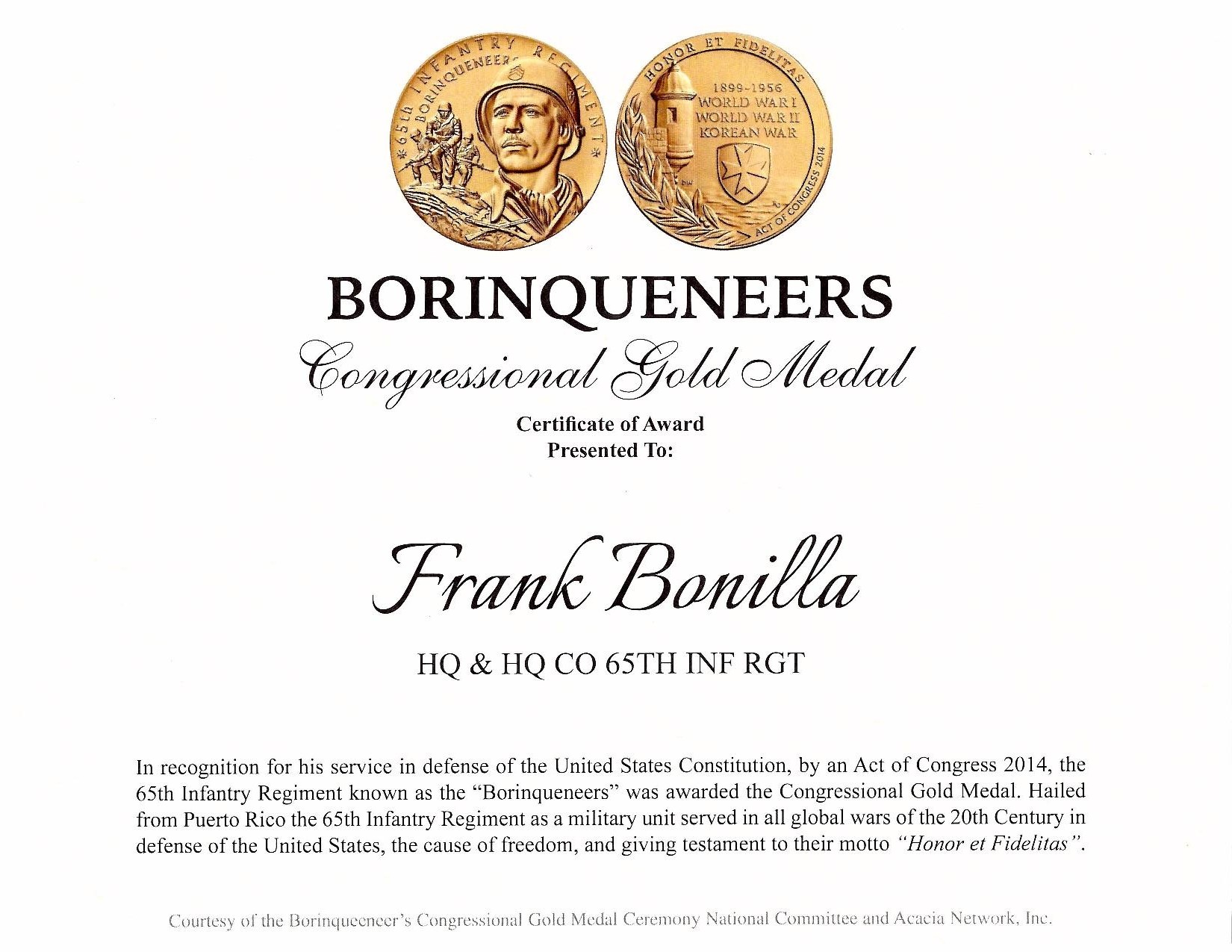
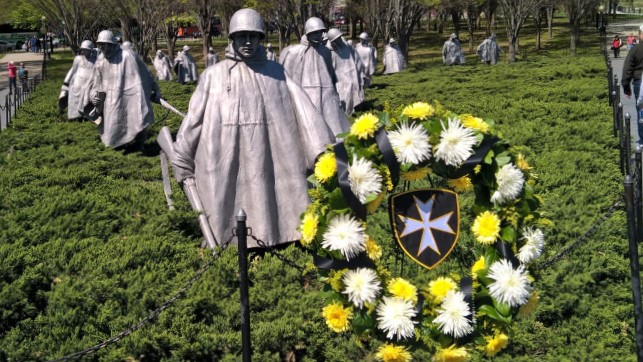
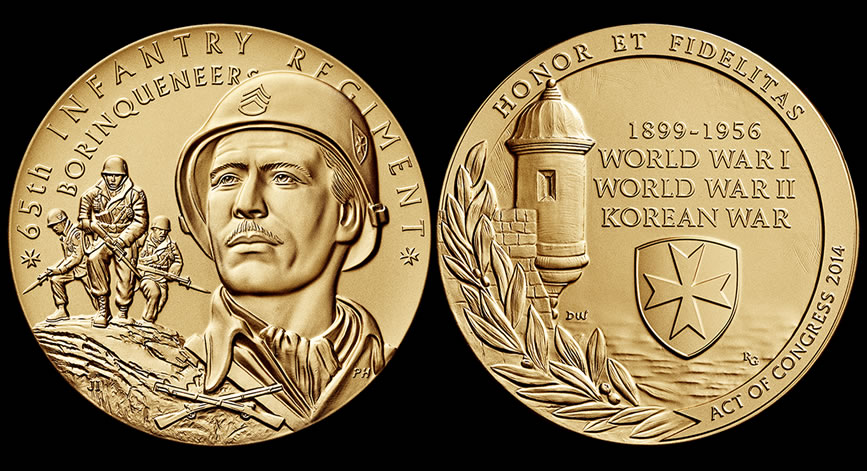
On June 10, 2014, President Barack Obama signed bills H.R. 1726 and S. 1174, awarding the Congressional Gold Medal to the 65th U.S. Army Infantry Regiment.
Since the American Revolution, the United States Congress has commissioned gold medals as its highest expression of national gratitude for distinguished achievement and extraordinary service. From the moment George Washington first received this honor in 1776, only a small number of individuals and entities — just over 160 to this day — have been so recognized.
Few combat units have ever earned this distinction. Among the most renowned are the Tuskegee Airmen of the 332nd Fighter Group, the Nisei soldiers of the 442nd Regimental Combat Team, and the Navajo Code Talkers, all honored for their service during the Second World War. They were later joined by the 6888th Central Postal Directory Battalion, the only Women’s Army Corps unit of color to serve overseas in that conflict.
The 65th became the first unit to receive this honor for service in the Korean War. El 65 thus joined Roberto Clemente, who in 1973 became the first — and remains the only — Latino individual to receive this distinction.
Though this recognition was an honest attempt to correct the historical record and to redress the many wrongs inflicted upon these brave men — their families, and Puerto Rico as a whole — and to honor their pride, courage, and sacrifice, it is not enough. It can never fully repay los hijos de este país for what they endured, for what they gave, and for what the burden they carried for us, for the rest of their lives.
With the utmost love and gratitude to all the Borinqueneers, their families, and every Boricua who has ever worn the uniform- gracias, mil gracias.
 in cOHERENT Thoughts